
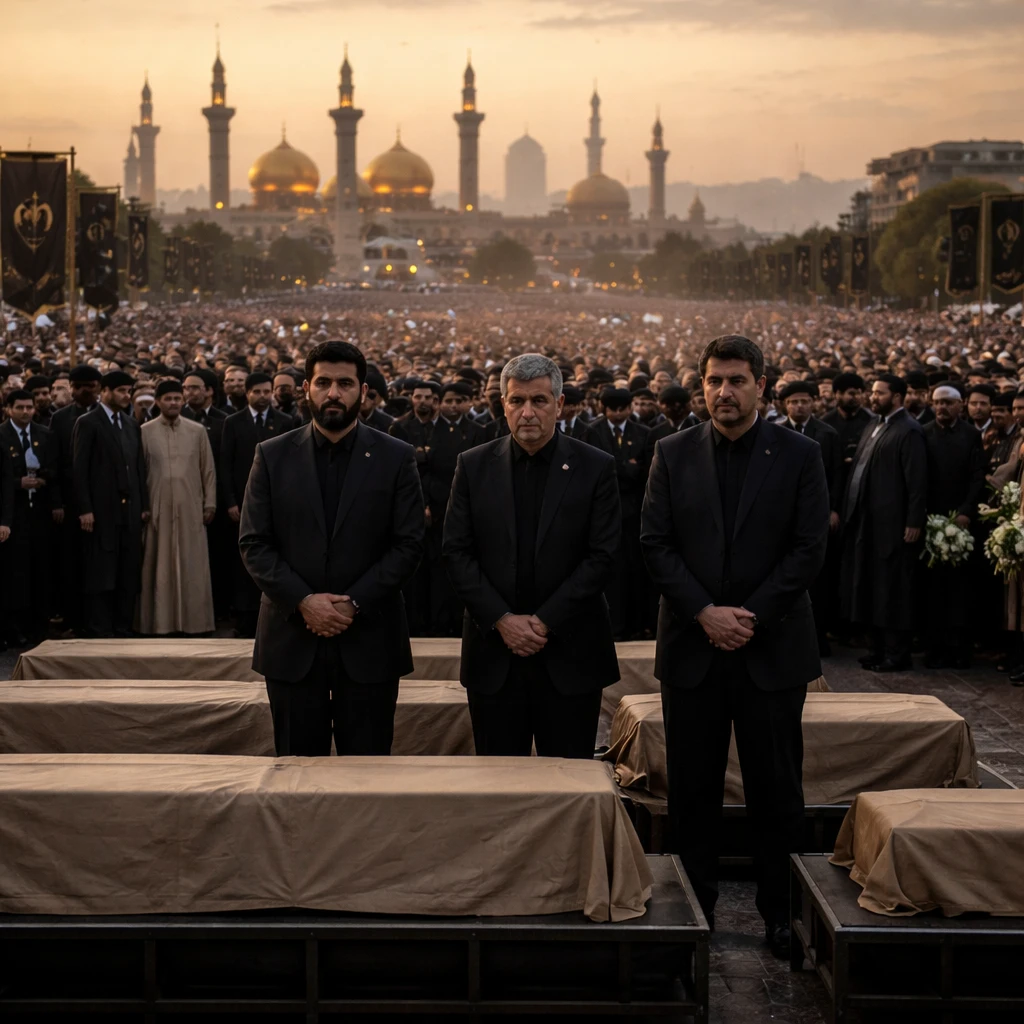
State media broadcasts showed Mostafa, Meysam and Masoud Khamenei participating in funeral prayers beside the coffins of their father and four other relatives on Sunday at Tehran's Imam Khomeini Grand Mosalla.
The coffins included those of Khamenei's daughter, his son-in-law, his daughter-in-law and a 14-month-old granddaughter, all of whom were among the victims of the strikes that precipitated the recent hostilities.
The man identified as the successor - Mojtaba Khamenei - did not appear at the public ceremony. Earlier reports indicated he sustained serious injuries in the attack, including wounds to his face and significant leg injuries, and his absence from the rites has left questions about his present condition.
Senior government figures were present with thousands of mourners for the funeral prayers. Among those attending were President Masoud Pezeshkian and Parliament Speaker Mohammad Baqer Qalibaf, according to state coverage.
State outlets also documented large crowds gathering overnight. Tehran's metro authority reported roughly seven million passenger trips as people traveled to the capital to take part in the ceremonies.
The official funeral program is set to continue over the coming week. It will include a sizable procession through central Tehran followed by the transfer of the remains to the religious city of Qom. After services there, ceremonies are planned in the Iraqi holy cities of Najaf and Karbala. The body is scheduled to return to Iran for burial in Mashhad later in the week.
The commemorations are taking place while a ceasefire involving Iran, Israel and the United States remains in effect after four months of fighting. U.S. President Donald Trump said that peace talks with Tehran were being paused for the duration of the funerary events and are expected to resume once the ceremonies conclude.
Authorities have outlined plans to mobilize millions for the remaining processions, arranging transportation, food and accommodation as they stage one of the largest state-sponsored ceremonies in recent memory.
Context and logistics
Officials' efforts to coordinate transport and services have produced significant movement into Tehran, as shown by metro usage figures. The scale of the ceremonies - extending from Tehran to Qom and then to Najaf and Karbala before returning to Mashhad - underlines the multi-day, multinational nature of the funeral program.
Political visibility
While several family members and senior officials have been publicly visible during the rites, the absence of Mojtaba Khamenei from these proceedings has left uncertainty about his physical condition and public role following the attack that killed the former supreme leader and relatives.