
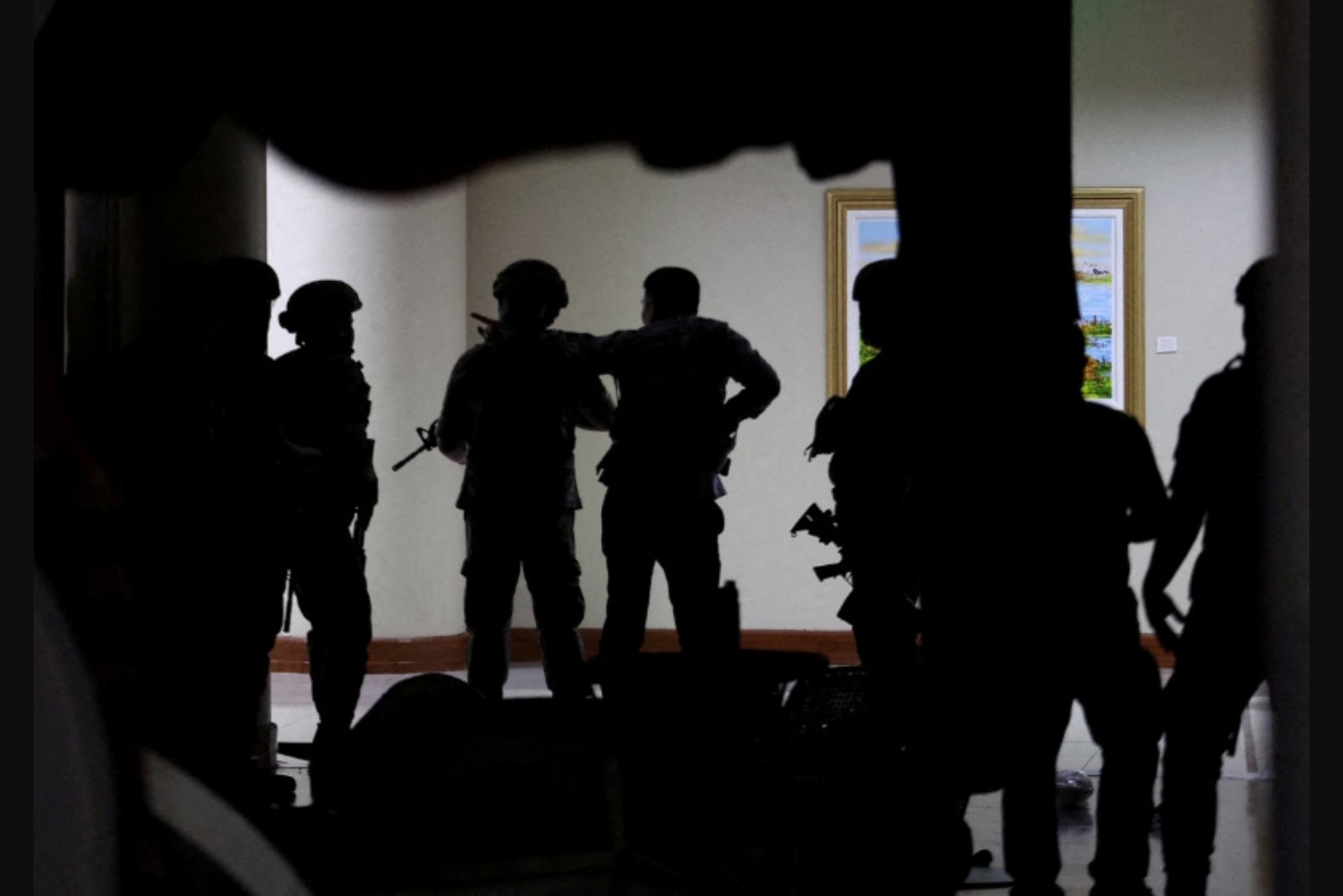
What began as a tense, fast-moving confrontation in the corridors of the Philippine Senate concluded with a senior lawmaker wanted by the International Criminal Court leaving the building unchallenged in the small hours after a volley of gunfire and an imposed lockdown.
Senator Ronald "Bato" Dela Rosa, 64, a former police chief sought by the ICC in relation to the country’s deadly drug war, had been sheltering in the Senate for days as authorities sought to serve an ICC arrest request. In the late afternoon and evening on Wednesday, a confrontation involving Senate security and agents from the National Bureau of Investigation (NBI) erupted into gunfire, after which Dela Rosa departed the Senate complex, records show.
The episode involved different arms of state security with contrasting loyalties. Senate security was led by Mao Aplasca, a retired police general and close associate of Dela Rosa with ties to former President Rodrigo Duterte’s camp, while the NBI is overseen by an appointee of President Ferdinand Marcos Jr. The incident followed an earlier close encounter in the week when Dela Rosa evaded NBI agents during a pursuit.
Politically, the incident sits at the heart of a sustained confrontation between the ruling faction aligned with President Marcos and allies of Vice-President Sara Duterte, the daughter of the former president. The ICC is pursuing accountability for the drug crackdown that resulted in thousands of deaths, and Dela Rosa - who led police units during the campaign - has publicly refused to apologize for his role. He has said he would accompany Duterte to The Hague in relation to the latter’s own ICC case.
Earlier in the week, Dela Rosa emerged from months of avoiding public view to participate in a pivotal Senate leadership vote. His presence enabled a pro-Duterte bloc to claim a majority and elect a new Senate president, Alan Peter Cayetano. That change in leadership also produced immediate staffing shifts, including the appointment of Aplasca to head Senate security.
As rumours spread on Wednesday that NBI agents were approaching, tension escalated. Closed-circuit footage shows Dela Rosa arriving at the building on Monday and later stumbling up a staircase while agents pursued him. Former senator Antonio Trillanes, who accompanied NBI agents to serve the warrant, said Dela Rosa pushed a female agent during that encounter. Trillanes also said the NBI had been tasked with attempting an arrest because of Dela Rosa’s lingering influence within police ranks.
In a public appeal on social media, Dela Rosa urged supporters and "fellow men in uniform" to mobilize, warning that government agents were poised to take him away. He posted:
"Let us not allow another Filipino to be taken to The Hague,"a message that helped mobilize a defensive posture in and around the Senate complex.
At about 7 p.m., Mao Aplasca went before reporters to say his security team was "going to arrest someone" and that the Senate would enter "total lockdown." Aplasca, who attended the military academy with Dela Rosa and served under him during the drug war, later said his comment referred to plans to detain NBI agents attempting entry. According to Trillanes, Aplasca, installed by the newly configured Senate leadership, prevented NBI agents from entering the chamber during the first arrest attempt.
As the building moved into lockdown, Senate security personnel donned ballistic vests. Journalists observed uniformed police officers and marines, carrying rifles and wearing Kevlar helmets, who had been summoned by Aplasca, according to military accounts. Aplasca led armed men to an entrance of the adjacent Government Service Insurance System (GSIS) building.
Ten minutes after that movement, gunfire broke out. Aplasca later said the shots were triggered when NBI agents raised their rifles, and that his team fired 27 "warning" shots in response. Dozens of rounds were discharged, sending Senate staff and reporters scrambling for cover as lights were switched off in corridors and some continued to transmit live video.
Dela Rosa posted during the chaos:
"The Senate is under attack! Pls help us,"amplifying the impression of an armed standoff inside a national legislative chamber. Despite the intensity of the confrontation, authorities reported no injuries.
High above the chaos, House Secretary General Cheloy Garafil completed and submitted impeachment papers aimed at Vice-President Sara Duterte, an action that advances the process toward a formal trial. The vice-president has denied allegations that include misuse of public funds, unexplained wealth accumulation, and threats to the lives of the president, the first lady, and a former House Speaker.
By about 8:30 p.m., the immediate confrontation had subsided. The national police chief and Interior Secretary Jonvic Remulla arrived and subsequently directed that reporters leave the area. Remulla later said Dela Rosa was "resting" in his office. Records from Senate security provided by President Cayetano show Dela Rosa left the premises around 2:30 a.m., departing without challenge from guards.
The NBI offered a different account, saying it had sent agents to the GSIS building at that institution’s request but that the agency did not attempt to enter the Senate chamber. The GSIS has not issued a public comment on the matter. In the immediate aftermath of the incident, Mao Aplasca was placed on a six-month suspension while investigators examine the sequence of events; he did not respond to requests for comment.
Critics of the events said the episode highlighted how allies of the former president might leverage institutional levers to shield a figure targeted by international authorities. Former senator Antonio Trillanes said the standoff demonstrated the potential for the Senate to be used as a sanctuary for an international fugitive and argued it strengthened calls to try drug war cases outside the country.
Dindo Manhit, founder of the Stratbase Institute for Strategic and International Studies, described the situation as "very hard to explain" and "quite embarrassing for the institutions of governance in a country," reflecting concern among analysts about institutional coherence and public trust.
The episode remains unresolved. Justice Secretary Fredderick Vida said on Friday the Philippines would "definitely" comply with the ICC’s arrest request and would take measures to prevent Dela Rosa from leaving the country. At the same time, Dela Rosa has filed an emergency appeal with the Supreme Court arguing that the ICC lacks jurisdiction in his case. The competing legal and operational claims mean the situation is still moving through domestic and international channels.
Summary
A tense confrontation in the Philippine Senate involving rival security forces allowed Senator Ronald "Bato" Dela Rosa - who is wanted by the International Criminal Court - to leave the building in the early hours after an exchange of gunfire and a lockdown. The incident exposed fault lines between forces aligned to former President Duterte and current administration appointees, and has prompted official inquiries and conflicting accounts by the NBI and Senate security leadership.
Key points
- Senator Ronald "Bato" Dela Rosa, sought by the ICC for alleged actions in the country’s drug war, evaded arrest and left the Senate after a night of armed confrontation and lockdown; sectors most affected include national security and government institutions.
- The confrontation involved Senate security under Mao Aplasca - appointed by the new Senate leadership with links to Duterte's camp - and agents from the NBI overseen by an appointee of President Marcos Jr; the episode raises immediate questions for legal and political sectors.
- Despite a heavy show of arms and dozens of shots fired, no injuries were reported; the incident nevertheless disrupted legislative operations and coincided with the filing of impeachment papers targeting the vice-president, influencing political and governance stability.
Risks and uncertainties
- Conflicting official accounts - between Senate security and the NBI - create uncertainty over chain-of-command and institutional procedures, posing risks to public confidence in government security and judicial processes; this could affect the legal sector and investor sentiment tied to governance quality.
- The unresolved status of Dela Rosa's legal situation - with an ICC arrest request and a pending emergency Supreme Court appeal by the senator - leaves open the risk of prolonged legal and diplomatic contestation, which could impact international relations and legal institutions.
- Political polarization shown by the standoff and its timing around an impeachment filing introduces the risk of further institutional clashes that could strain administrative functioning and stability in governance-related markets.