
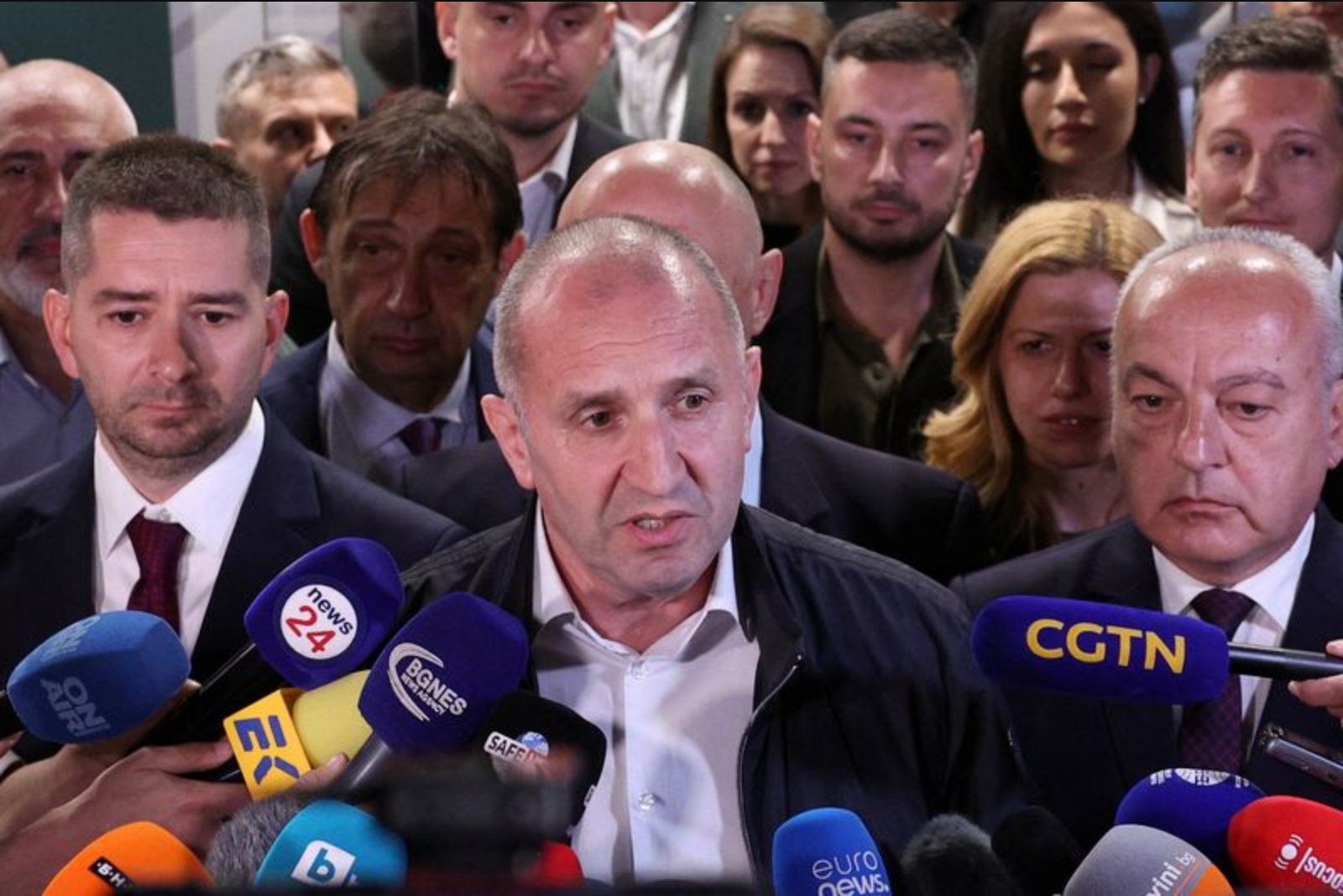
SOFIA, April 20 - Pro-Russian former President Rumen Radev appears set for a decisive win in Bulgaria’s parliamentary election, according to official tallies released as counting continued. With 60% of ballots counted, his Progressive Bulgaria party held 44.6% of the vote, a result that would represent one of the most dominant performances by a single political force in decades and could end, at least temporarily, the political fragmentation that produced eight national votes in five years.
The Progressive Bulgaria total puts it well clear of the main pro-European bloc, the We Continue the Change-Democratic Bulgaria (PP-DB) coalition, which stood at 14.2%, and far ahead of GERB, the long-dominant party led by former Prime Minister Boyko Borissov, at 13%. The margins suggest Progressive Bulgaria could govern alone in a strong minority configuration, though Radev has not ruled out forming a coalition with a pro-European grouping or a smaller partner.
Addressing supporters late on Sunday, one day before final results were expected, Radev framed the outcome in moral terms: "This is a victory of hope over distrust, a victory of freedom over fear, and finally, if you will, a victory of morality." He stepped down from the presidency in January to contest the parliamentary ballot after mass protests in December forced the previous government from office.
Radev, a eurosceptic and former fighter pilot, has opposed military support for Ukraine in its war with Moscow and campaigned on promises to improve relations with Russia. His platform included calls to resume the free flow of Russian oil and gas into Europe and criticisms of the European Union for relying too heavily on renewable energy. Observers linked elements of his message to rhetoric associated with Hungary’s pro-Kremlin former Prime Minister Viktor Orban.
Despite these positions, Radev has been cautious in detailing specific policy shifts, and it remains unclear how far his administration would move Bulgaria away from existing diplomatic and security alignments. Bulgaria is a NATO member and sits on the EU’s southeastern border; it joined the euro zone in January, a decision Radev has criticized. On Sunday he indicated a willingness to work on judicial reform with PP-DB and said Bulgaria would "make efforts to continue on its European path."
The election result reflected widespread voter frustration with recurring instability, entrenched corruption and veteran parties that many electors view as out of touch. Protest fatigue and a desire for change propelled Radev’s ascent after he resigned the presidency to run for parliament.
People on the ground described expectations for visible change. "There is now an opportunity for the things people have been hoping to see change to actually become visible," said Evelina Koleva, a manager at a digital marketing company in Sofia, the capital.
Commentators cautioned that the incoming governing camp has not set out detailed remedies for deep structural challenges. "The country’s main challenge is the economic crisis and the demographic crisis," said Tihomir Bezlov, a senior fellow at the Centre for the Study of Democracy in Sofia. "There do not seem to be many ideas in the winning camp on either of these issues."
Bulgaria’s post-communist trajectory has included rapid development in some measures: it joined the European Union in 2007, life expectancy has risen markedly, unemployment is currently the lowest in the EU, and the economy has acquired greater safeguards since adopting the euro. Yet the country trails other EU members on multiple metrics, and the cost of living has become a particularly sensitive issue since the switch to the euro.
The government ousted in December collapsed amid protests over a proposed budget that included tax increases and higher social security contributions, reflecting public unease about pressures on household incomes. Those economic grievances were a prominent theme in the campaign and shaped voter sentiment at the ballot box.
Key points
- Progressive Bulgaria leads with 44.6% of votes counted (60% counted), suggesting a potential strong minority government under Rumen Radev.
- Pro-European PP-DB stood at 14.2% and GERB at 13%, indicating a significant reshuffle of political strength among established parties.
- Energy policy and relations with Russia are central uncertainties, with possible implications for energy supply dynamics and consumer costs.
Risks and uncertainties
- Foreign policy direction - Radev’s pro-Russian stance and vague policy commitments create uncertainty for NATO and EU-aligned policies and for energy import arrangements.
- Economic and demographic challenges - Analysts warn the winning camp has not articulated clear solutions for the country’s economic crisis and demographic decline, raising questions for public finances and long-term growth.
- Cost of living pressures - The switch to the euro has heightened sensitivity to household incomes; further fiscal measures or energy supply shifts could impact consumers and vulnerable sectors.
Final vote totals and formal government-formation steps were expected to follow as remaining ballots were counted and political negotiations unfolded. The result marks a potential end to the recent cycle of rapid elections, but it also raises questions about how the new parliamentary majority will address pressing economic and foreign-policy dilemmas.