
Uncertainty over whether a fragile, temporary ceasefire between the United States and Iran will hold deepened on Monday after a U.S. seizure of an Iranian-flagged vessel, raising fresh doubts ahead of the agreement's scheduled expiration later this week.
The two-week halt to hostilities is due to lapse in the coming days. U.S. President Donald Trump said envoys from Washington would head to Pakistan for another round of negotiations. But Tehran has signaled it will not attend a second U.S.-led meeting, according to state news agency IRNA, citing what Iranian officials called Washington's “excessive demands” and shifting positions.
Iran's public statements framed its refusal around several complaints, including “unrealistic expectations,” “constant shifts in stance,” and “repeated contradictions” from the United States. Tehran also pointed to an ongoing naval blockade as a breach of the ceasefire. Axios reported that Iranian officials are additionally concerned that the U.S. may be preparing a surprise attack.
Separately, Reuters reported that President Trump told Pakistan's army chief, Asim Munir, he would take into account Munir's counsel that the U.S. blockade was complicating efforts to negotiate with Iran. The two spoke by phone, a Pakistani security source told the news agency.
Details of the vessel seizure
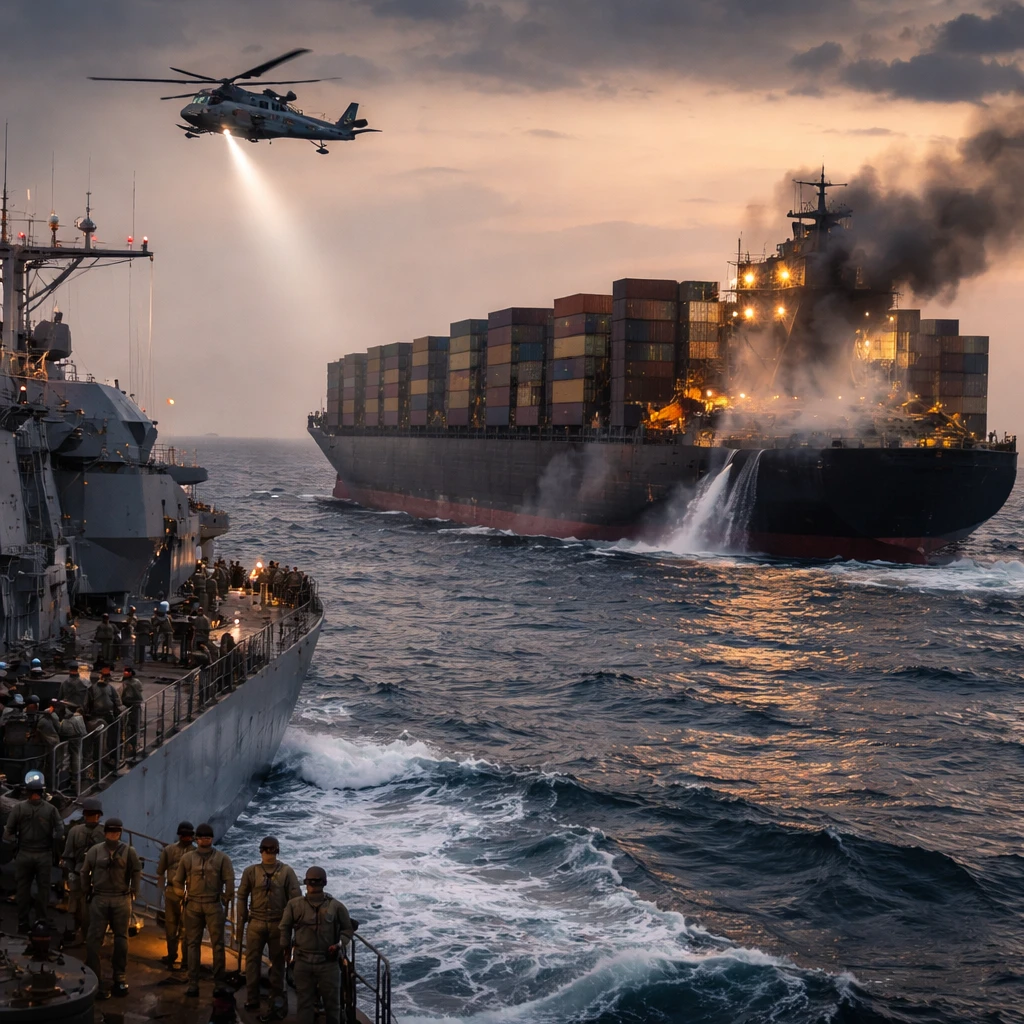
On Sunday, President Trump described the interception of an Iranian cargo ship that tried to breach the U.S. naval blockade. He named the vessel as the TOUSKA, describing it as nearly 900 feet long and comparable in weight to an aircraft carrier. According to the president, a U.S. warship, the guided-missile destroyer USS SPRUANCE, intercepted the TOUSKA in the Gulf of Oman, issued a warning to stop, and then disabled the vessel after the Iranian crew allegedly ignored orders.
In the president's account, the U.S. ship "stopped them right in their tracks by blowing a hole in the engineroom." He added that U.S. Marines have custody of the vessel, and noted that the ship is subject to U.S. sanctions related to prior illegal activity.
The action has been underscored in Tehran as evidence that Washington is prioritizing force over diplomacy. Iran’s Ambassador to Pakistan, Reza Amiri Moghadam, said in a post on X that the seizure demonstrates the U.S. is not pursuing genuine diplomatic engagement.
"You cannot keep violating the international law, double down on your blockade, threaten Iran with further war crimes, insist on unreasonable demands, pace out with rethorics and pretend to be pursuing 'Diplomacy,'" Moghadam wrote. "As long as the naval blockade remains, faultlines remain."
Negotiations and political signals
Iran's deputy foreign minister, Saeed Khatibzadeh, told reporters there is no fixed date for another round of talks with the United States. Speaking on the sidelines of a diplomacy forum in Antalya, Turkey, he said the two sides first need to reach a mutual framework before resuming formal negotiations.
"We are now focusing on finalising the framework of understanding between the two sides. We don’t want to enter into any negotiation or meeting which is doomed to fail and which can be a pretext for another round of escalation," Khatibzadeh said.
Those comments mark a step back from an optimistic tone that prevailed late last week, when both President Trump and Iran's foreign minister had asserted that the Strait of Hormuz - a critical chokepoint for roughly a fifth of global oil shipments - was open again to tanker traffic. Iranian authorities have since declared that the strait is once more closed.
Market response and official optimism
Energy markets reacted quickly to the renewed tensions. Oil prices rose on Monday after a sharp decline last week that had followed hopes for a reopening of the Strait of Hormuz and a possible peace agreement. Analysts at ING noted that after substantial selling on Friday, energy markets were stronger as friction in the Persian Gulf re-emerged.
Despite the heightened tensions, some U.S. officials signaled cautious optimism. U.S. Energy Secretary Chris Wright told Fox News on Sunday that talks with Tehran were continuing and suggested they were progressing more constructively than public statements indicated.
"There are negotiations with the Iranians going on, despite what you hear in the chatter in public, I think those are actually going well," Wright said. He described President Trump as "a creative negotiator" who uses pressure and uncertainty as part of his approach, and added: "I think we’ll have a nice end of this conflict."
Wright also noted that the resumption of shipping through the Strait of Hormuz would not be instantaneous even if an agreement were reached, but he expressed belief it would not take long to restore passage once reopening occurred.
The recent events - the reported refusal by Iran to attend a second U.S. negotiating session, the seizure of the TOUSKA, and competing declarations about the status of the Strait of Hormuz - together signal that the pause in hostilities remains precarious as the ceasefire's expiration approaches later this week.
(Senad Karaahmetovic and Frank DeMatteo contributed reporting)