
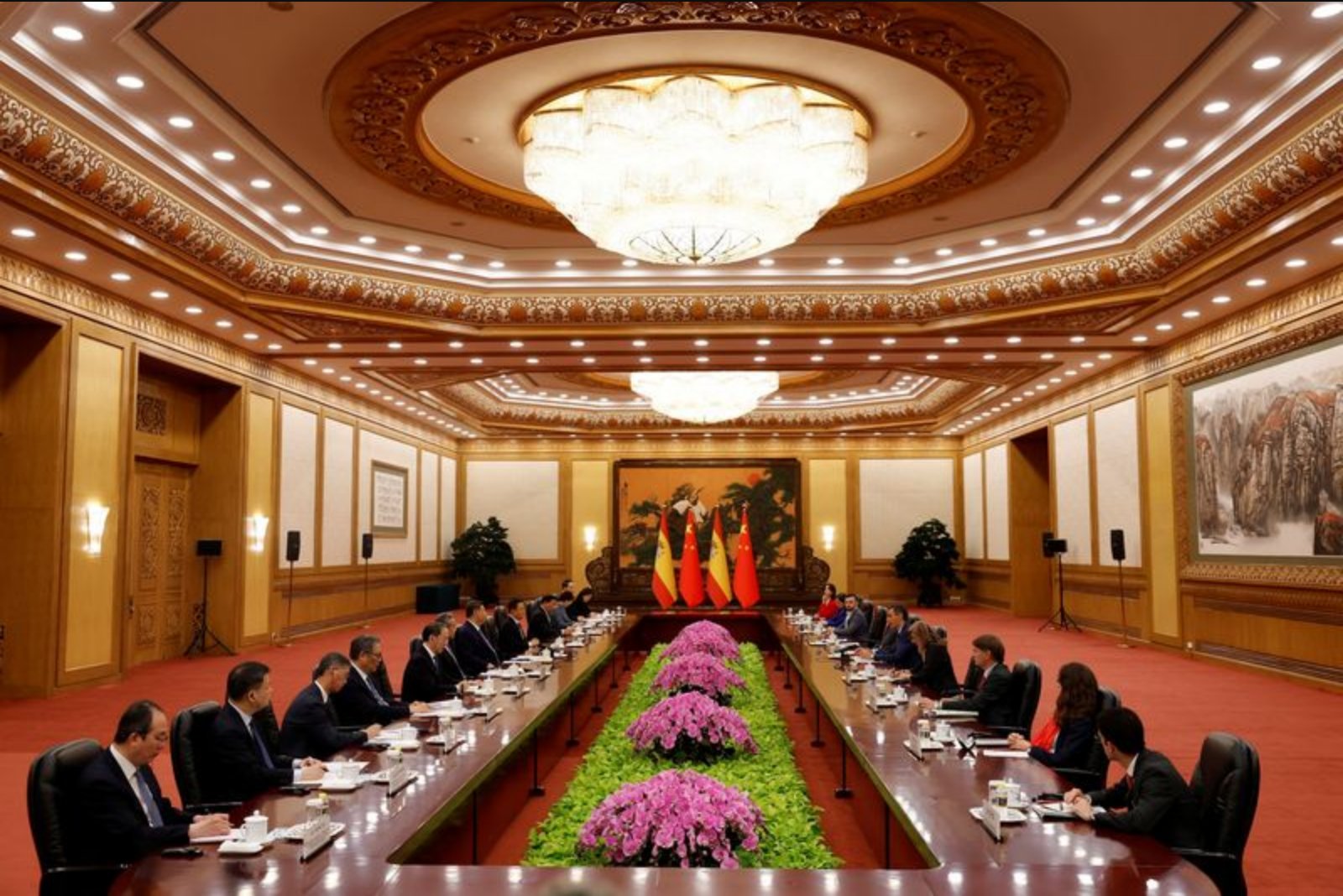
As a string of senior foreign officials prepared to visit Beijing last week - among them Russia's foreign minister and leaders from Spain, Vietnam and the United Arab Emirates - China was stepping up a dual-pronged approach to the world's heightened geopolitical tensions. At the same time that its foreign ministry presented a busy calendar of diplomacy, Chinese statecraft combined public-facing calls for stability with increasingly assertive moves in its wider neighbourhood.
The backdrop includes a widening Gulf crisis, recent U.S. actions described as a military "blockade" of the Strait of Hormuz, and continuing Iranian demands for cryptocurrency payments to guarantee the safety of vessels. Against that backdrop, Beijing has been intent on positioning itself as a stabilising global interlocutor - an alternative voice calling for calm. President Xi used the language of resisting a "regression to the law of the jungle" when meeting Spain's prime minister, underscoring that public-facing posture.
Yet Beijing's outreach to global capitals has been accompanied by a clear hardening of posture closer to home. In recent weeks, Chinese vessels have been employed to block a Philippine approach to a disputed shoal, tensions with Japan have intensified, and Beijing has launched an unusually visible effort to court Taiwan's opposition party ahead of next decade's election. The sum of these actions signals not only diplomatic activism at the global level but also a recalibration of China's Taiwan strategy and the timetable for any potential future actions.
For years U.S. officials have warned that China's force buildup was being organised to achieve readiness to invade by 2027. Beijing's evolving narrative, however, now places much greater emphasis on the outcome of Taiwan's 2028 vote as a decisive political hinge. In this framing, a Kuomintang (KMT) victory would open the door to far closer relations and reduce the immediate risk of confrontation, while a re-election of the incumbent Democratic Progressive Party (DPP) could prompt a further escalation by Beijing.
Under this new messaging, Beijing appears to be preparing the international environment for two alternative paths. One path assumes that if Taipei moves toward elected leadership Beijing prefers, tensions could ease; the other path sets the stage for intensified pressure if the DPP remains in power. The messaging also aims to exert pressure on external powers - notably the United States and Japan - by suggesting that their continued intervention on Taiwan's behalf would be unwise and that they should not expect outside support should Beijing pursue a more confrontational approach.
That strategy helps explain China’s reaction to Tokyo. Beijing has been openly critical of the new Japanese prime minister, blaming comments he made in November that characterised a Chinese takeover of Taiwan as potentially "survival-threatening" for Japan. Chinese analyses have also flagged the possibility that Japan could consider acquiring nuclear weapons in response to regional threats - an outcome Beijing views as a complicating factor that might deter any direct action against Taiwan or Japan. Tokyo's government maintains its commitment to Japan's non-nuclear status while simultaneously moving to deepen defence and diplomatic ties; it has invited more than 30 ambassadors from NATO and other countries to Tokyo to broaden cooperation across defence and related areas.
Despite those bilateral strains, Beijing has gained diplomatic traction elsewhere. In a highly publicised meeting in Beijing, the new KMT leader Cheng Li-wun pledged to invite Xi to Taiwan if she wins the 2028 election. That pledge, amplified by Chinese media, feeds directly into Beijing's recalibrated narrative: electoral outcomes in Taiwan will determine whether relations move toward reconciliation or confrontation.
Meanwhile, Taiwan's DPP administration is reinforcing its own defensive preparations. Taipei's leaders are also watching closely for signs from planned high-level meetings between U.S. and Chinese leaders - including a repeatedly postponed summit between the two presidents - for indications that Beijing might secure concessions from Washington in return for helping to dial down tensions in the Gulf. The prospect of a linkage between Chinese cooperation on the Middle East and its stance on Taiwan has generated unease in Taipei.
Gulf ties, arms questions and diplomatic denials
On the Gulf question, Beijing's behaviour remains partly opaque and contested. Chinese officials and state media have angrily denied reports that China supplied weapons to Tehran during the current crisis, while other analysts suggest Beijing prefers providing "dual use" civilian components that may have military utility rather than entire weapons systems. U.S. President Donald Trump has threatened to impose new tariffs on Beijing if arms shipments are confirmed, a prospect that would add further strain to already slowing global growth.
China has been quick to seize the narrative that the wider global turmoil reflects poorly on U.S. policy, and Beijing is using that narrative to present itself as a defender of free trade and a more stable world order. Much of Europe has been reassessing its relationship with Washington amid recent events, according to senior EU officials, with some describing U.S. actions in the Middle East as deeply damaging to the international system. Yet whether that recalibration will translate into broader acceptance of Beijing's expanded role remains uncertain: Britain, for example, criticised Russia and China together for vetoing a U.N. Security Council resolution from Bahrain that sought to condemn Iran's obstruction of ships in Hormuz.
The U.S. decision to impose its own blockade this week - implying that U.S. warships may stop vessels, including Chinese-owned ships, suspected of carrying Iranian energy - appears to have given Beijing an opening to position itself as a defender of unfettered commerce. Some Chinese commentators predict that the Trump administration may dominate headlines while a new architecture of international relations takes shape, in which nations pursue vital interests by working around the United States.
That broader environment has already allowed a number of consequential but under-reported incidents to occur: clashes between Pakistan's military and Afghanistan; suspected Iranian strikes on energy infrastructure in Azerbaijan; and constrained flows through the Strait of Hormuz. China’s state-run outlets have amplified the narrative of careful engagement, with voices such as Chinese international relations academic Mabel Miao Lu writing that "China is increasingly seen by many as a major country that has consistently emphasised peace, development, sovereignty and dialogue." She added that "more people are listening carefully when China speaks," even while acknowledging that not all concerns about China have vanished.
Implications for defence, trade and supply chains
Beijing's dual approach - projecting calm on the world stage while ratcheting pressure locally - has immediate implications for several sectors. Energy markets have already felt significant strain from Middle East developments, and analysts warn that a major Pacific conflict could inflict even larger supply shocks. Maritime trade faces increased friction, with Chinese-owned and -flagged tankers passing through Hormuz at reduced rates compared with the pre-crisis period.
In defence terms, the Pentagon's recent operations have underscored a continued U.S. capability in complex military actions, even if the political objectives of specific campaigns such as Operation Epic Fury have been mixed. Previous U.S. strikes on Tehran's nuclear programme last June and recent complex operations have been touted by U.S. planners as demonstrations of competence that China has not tested in combat. Beijing's confidence in its own armed forces may be uneven, suggested by recent removals of senior military commanders, even as China’s industrial and manufacturing scale continues to concern U.S. defence planners given potential for high-volume production of military stocks.
For global manufacturers and supply-chain managers the current environment highlights several vulnerabilities. China depends on global supply chains that are already showing signs of strain. Disruptions in shipping and energy flows add to working-capital pressures and complicate backlogs and production-rate planning. For firms with multi-tier vendor networks, the unpredictability of maritime routes and insurance costs could raise inventories and logistical spending, while firms exposed to energy-intensive production may face higher input costs.
Choices ahead for Beijing and other capitals
Beijing's most important message to the international community may be strategic in nature: if China moves to alter Taiwan's status in the future - either after an invitation framed by a KMT victory or after a decision by Beijing itself - it expects the rest of the world to refrain from intervention. That message is aimed both at deterring external support for Taiwan and at shaping global perceptions so that pressure on the U.S. may grow if Washington appears to respond with force.
At the same time, many countries are mindful that decisive military actions, whether by the United States in the Middle East or by Russia in Ukraine, can trigger immediate and far-reaching global dislocations. The energy shock from conflict in the Gulf has already shown how rapidly markets can be affected; a major Pacific war would carry the potential for even broader and deeper supply-chain and trade disruptions.
There are signs that Beijing still faces limits to its influence. It is far from certain that the KMT's current outreach to Beijing will translate into a dominant electoral outcome in Taiwan; Cheng Li-wun's promises do not equate to a call for annexation, and public opinion in Taiwan remains a complex and unpredictable factor. Similarly, China's efforts to isolate the new government in Tokyo appear to have made limited progress so far, and European and Pacific states that worry about future U.S. policy have in some cases become more, not less, inclined to cooperate with Japan or South Korea.
Beijing also faces the operational challenge of the Gulf situation. Chinese-owned tankers have continued to transit Hormuz, but at reduced volumes compared with normal flows. China's own supply chains are showing stress. The practical difficulties of securing unimpeded maritime trade and energy supplies suggest Beijing may ultimately need to reach some negotiated outcome with Washington or seek traction within the United Nations system to press Iran to allow freer passage.
Conclusion
The current global disorder presents both opportunities and warnings for Beijing. The crisis in the Middle East has allowed China to step forward as an interlocutor in international fora and to capitalise on disquiet about U.S. policy in certain quarters. But the same events highlight the constraints facing an ambitious China: the limits of influence over regional allies, the fragility of global supply chains on which China depends, and the continuing concerns among many nations about Beijing's long-term intentions.
How these tensions evolve - whether through electoral outcomes in Taiwan, shifts in U.S.-China dialogue, or negotiated solutions to Gulf friction - will matter not only for geopolitics but for energy markets, defence planning and global manufacturing and logistics. For companies and policymakers with exposure to maritime trade lanes, energy inputs or defence-related supply chains, the current environment calls for heightened attention to contingency planning, inventory management and vendor resilience.
China's immediate diplomatic bustle masks an underlying strategic gamble: that by amplifying its voice on the world stage while simultaneously reshaping the regional environment, it can alter the terms of engagement around Taiwan and elsewhere. Whether that calculation pays off will depend on electoral dynamics in Taiwan, the responses of other major capitals, and the degree to which supply chains and markets absorb further shocks.