
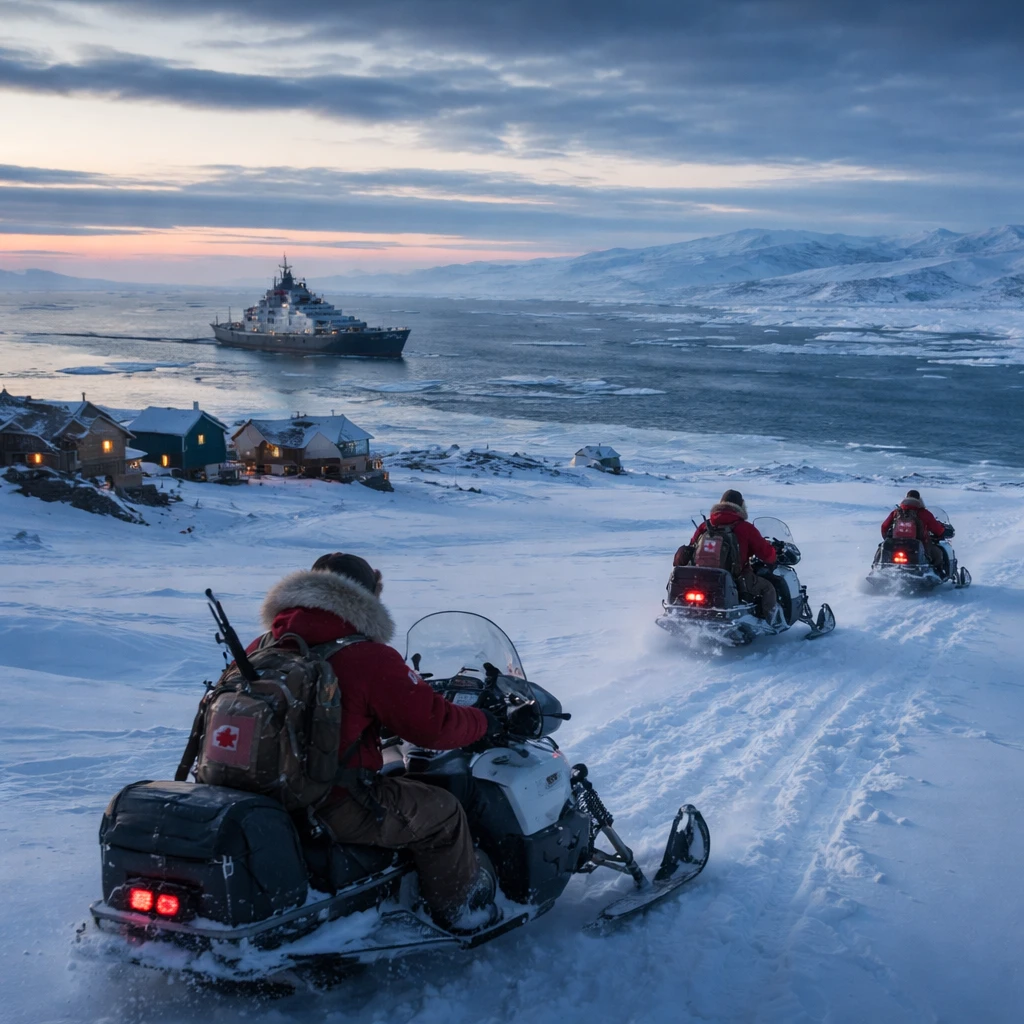
CAMBRIDGE BAY, Nunavut - Canada is intensifying security cooperation with Nordic nations as it seeks to rebalance Arctic defense arrangements in response to geopolitical tensions and pointed rhetoric from Washington. Officials in Greenland and Denmark have been in discussions with Canadian counterparts for three years about creating a local equivalent of the Canadian Rangers - a reserve unit that maintains continuous presence in remote Arctic settlements - and those talks became more urgent after a wave of threats from the U.S. president about seizing Greenland.
Whitney Lackenbauer, an honorary lieutenant-colonel with the Canadian Rangers who has taken part in the consultations, said the tone from the White House accelerated efforts by Arctic communities to resist the notion that the United States must be the default security guarantor. Speaking during a lengthy 5,000-kilometer snowmobile trek by the Rangers, he said: "The rhetoric coming out of the White House has sped up efforts to rebuff the idea that Arctic communities need the U.S. to come in and save them."
Lackenbauer added that Canada and the Nordic countries are increasingly aligning their military and diplomatic actions to convey a message with significant moral force. "The Nordic countries and Canada, we’re increasingly realizing we can come together in military and diplomatic ways to send a message that carries moral weight," he said.
Prime Minister Mark Carney has framed the deeper Nordic engagement as part of a broader pivot away from sole reliance on the United States for Arctic security. Carney describes the Nordic states as trusted partners and is promoting alliances among what he calls "middle powers" in an international environment where the U.S. is seen as a less reliable partner.
The White House, for its part, said that President Trump’s leadership has prompted allied countries "to recognize the need to meaningfully contribute to their own defense" and stressed that the Arctic constitutes a critical region for U.S. national security and economic interests. A White House spokesperson added in an email that the administration is taking part in "diplomatic high-level technical talks with the governments of Greenland and Denmark to address the United States’ national security interests in Greenland."
Climate change is reshaping the strategic landscape of the Arctic by making the region more accessible. That shift has coincided with a larger presence of Russian military infrastructure across the Arctic and growing Chinese activity in resource-rich areas, principally through partnerships with Russia. Within this context, Canadian officials say Russia represents the most significant threat to Arctic stability, and Nordic countries have been augmenting their defenses since Russia’s invasion of Ukraine.
In March, Canada and the five Nordic countries - Denmark, Finland, Iceland, Norway and Sweden - agreed to deepen cooperation on military procurement and to scale up defense production. The plan addresses a range of security challenges, including cyberattacks, and signals a coordinated effort to strengthen northern security capabilities.
Government policy documents indicate that a blueprint for how Greenland might implement a version of the Canadian Rangers is expected by the end of the year. The Rangers model has long been a Canadian instrument for establishing and maintaining year-round presence in largely inaccessible Arctic communities through a locally recruited reserve force.
Canadian Foreign Affairs Minister Anita Anand told Reuters that she speaks regularly with Nordic counterparts on collective defense and Arctic security. While she reaffirmed the importance of the Canada-U.S. partnership through NORAD - the North American Aerospace Defense Command - Anand said Canada is intensifying work to build new alliances.
Concrete steps include the opening of a Canadian consulate in Nuuk in February and invitations to Nordic officials to visit Canada’s Arctic region later in the year. Danish Prime Minister Mette Frederiksen told Prime Minister Carney during a Nordic-Canadian summit in Oslo in March that "We have to build something new, and it has to be a world order that is built on the values that we represent."
Further evidence of deepening ties came in April when Alexander Stubb became the first Finnish president in a dozen years to visit Canada and signed several agreements related to Arctic cooperation. After a joint hockey practice in Ottawa, Stubb said he and Carney exchange messages almost daily and that their conversations range from sports to security matters. Stubb told reporters that "most of the time it’s about NATO or Ukraine or Iran," underscoring a broad security agenda in bilateral communications.
No More "Free Pass in the Arctic" for Hostile Actors
Lackenbauer, who is also an Arctic scholar at Trent University in Peterborough, Ontario, urged a transformation of Canada’s Arctic security approach comparable to the shifts Nordic countries undertook after the 2022 Russian incursion into Ukraine. He said enhanced cooperation with northern European partners will signal clearly to hostile states that they cannot operate in the Arctic without consequence. "The more we can go and help Canada’s allies in northern Europe, the more hostile nations will get the message that they do not get a free pass in the Arctic," he said.
Among the eight Arctic states, Canada’s defense investment in its far north has consistently ranked near the bottom. According to the Arctic Business Index - a network of research institutions and analysts focused on the far north - Canada’s spending on defending the territory trails that of Russia, the United States, Norway, Sweden, Denmark and Finland. The Index indicates that along with Greenland, Canada has historically invested the least.
Last year Canada achieved the NATO target of allocating 2% of gross domestic product to defense spending, reaching roughly CA$63 billion, a substantial increase from a low point of about 1% in 2014. The boost followed persistent pressure from the U.S. administration.
Neil O’Rourke, Director General at Canada’s Coast Guard for Fleet and Maritime Services, said he and a Danish defense colleague have long recognized the practical necessity of reaching out to one another first in the event of a serious Arctic incident. "Up north, we’re just across the water and it makes much more sense to share resources than to get help from down south," he said. O’Rourke noted Canada is seeking to learn from Norway’s maritime services, particularly in areas like emergency towing for vessels.
Rob Huebert, an Arctic analyst at the University of Calgary, cautioned that cooperation with the United States remains essential. He noted that the U.S. continues to produce some of the most advanced military systems and that Canada’s armed forces remain highly dependent on U.S. capabilities for defending the northernmost reaches of the country. "If we are talking about war-fighting capability, that means working with the U.S. military," he said.
Huebert also pointed to Prime Minister Carney’s March visit to observe a Norwegian-led NATO exercise in Bardufoss as a potential sign of changing priorities. He observed that Canada’s past participation in NATO Arctic exercises in the Nordic region had been largely symbolic, but that the recent shift to stronger engagement coincided with concerns about U.S. reliability. "Until very recently, Canada’s participation in NATO’s Arctic exercises in the Nordics has been very token," he said. "But then all of a sudden because of Trump, we decide we’d better do something with the Nordics."
Looking Ahead
Canada is pursuing a dual track of sustaining its long-standing partnership with the United States through NORAD while simultaneously cultivating closer security ties with Nordic neighbors. Plans to adapt the Rangers model for Greenland, steps to boost procurement and defense production across allied northern states, and diplomatic outreach such as openings of consular posts and leader-level visits all point to a coordinated attempt to fortify northern defense and send a shared message to potential adversaries.
How these efforts will translate into operational capability and what precise timing will apply to initiatives such as Greenland’s Rangers adaptation remain matters for ongoing policy work and follow-up between the involved governments.