
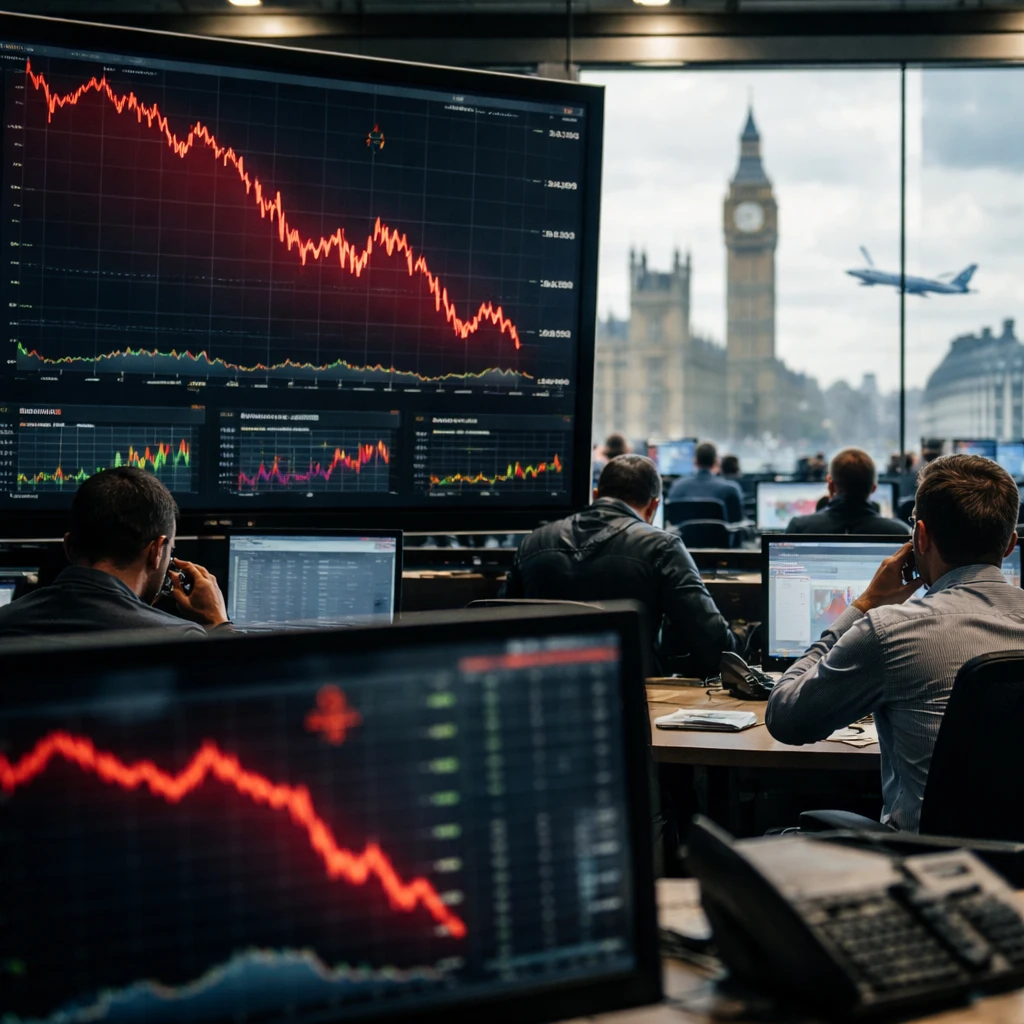
European equity markets started Friday on the back foot as a combination of domestic political turbulence in the United Kingdom and ongoing uncertainty related to Iran weighed on investor sentiment.
In early trade, the pan-European Stoxx 600 was down 0.76%. Germany's benchmark DAX fell 0.86% and France's CAC 40 slid 0.79%. In London, the FTSE 100 dropped 0.70% as of 03:08 ET (07:08 GMT).
Political developments in the UK focused attention on the ruling party's stability. A parliamentary vacancy has emerged after a sitting Labour MP stepped aside, creating an opportunity for Greater Manchester Mayor Andy Burnham - widely seen as a left-leaning alternative within Labour - to seek entry to the House of Commons. The open seat clears a path for Burnham to contest a by-election, though a strong showing from Reform UK could complicate his route.
On the international front, U.S. President Donald Trump concluded a two-day state visit to Beijing and boarded Air Force One on Friday. He described the trip as "incredible," citing "fantastic trade deals" and saying there had been progress on Iran. The president noted that both sides agreed the Strait of Hormuz must remain open. China's Ministry of Foreign Affairs said the two presidents "reached a series of new common understandings" and agreed on a "new vision" for a constructive and strategically stable China-U.S. relationship. Mr. Trump also confirmed that President Xi Jinping is expected to visit the United States around September 24.
Corporate news in Europe offered a mix of reassurances and new collaborations. Labour representatives at Volkswagen reiterated that there will be "no plant closures" in Germany while indicating they remain open to defence and Chinese partnerships to tackle overcapacity. Meanwhile, Stellantis and Dongfeng have agreed to jointly produce Jeep and Peugeot vehicles in China beginning in 2027, with total investment set to exceed $1.2 billion.
In financial results, Unipol reported a 15.4% increase in first-quarter net profit, reaching 329 million, a rise attributed to strength in its core insurance operations.
Commodities moved in opposite directions. Gold fell for a fourth consecutive session, pressured by a firmer dollar and waning expectations for Federal Reserve rate cuts; bullion was down roughly 2% for the week. Oil prices climbed after comments from the U.S. president indicating he would not be "much more patient" with Iran, with Brent crude up nearly 6% for the week.
Market snapshot (early trade):
- Stoxx 600: -0.76%
- DAX (Germany): -0.86%
- CAC 40 (France): -0.79%
- FTSE 100 (UK): -0.70% (03:08 ET / 07:08 GMT)
The trading day reflected a blend of political risk, corporate developments and commodity-driven headline moves. Equity weakness in Europe came as investors digested both homegrown political questions in the UK and overseas developments that influence energy and precious metals prices.
As trading progresses, market participants will likely watch the by-election contest trajectory in the UK, monitor further details about the China-U.S. understanding announced during the bilateral summit, and track corporate updates from major automakers and insurers for signs of operational or strategic shifts.