
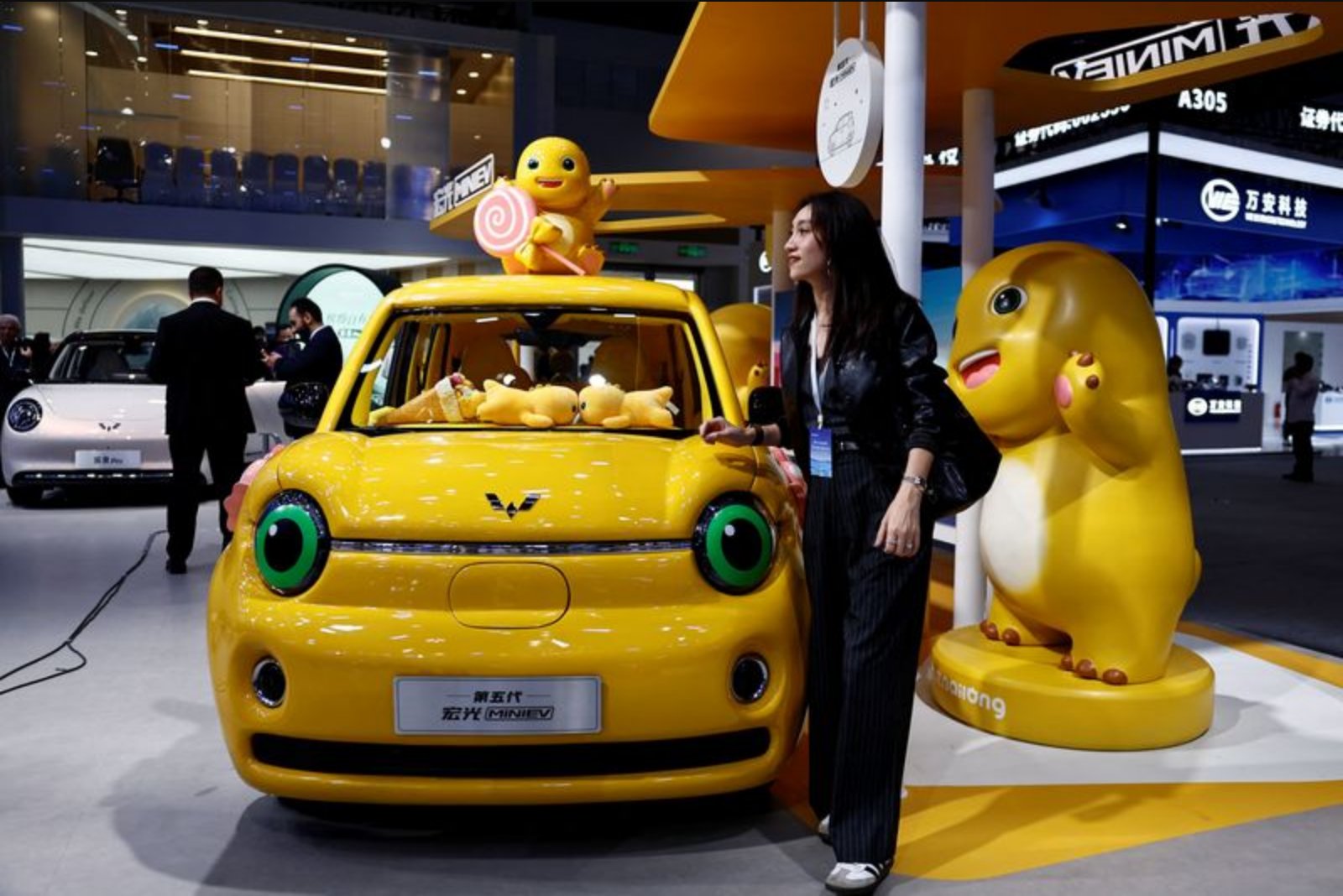
Call it sticker shock of a different kind. The current Beijing Auto Show has put a spotlight on how intense competition in China’s car market has pushed the retail prices of new vehicles to levels well below those seen in the United States.
By one comparison, the average new car in the United States in March had a list price of $51,456, according to Kelley Blue Book. In contrast, China now offers more than 200 battery-powered models, including hybrids, listed at prices that convert to less than $25,000, based on data from DCar, an information and trading platform.
Using DCar data, a compilation identifies five of China’s best-selling electric vehicles whose starting prices are below $12,000. These compact EVs are not offered in American showrooms - and may never be - yet together they illustrate the scale of price compression in China: for about the price of a single average new car in the United States, a consumer in China could buy all five.
Geely EX2 - Starting price: $10,060
The pure-electric Geely EX2 emerged as the top-selling model in China for any vehicle category in 2025. The small EV offers a handful of features that belie its compact footprint: a front trunk, multiple storage compartments distributed through the cabin, and a 14.6-inch central touchscreen running on a Geely-developed infotainment system. Geely’s top-trim EX2 is rated at roughly 255 miles of range under China’s testing standard.
Sold under the local name "Star Wish" in China, the EX2 launched in 2024 and proved popular early on. Geely expanded sales of the model to Brazil, Indonesia and Thailand last year. Analysts noted the car’s cabin and perceived quality can feel larger than its dimensions suggest.
Wuling Hongguang MiniEV - Starting price: $6,560
The Wuling Hongguang MiniEV embodies the inexpensive, cheerful microcar ethos. Revised for 2026 with a stretched body to add four doors and slightly more rear seating room to accommodate adults, the car remains diminutive by U.S. standards. Observers have pointed out that two earlier-generation MiniEVs could fit in the footprint of a standard Ford F-150.
The basic MiniEV prioritizes low cost and charm: its top speed in that specification is about 62 miles per hour and its China-rated battery range measures 127 miles. Wuling also markets a larger subcompact EV, the retro-styled Bingo Pro, which starts just above $8,000 and is intended for highway travel with a China-rated range of 250 miles.
BYD Seagull - Starting price: $10,200
BYD Yuan UP - Starting price: $10,945
BYD Qin Plus DM - Starting price: $11,675
BYD is a major player in China’s small-EV segment. The company’s three models with starting prices under $12,000 collectively accounted for 700,000 vehicle sales over the 12 months covered in the data.
The Seagull drew immediate attention when it debuted three years ago, surprising industry watchers with its combination of performance, styling and price. The 2026 Seagull offers an optional lidar remote sensing system intended to support driving-assistance features such as automated lane changing, a new fast-charge capability, and a premium-version battery range of about 314 miles under China’s testing standard.
At its initial launch, BYD cut costs on the Seagull by fitting a single "monoblade" windshield wiper. Some analysts praised that as a practical savings measure, while some drivers complained it performed poorly in heavy rain. For 2026, BYD has returned to a standard dual-wiper setup.
These vehicles and the pricing dynamics they reflect are specific to China’s marketplace and regulatory environment. Several of the technical specifications cited - notably range figures - are reported under Chinese testing standards. That distinction is noted in the data for the vehicles listed above.
Embedded in the broader presentation at the auto show is a reminder of how market structure and competitive intensity can produce divergent pricing outcomes across countries. For buyers and observers, the Chinese examples underscore how manufacturers can offer basic, lower-priced electric mobility in large volumes while also experimenting with incremental technology options and cost-saving details.
Investment note included in original reporting
Should you invest $2,000 in 1211 right now? ProPicks AI evaluates 1211 alongside thousands of other companies every month using more than 100 financial metrics. The AI looks across fundamentals, momentum and valuation to surface ideas it views as offering attractive risk-reward based on current data, and highlights past winners. The original material invited readers to explore whether 1211 appears in any ProPicks AI strategies or whether alternative opportunities exist in similar spaces.
This analysis refrains from projecting future outcomes beyond the reported facts. The examples and figures above are drawn from the DCar dataset and stated manufacturer specifications, including price points and ranges noted under Chinese testing standards.