
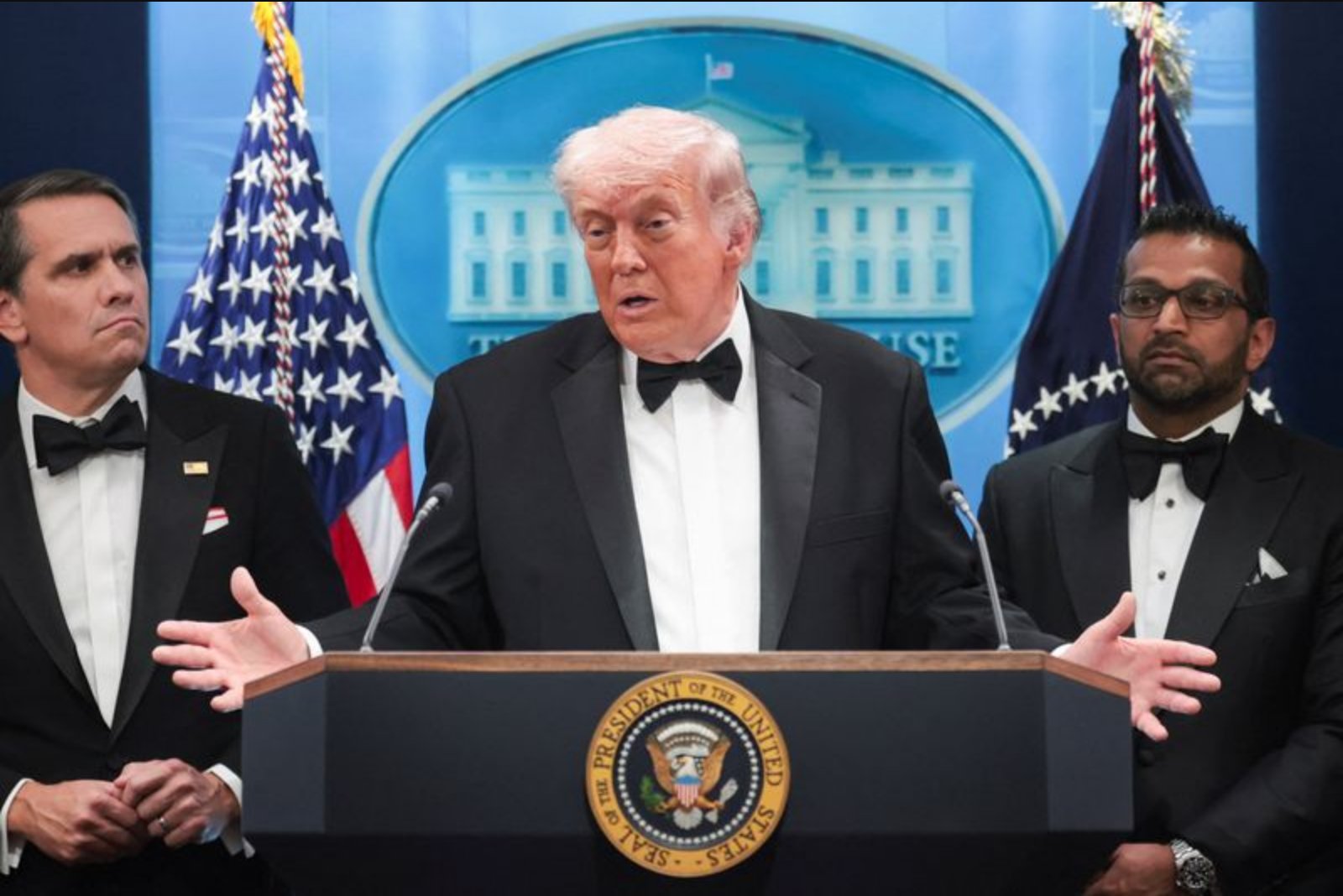
Saturday’s attack at a black-tie Washington gala where President Donald Trump was present ended without deaths, but it highlighted the contingency plans embedded in U.S. law for preserving executive authority if the president and other high-ranking officials are killed or incapacitated.
The legal framework governing succession is explicit and includes members of the executive branch and top congressional officers. Past events, notably the attacks of September 11, 2001, prompted concern that a single catastrophic incident could incapacitate several people in the succession line if they were assembled together. To guard against that possibility, administrations customarily ensure at least one official in the line of succession is absent from gatherings where the country’s leaders congregate.
Constitutional eligibility and 25th Amendment mechanics
The U.S. Constitution sets eligibility rules that apply to anyone who would assume the presidency: they must be at least 35 years old, be a natural-born citizen, and have resided in the United States for at least 14 years. In addition, members of the presidential line of succession must have been confirmed by the Senate to their posts.
Under the 25th Amendment, if the president is killed or otherwise unable to discharge the duties of the office, the vice president would assume the role and serve the remainder of the term. In the current administration, Vice President JD Vance would take over and, governed by the 25th Amendment, would hold the presidency until the term’s scheduled end in January 2029. The vice president-turned-president would then be responsible for nominating a new vice president to be confirmed by the Senate.
Order of succession beyond the vice president
If both the president and vice president were simultaneously incapacitated, the next official in line is the Speaker of the House. At present, that is House Speaker Mike Johnson. Should the speaker also be unable to serve, the succession moves to the Senate president pro tempore, an office that is largely ceremonial and is typically held by the majority party’s longest-serving senator. At the moment, that post is occupied by Republican Senator Chuck Grassley of Iowa, who is 92 years old.
After those congressional leaders, the statutory order continues with members of the president’s cabinet. The sequence among cabinet officers is determined by the historical establishment dates of their departments. In the current order, the cabinet line begins with Secretary of State Marco Rubio, followed by Treasury Secretary Scott Bessent and Defense Secretary Pete Hegseth. The attorney general would follow, but there is uncertainty about whether Todd Blanche meets the statutory criteria because he was confirmed by the Senate to the Justice Department’s No. 2 position and has not been nominated or confirmed to lead the department.
Following the attorney general in the order are, in succession: Secretary of the Interior, Secretary of Agriculture, Secretary of Commerce, Secretary of Labor (a post currently vacant), Secretary of Health and Human Services, Secretary of Housing and Urban Development, Secretary of Transportation, Secretary of Energy, Secretary of Education, Secretary of Veterans Affairs, and finally the Secretary of Homeland Security.
Designated survivor practice
To reduce the risk that a single incident could remove multiple successors at once, presidents have for decades selected a so-called designated survivor. That individual, typically a cabinet member, stays away from events where the president and other leaders gather in the same place, such as inaugurations or the annual State of the Union address to Congress. The practice is not mandated by statute, but it has been routine since the 1980s.
Historically, the secretary of agriculture has most often been chosen as the designated survivor, according to records compiled by the American Presidency Project at the University of California, Santa Barbara. In the recent terms noted in the current administration, President Trump named Veterans Affairs Secretary Doug Collins as designated survivor in both 2025 and 2026.
Context from Saturday’s event
The White House Correspondents’ Association dinner is a prominent event on the Washington calendar, but it does not always prompt the administration to employ the designated survivor practice. President Trump did not attend the dinner during his first 2017-2021 term and boycotted it last year. This year, he attended along with Vice President JD Vance, Speaker Mike Johnson, Secretary of State Marco Rubio, Defense Secretary Pete Hegseth and a number of cabinet officials. Their presence together raised the theoretical risk of a constitutional and administrative crisis had the assailant succeeded in killing senior officials.
Notably, Senator Chuck Grassley did not attend the dinner, meaning at least one high-ranking member of the succession line was not present at the gathering.
Implications for governance and continuity
The statutory line of succession, constitutional eligibility thresholds and the designated survivor practice together form the standing protections intended to preserve continuity of government. While the September 11 attacks and other contingencies have underscored vulnerabilities when leadership is assembled, the combination of legal requirements and precautionary practices aims to ensure that someone qualified and confirmed is available to assume presidential duties in the event of a catastrophe.
As illustrated by the recent Washington incident, the presence or absence of particular officials at high-profile events can have immediate bearing on the practical resilience of continuity plans, even as questions can remain about the status of specific nominees or vacancies in the succession roster.