
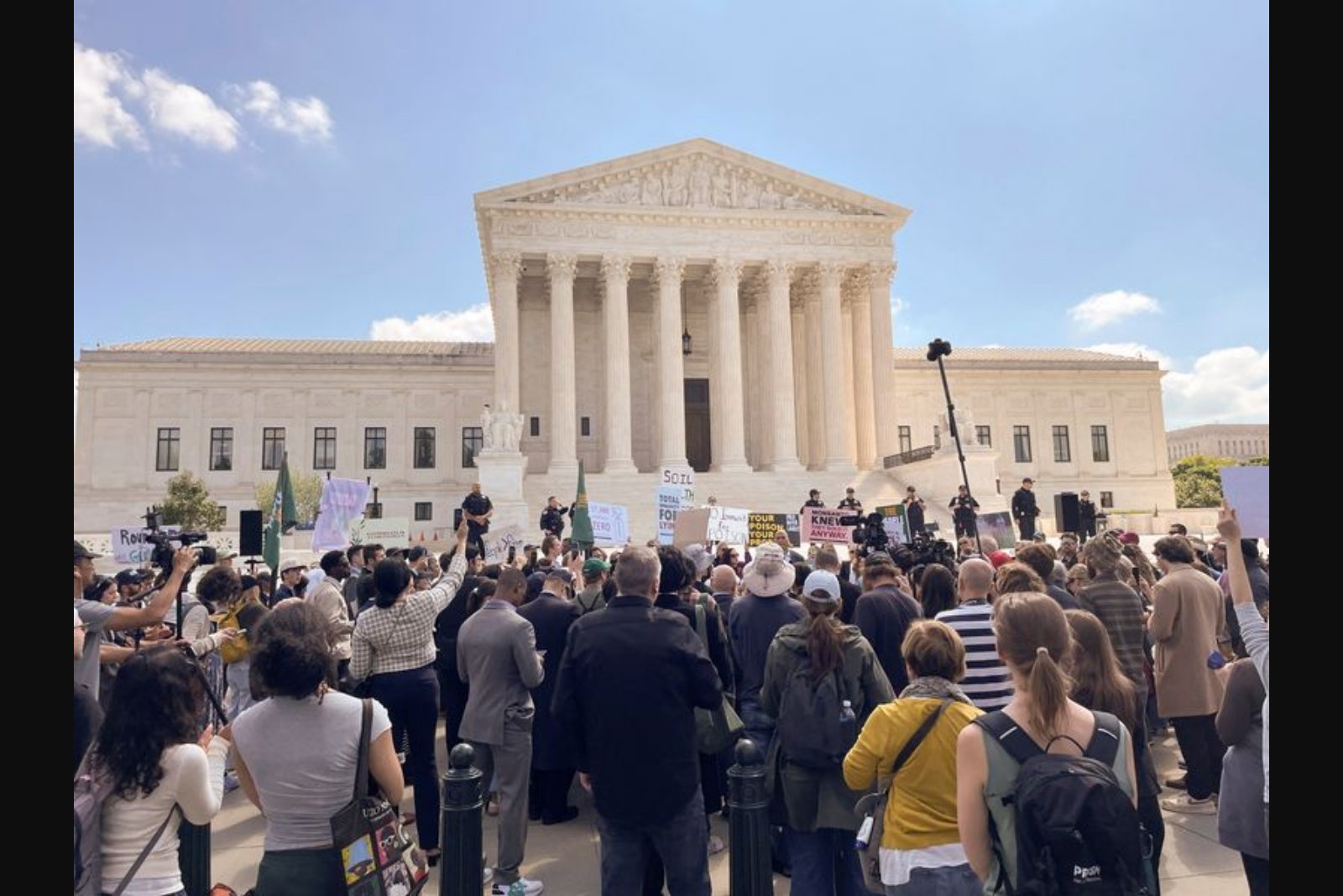
Dozens of demonstrators affiliated with the Make America Healthy Again movement assembled on the sidewalk in front of the white marble U.S. Supreme Court building on Monday as the justices heard oral arguments in Bayer’s effort to curtail thousands of lawsuits claiming the company’s weedkiller Roundup causes cancer.
The rally, organized under the banner "The People vs. Poison," drew a couple of hundred supporters who chanted and cheered as they waved placards outside the neoclassical courthouse. Demonstrators carried signs and banners expressing opposition to corporate immunity and raising questions about cancer risks; speakers criticized both the use of pesticides in agriculture and the Trump administration’s stance in the litigation.
"You cannot make America healthy again and protect the corporations that are poisoning us," Vani Hari, a MAHA activist and author who addressed the crowd, said in remarks captured at the event.
Another speaker, Kelly Ryerson, co-executive director of the advocacy group American Regeneration, told attendees the Trump administration needs to alter its pesticide policies to retain MAHA voters ahead of the November congressional elections. Ryerson said voters were motivated by pesticide-related concerns and the expectation that the issue would be addressed.
The MAHA movement has expressed support for Health Secretary Robert F. Kennedy Jr., a Trump appointee, and its authorship of the rally featured a mix of environmental and legislative voices. Participants included leaders from environmental organizations such as Friends of the Earth and the Center for Biological Diversity, plus lawmakers including Democratic Representative Chellie Pingree of Maine and Democratic Senator Cory Booker of New Jersey, who appeared among the speakers.
On the legal front, Bayer is appealing a Missouri state jury verdict that awarded $1.25 million to John Durnell, who said that years of exposure to glyphosate, the active ingredient in Roundup, led to a diagnosis of non-Hodgkin lymphoma. The company faces tens of thousands of related lawsuits in courts at both the federal and state level across the United States. Glyphosate is described in court filings as among the most commonly used weedkillers.
During arguments, the Supreme Court appeared divided on the central legal questions, and observers said a ruling could be expected by the end of June. Paul Clement, the attorney representing Bayer, warned that a decision against the company could open the door to crippling liability and harm farmers who rely on federally registered pesticides for their livelihoods.
While the nation’s largest farm lobby filed a brief backing Bayer’s legal position, some smaller farming organizations challenge the assertion that U.S. agriculture must depend on glyphosate. At the rally, Angela Huffman, co-founder, president and CEO of Farm Action, told attendees that claims Bayer has made about removing glyphosate and triggering a collapse of the food system are inaccurate, and that farmers have alternatives.
A recent Reuters/Ipsos poll cited at the event found a majority of Americans are worried about pesticide use on food crops and oppose legal protections for companies selling products that can cause cancer, even when the seller includes warnings about the risks.
The legal dispute and public concern intersect with financial questions. Promotional material present at the scene and online raised the question of investing in Bayer’s U.S. listing, BAYGN. The material explained that an AI-driven research product, ProPicks AI, evaluates BAYGN among many companies using a wide set of financial metrics and noted past performance of its model, which highlighted prior winners. The promotional copy invited readers to consider whether BAYGN is included in current AI strategies or whether other opportunities in the sector present a better risk-reward profile.
The rallies outside the court and the ongoing litigation underscore the complex mix of public health concerns, legal liability, agricultural practices, and investor interest centered on glyphosate and the Roundup brand. With the justices appearing split in oral argument and a decision expected within a matter of weeks, stakeholders across environmental advocacy groups, farming constituencies, and financial markets will be watching closely for the court’s next move.