
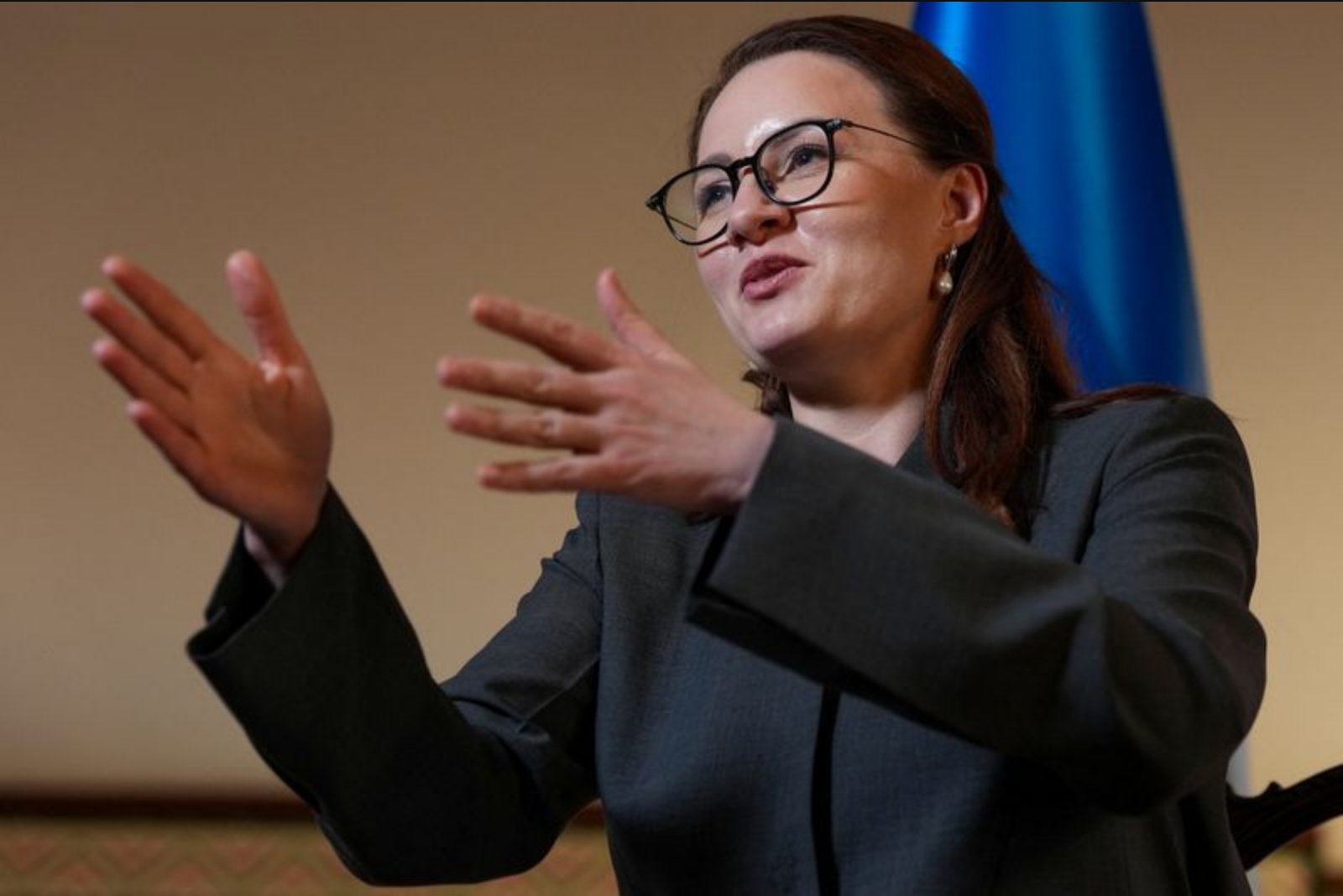
Ukrainian Prime Minister Yulia Svyrydenko departed the United States on Thursday reporting a more confident tone in Washington toward Kyiv after meetings with senior officials, including Treasury Secretary Scott Bessent. In her only media interview during the spring meetings of the International Monetary Fund and the World Bank, Svyrydenko said she found Bessent to be sympathetic to Ukraine’s position and strongly supportive of preserving sanctions imposed on Russia following its full-scale invasion.
She said the meeting with Secretary Bessent was used to press the case that sanctions on Russia should not be relaxed, waived or delayed. Svyrydenko noted that Washington had temporarily eased some restrictions on Russian oil to address supply disruptions linked to the Iran war, but that those measures have since been reversed and the sanctions are now again in force.
"I think Secretary Bessent stands with Ukraine and stands for Ukraine," she said, describing their exchange as "very friendly" and characterizing him as "very supportive." Svyrydenko added that U.S. counterparts broadly understand Kyiv’s concern that preventing circumvention of sanctions - and, where possible, strengthening them - is a critical step to weaken Russia.
Ukrainian and U.S. officials met last month in Florida to discuss paths toward ending the conflict with Russia, but Svyrydenko acknowledged that prospects for a swift settlement have dimmed. She reiterated Ukraine’s insistence that robust security guarantees be in place before any peace agreement is finalized.
"I dream that this war will end, but it will end ... with the proper security guarantees, the proper prosperity plan, with a proper plan for the reconstruction and the recovery," she said. "That would give the opportunity for Ukrainians to live the life that they deserve because they have been fighting so hard."
Beyond sanctions and diplomacy, Svyrydenko highlighted deepening U.S.-Ukraine cooperation through a joint Reconstruction Investment Fund. The fund, which she said approved its first project last month, is expected to approve a second project in the energy sector this summer. She said the effort has already attracted more than 200 applications and expressed hope the fund could be scaled up to approve more than the initial target of three projects planned for this year.
Drawing on her experience as a former economy minister, Svyrydenko framed the fund as a vehicle to accelerate reconstruction and recovery, with particular attention to energy projects. She said that expanding the pipeline of approved projects would support both immediate recovery needs and longer-term prosperity.
On macro-financial support, Svyrydenko noted progress with the IMF. She referenced an $8 billion loan that the IMF approved in February and said the fund would send a staff mission to Kyiv in May. According to the prime minister, the IMF has demonstrated a willingness to provide Ukraine with greater flexibility in specific cases, having eased some conditions in February after acknowledging the country’s deteriorated circumstances during sustained Russian attacks that significantly damaged Ukraine’s energy infrastructure this past winter.
After two days of round-the-clock engagements in Washington, Svyrydenko said she felt a renewed sense of support. "During this visit, I felt that everybody was very supportive," she said, adding that the tone of discussions felt more constructive than in earlier meetings.
Following a meeting of finance ministers from Group of Seven countries, officials released a statement pledging continued assistance to Ukraine, including help to prepare for the coming winter. Svyrydenko viewed the G7 declaration as a welcome reinforcement of broader international backing.
She also pointed to recent electoral developments in Hungary, which removed Prime Minister Viktor Orban from power, as a potential catalyst for unlocking further European Union support. Svyrydenko said she hoped the change would help lift Hungary’s blockade of a 20th package of EU sanctions against Russia and clear the way for a 90 billion euro loan from the EU that had been held up.
On Ukraine’s long-term geopolitical trajectory, Svyrydenko described the country’s push to join the EU as "irreversible." She said Ukrainians see themselves as part of the EU family and argued the time is right to accelerate integration, calling for a fast-track approach to EU accession that would reflect the country’s aspirations and sacrifices.
Currency note: ($1 = 0.8492 euros)
Summary
Ukrainian Prime Minister Yulia Svyrydenko reported a more positive reception in Washington after meetings with U.S. officials, including Treasury Secretary Scott Bessent. She emphasized the importance of maintaining and strengthening sanctions on Russia, highlighted progress on a U.S.-Ukraine Reconstruction Investment Fund that has approved one project and expects an energy-sector approval this summer, and said the IMF will send a staff mission to Kyiv in May to follow up on an $8 billion loan approved in February. She also expressed hope that recent elections in Hungary could help unlock stalled EU aid and sanctions measures.
Key points
- High-level U.S. support - Treasury Secretary Scott Bessent signaled backing for Ukraine and for maintaining sanctions on Russia, according to the prime minister. Impacts: sanctions and financial markets, energy trade flows.
- Reconstruction investment - The U.S.-Ukrainian Reconstruction Investment Fund has approved its first project and expects a second in the energy sector; over 200 applications have been submitted. Impacts: infrastructure, energy sector, construction and related supply chains.
- IMF engagement - An $8 billion IMF loan approved in February remains in place and IMF staff will visit Kyiv in May, with the fund having eased some conditions earlier. Impacts: sovereign financing, fiscal stability, international capital flows.
Risks and uncertainties
- Ongoing conflict - Continued Russian attacks, which previously damaged Ukraine’s energy infrastructure, create uncertainty for reconstruction timelines and energy-sector investment.
- Sanctions dynamics - Temporary adjustments to oil-related restrictions in Washington during supply disruptions illustrate the potential for policy shifts that could complicate enforcement and create opportunities for circumvention.
- EU support conditionality - Hungary's prior blockage of EU financial and sanctions measures shows that political developments within EU member states can delay or withhold significant financial assistance to Ukraine.