
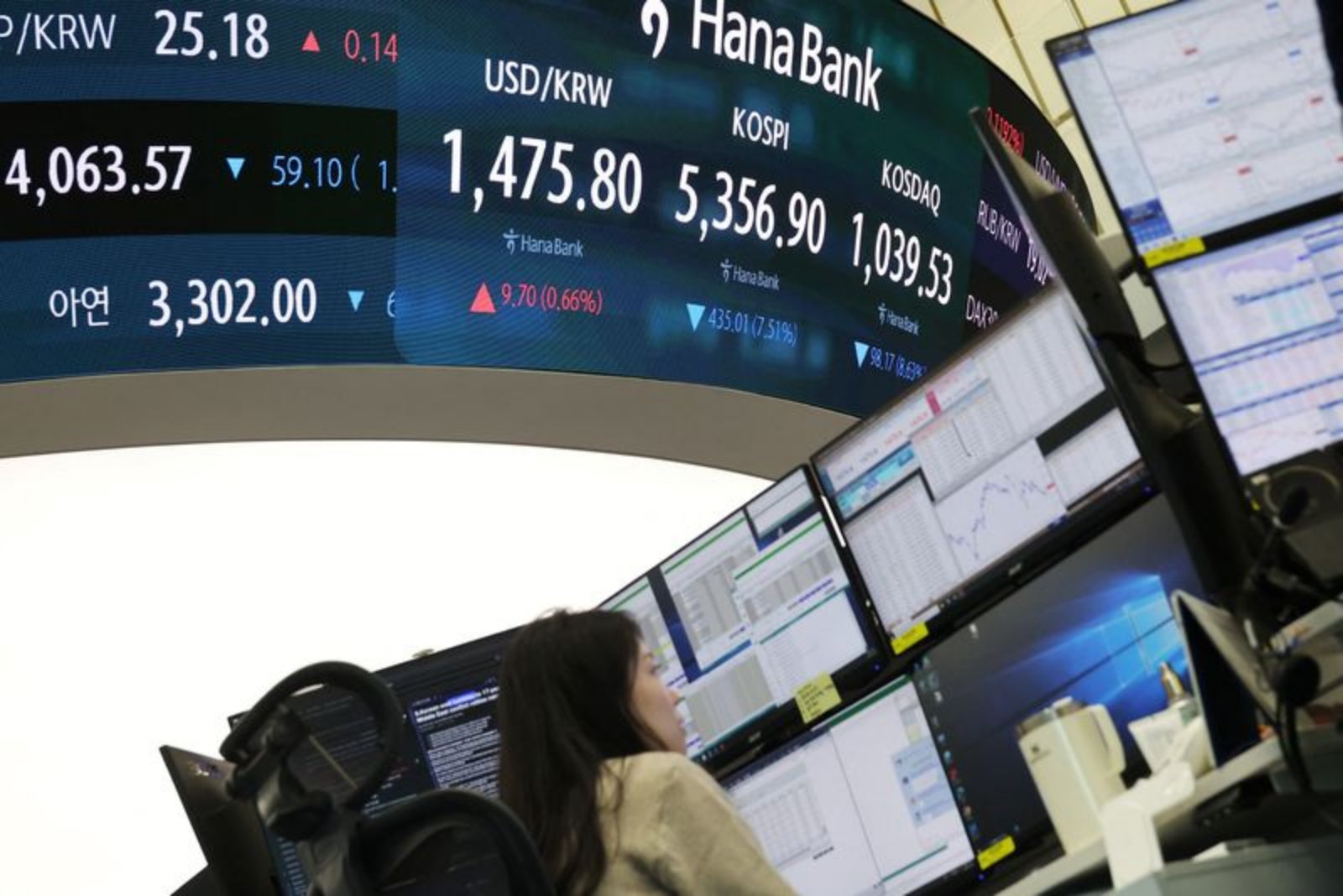
South Korea’s financial markets are drawing back overseas investors after a violent correction in March, as confidence in the stability of Middle East markets, strong demand for AI-related memory products and steps to reform corporate oversight encourage renewed inflows across equities and debt.
The benchmark KOSPI has clawed back almost all of the 19% decline it suffered last month, returning momentum that made it the top-performing major stock index in the prior year. Still, the episode exposed vulnerabilities in an equity market concentrated around a small group of companies linked to artificial intelligence and subject to swings that outstrip most global peers.
Foreign purchases have resumed, with $4.2 billion flowing back into South Korean stocks this month, according to LSEG data. That inflow follows a record $23.8 billion that left the market in March. The selloff and subsequent rebound have highlighted how rapidly sentiment can shift in Seoul given its export-oriented economy and deep exposure to energy price swings, particularly when the currency is weak.
Investors such as Isaac Thong, senior investment director for Asian equities at Aberdeen Investments, treated the steep decline as a buying opportunity. Thong said he shifted positions away from Taiwanese semiconductor names and into more cheaply priced South Korean memory chipmakers, naming Samsung Electronics as an example. He described the secular rise in demand for high bandwidth memory used in data centres as a megatrend and voiced cautious optimism that, barring a recessionary scenario, it is likely to continue.
Despite South Korea’s geographic distance from the Middle East, markets there felt the impact of the conflict. The economy’s openness and reliance on exports make it sensitive to an energy shock, a sensitivity that is compounded by persistent weakness in the Korean won. During the turmoil the KOSPI at times plunged as much as 12% in a single session and later rallied by as much as 9% in other sessions. Even after this turbulence, the index is higher by 44.5% so far this year, following a 75% gain in 2025.
Policy makers in Seoul have sought to narrow the so-called Korea Discount - a valuation gap attributed to weak shareholder protections and the dominance of family-controlled conglomerates known as chaebols. Corporate governance reforms intended to address these structural issues have attracted activist investors, who see opportunities similar to those that produced returns in Japan under former premier Shinzo Abe’s Abenomics policies.
While stocks have posted sharp moves, South Korea’s bond market has shown notable resilience. Companies domiciled in Korea raised $74.7 billion in the first quarter of 2026, maintaining the brisk pace of corporate fundraising seen recently, according to LSEG. The benchmark 10-year government bond yield has eased 17.5 basis points this month and reached its lowest level since February.
Investor interest in Korean sovereign debt is also rising ahead of anticipated inclusion in the FTSE World Government Bond Index. Japan’s Government Pension Investment Fund began buying Korean treasury bonds prior to their inclusion, and asset managers including Goldman Sachs Asset Management and Principal Global Investors have signaled interest. Riad Chowdhury, head of Asia-Pacific at MarketAxess in Singapore, expects between $50 billion and $70 billion of flows from passive funds alone and described the move as a substantial Asia-to-Asia trade.
Currency weakness remains a central concern for global investors. The won is trading near lows not seen in 17 years, levels comparable to those reached during the Asian or global financial crises. Capital outflows and demand for the dollar as a safe haven have pressured the currency, prompting repeated public warnings from authorities. In response, South Korea’s state-run pension fund has carried out strategic foreign exchange hedging operations, effectively intervening to support the won.
The recent market cycle underscores tensions for policy makers. A weak currency raises the cost of imported energy that South Korea depends on and constrains the scope for growth-supporting measures, as further stimulus risks worsening inflation pressures. At the same time, equity market gains remain heavily concentrated in a handful of AI-linked firms, amplifying volatility and investor risk.
ProPicks AI-style promotional content in the original reporting discussed whether to invest $2,000 in the Samsung Electronics ticker 005930 and described an AI-driven strategy that evaluates thousands of companies using more than 100 financial metrics. That material positioned the AI as a tool that identifies stocks with favorable risk-reward profiles based on current data, and referenced notable past winners such as Super Micro Computer and AppLovin.
Summary - South Korea’s equity and bond markets have rebounded after a sharp March selloff, buoyed by demand for AI-related memory chips, corporate governance reforms and steady issuance in the bond market. However, concentrated gains among AI-linked firms, pronounced equity volatility and a weak won that raises energy import costs present policy and market risks.
Key points
- KOSPI recovered nearly all of the previous month’s 19% decline and is up 44.5% this year after a 75% surge in 2025 - equity markets are driven by a small number of AI-linked companies.
- Foreign investors returned $4.2 billion this month after a record $23.8 billion fled in March; corporate bond issuance remains strong with $74.7 billion raised in Q1 2026.
- Anticipated inclusion in the FTSE World Government Bond Index and pre-inclusion purchases from major institutional investors have increased demand for Korean sovereign bonds, while the 10-year yield has fallen 17.5 basis points this month.
Risks and uncertainties
- Currency risk - the won is near 17-year lows, increasing the cost of imported energy and complicating monetary and fiscal policy choices.
- Market concentration and volatility - heavy exposure to a few AI-linked companies heightens equity market swings and investor risk.
- External shock exposure - South Korea’s openness and export orientation leave it vulnerable to energy shocks stemming from geopolitical instability.