
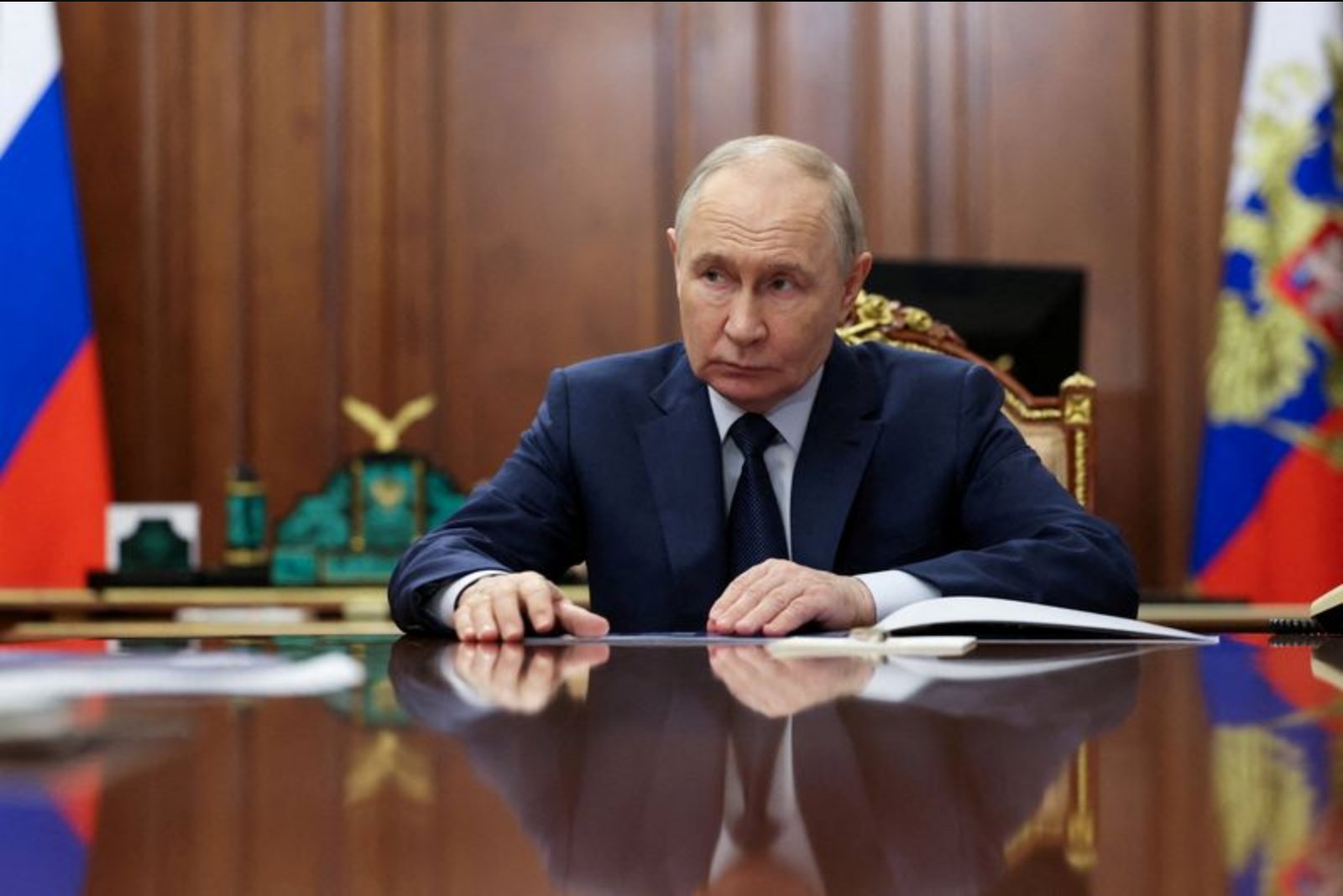
Russian leaders convened in the Kremlin this week to discuss a raft of policy options after President Vladimir Putin criticised the country’s economic performance, saying it had registered its sharpest contraction in more than three years.
Speaking at the start of a meeting with senior economic officials on Wednesday, Putin said the economy had contracted 1.8% in the first two months of this year and that key sectors - manufacturing, industrial production and construction - posted negative results compared with the same period a year earlier. He told his team the trajectory of the economy was below expectations and asked for detailed proposals on steps that could be taken to address the downturn.
The gathering included Prime Minister Mikhail Mishustin; Kremlin Deputy Chief of Staff Maxim Oreshkin; First Deputy Prime Minister Denis Manturov; Deputy Prime Minister Alexander Novak; Central Bank Governor Elvira Nabiullina; and Piotr Fradkov, CEO of PSB bank.
Kremlin spokesman Dmitry Peskov said on Thursday that the closed portion of the meeting ran for several hours and involved an open exchange of views. "The members of the government’s economic bloc have many proposals to activate the economy and give it greater momentum," Peskov told reporters, declining to provide further details.
Those proposals come against a backdrop of uneven performance since the onset of the Ukraine war. Russia’s $3.1 trillion economy contracted 1.4% in 2022, then expanded 4.1% in 2023 and 4.9% in 2024. Growth slowed markedly last year to just 1%, and Moscow’s official forecast for this year stands at 1.3%.
While the economy has so far avoided the collapse some Western powers expected after the imposition of wide-ranging sanctions, officials say the strain of the war in Ukraine - which has been described as the deadliest conflict in Europe since World War Two - along with double-digit interest rates are weighing on activity. Putin highlighted those pressures in his remarks at the Kremlin meeting.
International forecasting has shifted in response to developments in the Middle East. The International Monetary Fund on Tuesday raised its forecast for Russia’s growth this year to 1.1%, up from 0.8%, citing higher oil and commodity prices linked to what the article describes as the Iran war and the resulting energy supply shock. Within official Russian statistics, the last quarterly decline comparable to the downturn seen in the first quarter of this year was probably in the first three months of 2023, when GDP fell by 0.8%.
Central Bank Governor Elvira Nabiullina, speaking on Thursday at a Moscow conference, said the economy faces an acute shortage of labour even as the Iran war raises the risk of upward pressure on prices. "The peculiarity of the current situation is that for the first time in modern history, our economy has faced shortages or limits on labour," she said. Nabiullina added that the labour constraint had created a new reality for both the state and for business. "Now we have the deterioration of external conditions, one could say, that is almost constant both in exports and imports."
At the same conference, Finance Minister Anton Siluanov, who also attended the Kremlin meeting, said the government was weighing an early re-entry to the foreign currency market after a recent strengthening of the rouble. A firmer rouble can aid the central bank’s fight against inflation but can hurt growth by reducing exporters’ profits, prompting cuts to investment and making Russian goods less competitive.
Officials’ deliberations underlined the policy trade-offs Moscow faces: higher commodity prices driven by geopolitical tensions can support an oil-oriented economy, but domestic constraints - notably labour shortages and tighter financing conditions - complicate the outlook for broader activity. Participants at the closed-door discussions reportedly offered numerous activation measures, but Peskov declined to disclose the specifics.
With the economy having outperformed some expectations since 2022 but now showing signs of renewed weakness, the Kremlin has tasked its economic bloc with producing concrete, actionable options to reverse the recent contraction. How officials balance measures to support growth, control inflation and manage external pressures remains a central uncertainty in the policy debate.
Clear summary
- President Putin reprimanded senior economic officials after reporting a 1.8% contraction in the first two months of the year and asked for detailed measures to stimulate the economy.
- Russia’s economy has shown resilience since 2022, but growth slowed to 1% last year and official forecasts for this year are modest; IMF forecasts were revised slightly upward to 1.1% due to higher commodity prices from the Middle East crisis.
- Officials cited a combination of the Ukraine war, double-digit interest rates, labour shortages and a stronger rouble as headwinds complicating policy choices.
Key points
- Economic activity: Manufacturing, industrial production and construction were negative in the opening months of the year, contributing to a reported 1.8% contraction in January-February.
- Macroeconomic indicators: Russia’s $3.1 trillion economy contracted 1.4% in 2022, expanded 4.1% in 2023 and 4.9% in 2024, but slowed to 1% growth last year; official 2026 forecast is 1.3% while the IMF raised its 2026 forecast to 1.1% from 0.8%.
- Policy tension: A stronger rouble can help fight inflation but undermines exporters’ margins and may depress investment, complicating decisions about returning to the foreign currency market.
Risks and uncertainties
- External shocks: Geopolitical developments in the Middle East are altering commodity prices, which could shift Russia’s growth outlook - this primarily affects the energy sector and government revenues.
- Labour constraints: An acute shortage of labour, as highlighted by the central bank governor, poses risks for industries reliant on workforce availability, including manufacturing and construction.
- Monetary and exchange-rate trade-offs: A firmer rouble helps curb inflation but can damage exporters and investment, representing a risk for export-oriented firms and the industrial sector.