
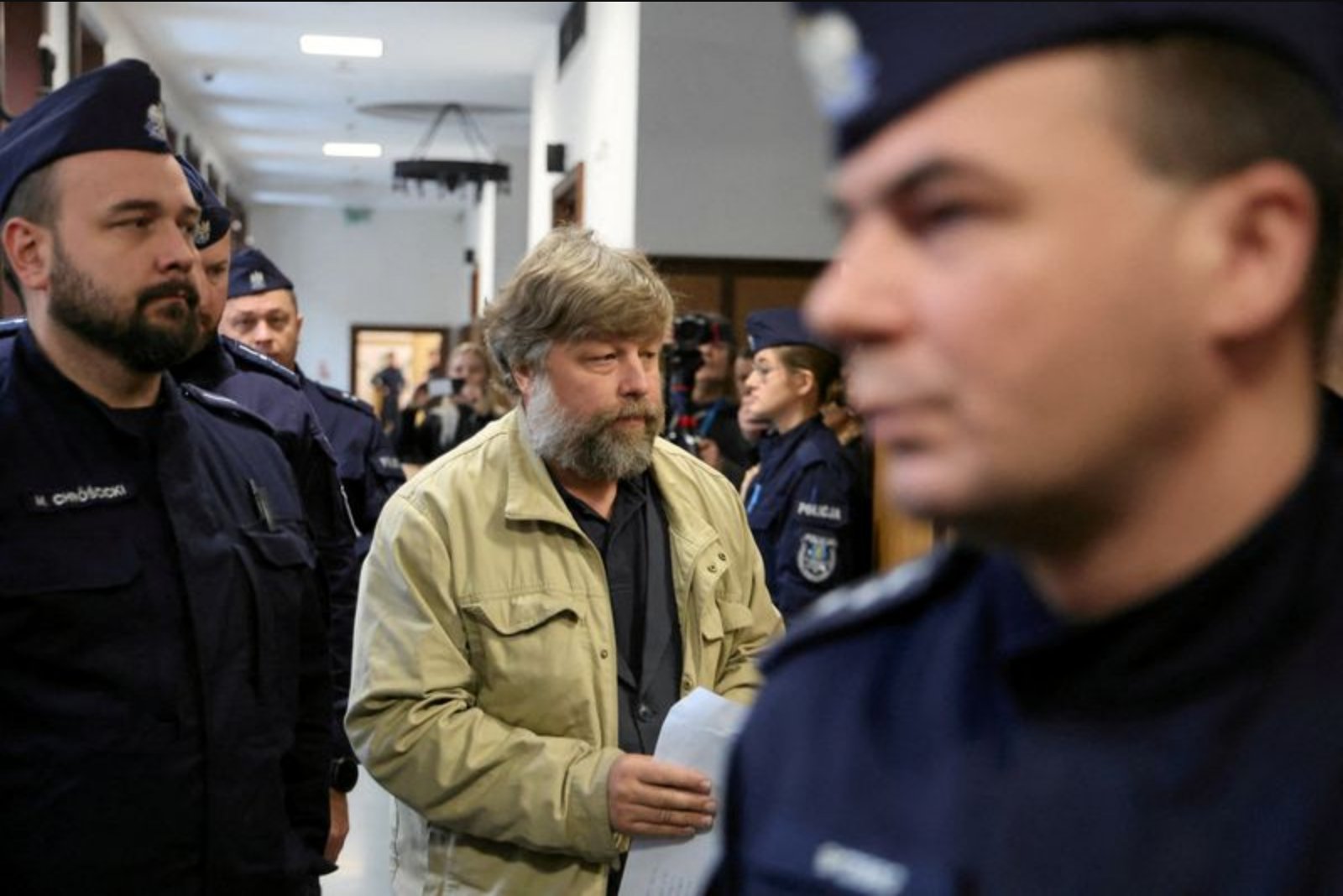
Belarus handed over Andrzej Poczobut, a journalist and activist of Polish origin, to Polish authorities on Tuesday in a prisoner exchange held at the frontier between the two countries, Polish Prime Minister Donald Tusk said.
Poland, in turn, released Alexander Butyagin, a Russian archaeologist who had been detained in Poland in December and was being prepared for extradition to Ukraine. The exchange was described by Tusk as five prisoners released in return for five Belarusian or Russian citizens. Among those identified by the Polish prime minister were Polish Carmelite priest Grzegorz Gawel and an unnamed Belarusian who Tusk said had cooperated with Polish special services.
Not all names of the released individuals were made public immediately, and officials did not at once clarify which other persons were handed over beyond Butyagin.
Background on the key figures involved in the swap is central to understanding the diplomatic sensitivity of the move. Poczobut, a Belarusian of Polish origin, was arrested in March 2021 and subsequently sentenced in 2023 to eight years in prison on charges of inciting ethnic hostility and undermining Belarusian security. Polish authorities have consistently argued the charges were unjust and politically motivated, and had long sought his return.
"Andrzej Poczobut is free! Welcome to your Polish home, my friend," Tusk wrote on social media platform X.
Tusk also characterised Poczobut as "unyielding" and recounted the first words they exchanged after the journalist's release. He said Poczobut had asked: "'Will I be able to go back there (to Belarus)?' - those were his first words." Tusk said he replied: "'Only you decide. You are now a free man.'"
The journalist has been recognised by the European Union with the 2025 Sakharov Prize for Freedom of Thought.
Gawel, the Carmelite priest from Krakow, had been detained by Belarusian authorities last year on charges of espionage, according to Polish statements.
The swap took place against a wider backdrop of shifting diplomatic engagement. Poland has emerged as a refuge for opponents of Belarusian President Alexander Lukashenko and as a staunch supporter of Ukraine since Russia, Belarus's principal ally, launched a large-scale offensive in 2022. Belarusian authorities have released hundreds of prisoners over the past two years, a process that sources say has accelerated following the return of Donald Trump to the U.S. presidency and his dispatch of a special envoy to negotiate with Minsk.
U.S. special envoy John Coale has been a central figure in recent engagement with Minsk. The United States has also begun removing some sanctions on Belarus, and Coale told Reuters on Tuesday he expects to secure additional releases within the next month. He added that the lifting of further sanctions on Minsk would remain a possibility if more prisoner releases occur.
Human rights organisations continue to highlight outstanding concerns. They say more than 830 political prisoners remain incarcerated in Belarus.
On the Russian side, the FSB security service, quoted by state news agency TASS, said two Russian nationals had returned home under the swap. One was identified as Alexander Butyagin, who had been held in Poland and was slated for extradition to Ukraine. Ukraine had accused him of unauthorised excavations and of plundering artefacts in Crimea; Russia protested his arrest and demanded his return.
The FSB said the other Russian released was the wife of a Russian soldier serving with Moscow's forces in Transdniestria, the breakaway region of Moldova. According to the FSB, both Russians were exchanged for two Moldovan citizens who had arrived in Russia last year and were detained by Russian security agencies on allegations of spying.
"Today, we are bringing two Moldovan citizens home from Russian captivity. This would not have been possible without @realDonaldTrump and the US administration, and our partners in Poland and Romania. We are deeply grateful. They’re coming home!" Moldovan President Maia Sandu wrote on X.
The identities of all individuals involved in the swap and the precise mechanics of the border exchange were not fully detailed by officials, leaving some aspects of the transaction unresolved in public statements.
The exchange highlights ongoing diplomatic manoeuvring in the region, as well as the continuing role of third-party mediation in securing the release of detainees. Officials and diplomats signalled potential for further negotiations and additional prisoner returns in the near term, while human rights groups emphasise that a substantial number of political detainees remain in Belarusian custody.