
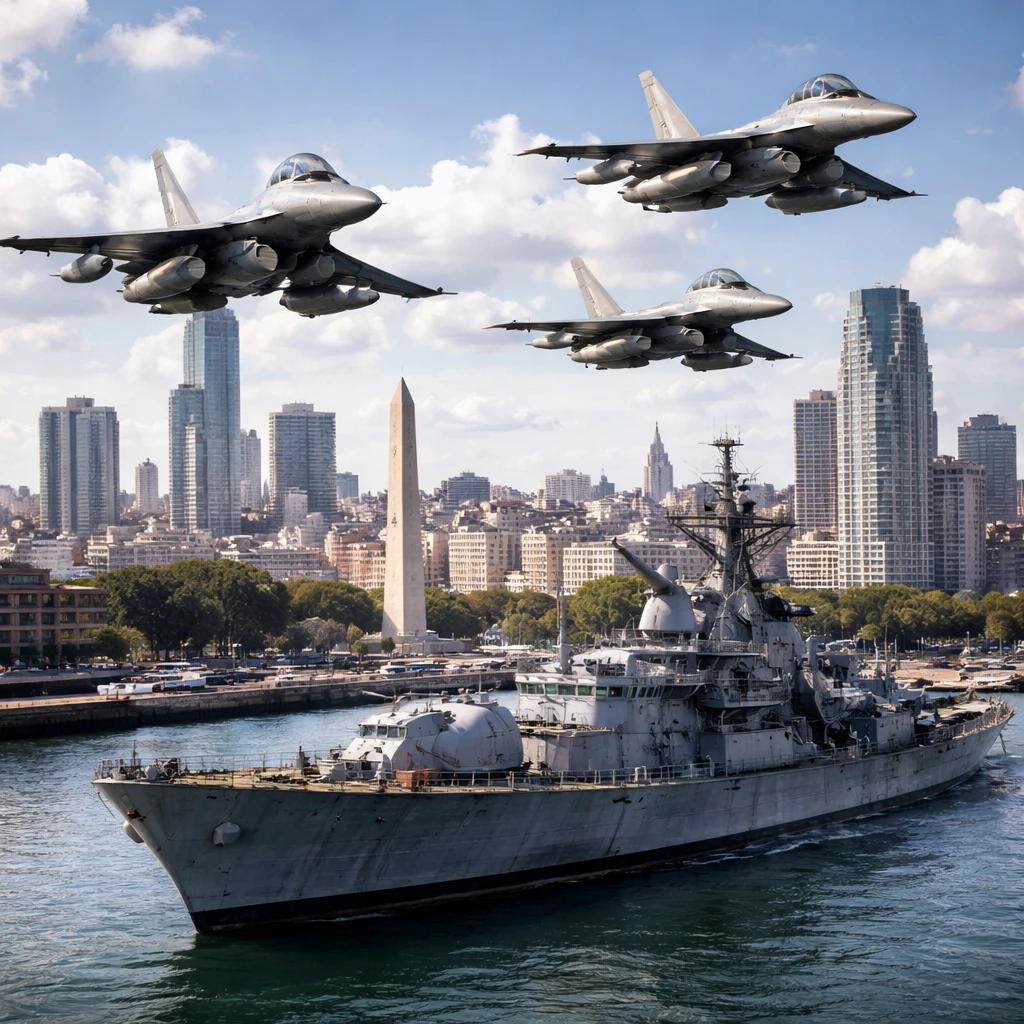
In recent months Argentina has moved to modernize parts of its armed forces, showcasing a fleet of F-16 fighters that flew over Buenos Aires in August and which President Javier Milei has described as the country’s "guardian angels." The aircraft are a focal point of Milei’s effort to retool Argentina’s defense posture and bolster its position in the South Atlantic, including renewed emphasis on sovereignty claims over the British-controlled Falkland Islands.
That agenda collides with long-standing material shortfalls. In 2025 Argentina allocated 0.56% of gross domestic product to defense, the lowest share among South American states, according to the Stockholm International Peace Research Institute. Years of underfunding and intermittent economic crises have left the armed forces with aging equipment and limited operational reach.
Milei has framed recent purchases as part of a broader rebuild supported by international partners. In April 2024 Argentina acquired US-made F-16s that had been sold by Denmark, a deal the government pursued over offers from several other countries. A former defense official from then President Joe Biden’s administration said Washington supported the transaction in part out of concern Argentina might otherwise turn to China for military hardware.
Washington has in recent years cleared a range of equipment for Argentina, including approval to buy four P-3C Orion surveillance aircraft, the sale of eight Stryker armored vehicles, and potential clearance for Black Hawk helicopters. At the same time Argentina is replacing its infantry rifles with Israeli-made weapons, and local media have reported that Germany and France have offered to sell submarines.
The political backdrop of the procurement push sharpened in September when Milei intensified his public claims to sovereignty over the Falklands, known in Argentina as the Malvinas. The move coincided with comments from US President Donald Trump suggesting Washington could rethink its traditionally neutral stance on the dispute, a development that briefly intensified diplomatic attention.
An international tribunal is due to rule on a request by Argentina for provisional measures aimed at halting British-authorized oil exploration near the archipelago. The pending decision adds a legal dimension to Milei’s campaign, which he says will pursue recovery of the islands through diplomacy rather than force.
Still, analysts and former military officers note that a more capable armed force could give Buenos Aires stronger leverage in the South Atlantic. "We don’t have the ability to project power towards the Malvinas," said Jorge Duran, a former commander in Argentina’s special operations. He added: "We could barely patrol our waters." Requests for comment to Argentina’s Defense Ministry and the presidential office were not answered.
Observers point to structural problems that predate the current administration. Luciano Anzelini, an international relations professor, said Argentina’s defense budget fell sharply after the end of the country’s military dictatorship in the 1980s and has remained constrained through subsequent economic crises. The navy’s operational capacity has been notably reduced; Argentina lost its last submarine in a 2017 naval disaster.
Material obsolescence extends to surface vessels. Marcelo Dalle Nogare, who leads the military, told Buenos Aires’ Rotary Club in October that some destroyers still operate with a vintage Commodore 64 computer for certain systems. "The military capacity is little more than a museum," said Juan Battaleme, a former defense secretary for international affairs who was involved in negotiating the $301 million contract for the F-16 fleet.
Milei has pledged to restore "respect" to the armed forces and for the first time since Argentina returned to democracy he appointed a career military officer as defense minister. The government has earmarked 10% of proceeds from the sale or lease of non-military public assets to boost defense spending. The administration has also launched a tender for a dock associated with a long-planned southern naval base intended to improve access to Antarctica.
Critics counter that the rhetoric of revival may outpace reality. "There’s been this sudden burst of patriotism from Milei regarding the Malvinas issue," said Agustin Rossi, a former defense minister and opposition congressman. He added that in practice the policy had been one of military downsizing.
Whether Argentina’s acquisitions materially shift the balance of power in the South Atlantic is uncertain. Britain maintains longstanding restrictions on arms transfers to Argentina and publicly affirms the security of its position in the Falklands. In Parliament in October Armed Forces Minister Louise Sandher-Jones said she was "confident that our military presence is at the appropriate level for the defence of the Islands."
Battaleme emphasized that the F-16s were not purchased to mount a campaign to retake the islands. A written statement by the program that manages the F-16s, under the air force, said the jets are intended to strengthen Argentina’s air control and to safeguard energy resources, critical infrastructure, and the country’s capacity as a global food producer, while continuing to consider interests in the South Atlantic.
Security analysts note the purchase marks a clear improvement in Argentina’s air capabilities. Daniela Portella Sampaio, a senior Latin America security fellow at the Royal United Services Institute, said the arrival of the aircraft alters Argentina’s "capability picture."
Yet the F-16 fleet is dependent on sustained US maintenance and logistical support. Several analysts argue that Washington’s long-term oversight of the aircraft limits the prospect that they could be used against a close US ally such as Britain. Argentine pilots remain in training on the platform.
"The Argentines are not doing anything that would put the US in an awkward position," said Evan Ellis, a professor at the US Army War College. "It’s just Britain has to worry that they now have them."
For now, Argentina’s defense modernization is a mix of visible acquisitions, political signaling and lingering capability gaps. The outcome of the international court’s decision on provisional measures for offshore drilling and the extent to which new equipment is fully integrated and sustainment secured will be critical to understanding how far Milei’s ambitions can translate into sustained strategic presence in the South Atlantic.