
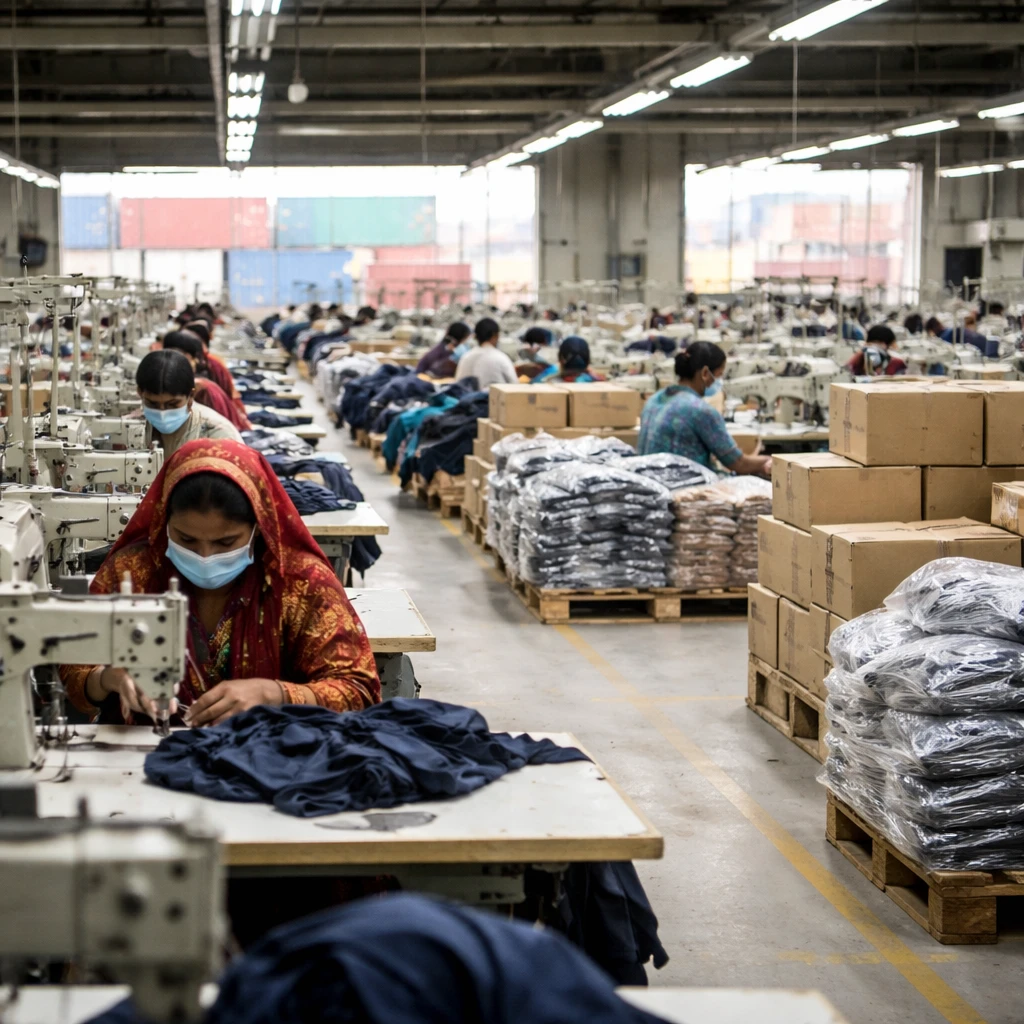
Global fashion retailers including Zara and H&M redirected almost a tenth of their monthly orders out of Bangladesh during the first half of November, according to three factory owners. The diversion - valued at about $254 million between November 1 and 18 - saw most orders rerouted to India, marking a significant setback for a sector that is a cornerstone of Bangladesh’s export economy.
Industry representatives said the shifts were driven by a combination of labour unrest that disrupted production and rising costs that have narrowed the country’s low-cost advantage. Bangladesh is the world’s second-largest apparel exporter after China and the garment trade accounts for more than 80% of the country’s export earnings and nearly 40% of its manufacturing jobs, putting any sustained decline in orders at the centre of broader economic concern.
The Bangladesh Garment Manufacturers and Exporters Association (BGMEA) estimates that the recent protests have already led to more than $400 million in production losses. Factory owners who spoke on condition of anonymity because of sensitivities around their relationships with international buyers confirmed that brands including Zara owner Inditex, H&M, Marks & Spencer, Celio and others temporarily diverted orders, with India absorbing the bulk of that displaced business.
Inditex declined to comment on the requests it received, while Marks & Spencer, H&M and Celio did not respond to inquiries, according to the factory owners.
Indian textile equities reacted to the reported shifts, with Gokaldas Exports jumping as much as 11% and Trident rising about 5% after the information circulated. Other potential beneficiaries named by market observers - Welspun Living, KPR Mill and Vardhman Textiles - were reported to have climbed roughly 2% each.
M. Mohiuddin Chowdhury, a director at the BGMEA, pointed to higher wages, rising utility bills and raw-material costs as compounding pressures on Bangladesh manufacturers. "The wage increase has added to costs at a time when buyers are demanding lower prices and competition from rival sourcing countries is intensifying," he said.
Mahmud Hasan Khan, president of the BGMEA, declined to identify specific brands but noted that a temporary relocation of some orders helps suppliers retain global clients while curbing potential financial losses.
An additional development that heightened buyer concern was the government-approved 36% rise in the minimum wage for garment workers. The increase - the smallest in four decades, according to reporting - fell well short of workers' demands for more than a doubling of pay. Abdur Rahman Tarafder, secretary of the Ministry of Labour and Employment, described the wage increase as "satisfactory" and expressed the hope that all garment workers would return to work from Saturday.
Industry leaders said the wage hike narrows Bangladesh’s labour-cost advantage relative to India, though union groups maintain that pay remains low when viewed against international apparel industry standards.
Factory managers warned that the immediate loss of orders could be the precursor to longer-term shifts in sourcing. They said buyers are reassessing supply chains in response to disruptions and increasingly prioritising reliable delivery schedules as well as cost.
Chowdhury explained that alternative sourcing hubs can offer speed advantages - India can potentially shorten delivery times by about a week, while Vietnam and Cambodia may cut lead times by as much as 15 days. Rival production centres typically work within a 60 to 90 day window for production and delivery, he said, compared with about 120 days in Bangladesh, a gap that becomes decisive when brands face stringent delivery deadlines.
Persistent energy shortages in Bangladesh - exacerbated by the Middle East crisis, industry sources said - have increased production interruptions and pushed some factories to resort to costlier backup power options. Those outages, combined with recent protests, have resulted in production backlogs and lost work days. Manufacturers in and around Dhaka reported losing an estimated 20 to 25 production days, with some exploring overtime and expensive air freight to meet contractual commitments.
Alps Apparels Group managing director Khan Monirul Alam, whose company primarily supplies European brands, said the unrest was already affecting new business. "Since November 1, most of my buyers have stopped placing orders because of the unrest," Alam said. "They are telling us our orders have been shifted, postponed or cancelled and that they have already found alternative solutions."
Political tensions tied to the possible return to Dhaka of former Prime Minister Sheikh Hasina from India have amplified concerns about renewed disruption, industry participants added.
Leaders within the sector emphasised that restoring stability and uninterrupted production would be essential to retaining international buyers. Chowdhury warned that if instability continues, buyers may not wait for conditions to normalise. "The challenge is restoring buyers’ confidence before temporary shifts become long-term sourcing decisions," he said. "Brands have options. They will not wait for us if instability persists."
Factory owners and industry officials underscored that the current episode highlights a broader trend of global brands diversifying their sourcing bases - moving orders to India, Vietnam, Cambodia and Indonesia to reduce supply-chain risk and improve delivery reliability.
For Bangladesh, the immediate questions are whether the combination of labour unrest, higher operating costs and energy constraints will prompt a sustained realignment of global apparel sourcing, and whether the country can regain buyer confidence quickly enough to prevent temporary diversions from becoming lasting losses of market share.