
Overview
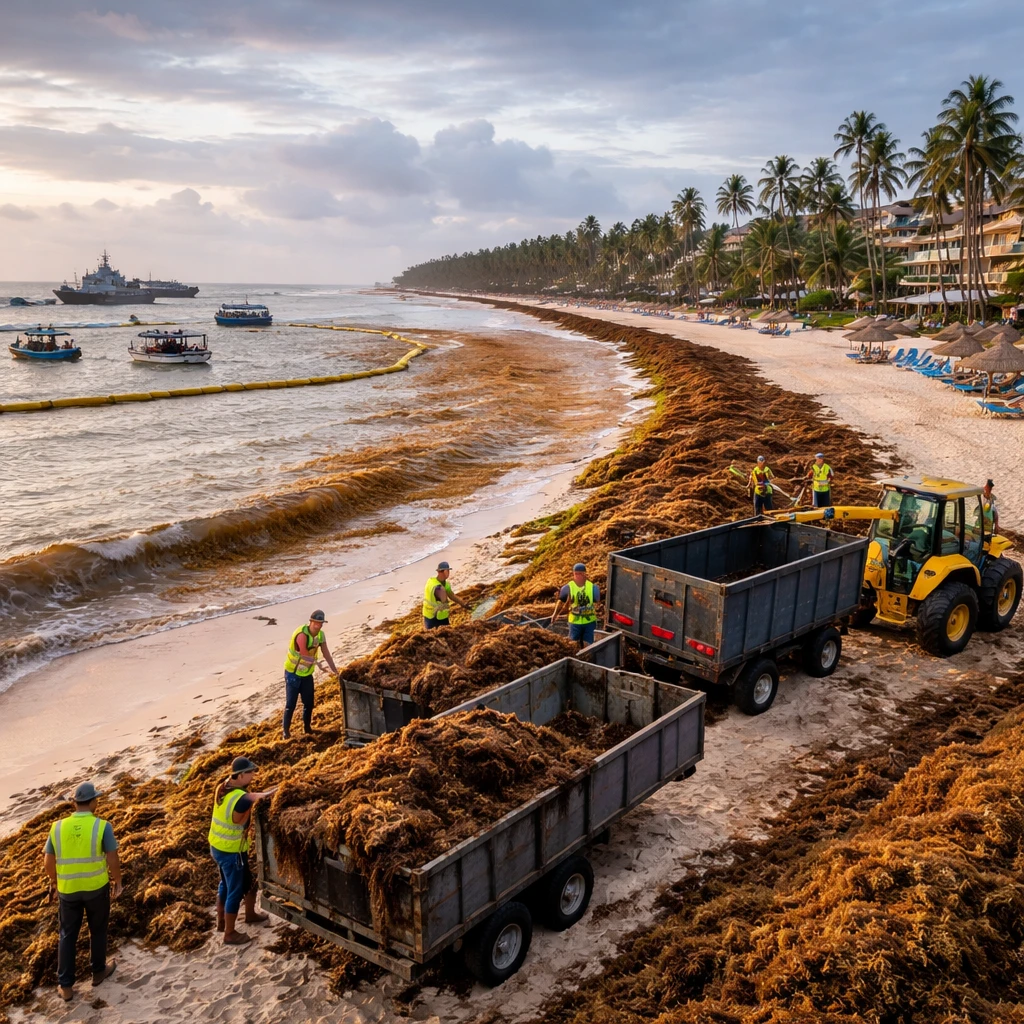
Each morning at dawn, hundreds of workers - from hotel staff and tractor drivers to specialized naval teams - head for beaches along Mexico's Caribbean coast to remove vast quantities of decaying sargassum seaweed that have washed ashore at popular resort destinations. The seasonal influx of foul-smelling algae has prompted hoteliers across the Caribbean to lower room rates and invest heavily in beach clearing, while governments and private firms pursue a range of responses from offshore interception to efforts to convert the biomass into commercial products.
How the sargassum crisis developed
Sargassum is a brown macroalgae that historically concentrated in the Sargasso Sea in the North Atlantic. Around 2010, unusually strong winds shifted large amounts of this seaweed into nutrient-rich tropical waters off West Africa, where it found conditions favorable for growth. The displaced mats then formed a self-sustaining belt that rides ocean currents toward northern Brazil, through the Caribbean and into the Gulf of Mexico, bringing heavy accumulations onto island nations and coastal tourism hubs such as the Riviera Maya.
In the tropical Atlantic, the algae feed on nutrients delivered by major rivers - including the Amazon, Orinoco and Congo - as well as by upwelling from deep waters, inputs of Saharan dust and rising sea temperatures. These combined inputs have created an environment in which sargassum can grow and persist in large floating masses.
Forecasts and scientific perspective
The University of South Florida's Optical Oceanography Lab projects that 2026 will be at least the second-largest year on record for sargassum abundance, with increased likelihood of further concentrations along Caribbean shores and southeastern Florida in the months ahead. Brian Barnes, a research assistant professor at the university's College of Marine Science who works in the lab, noted that the novelty and seasonal variability of the phenomenon complicates forecasting.
"Before 2010 there's nothing, and since then we've gone to up to 1 million metric tons over the entire area in 2011 to 40 million last year," Barnes said, suggesting the seaweed could be doubling in mass every five years.
Mexico's operational response
Mexican authorities have prioritized protecting key tourist destinations along the Riviera Maya - including Cancun, Tulum and Playa del Carmen - by expanding fleets of sargassum-collection boats and deploying larger floating barriers offshore. Mexico, which retrieves most of its sargassum after the seaweed lands on beaches, reported collecting 96,151 metric tons so far this year, compared with 92,783 metric tons last year, according to government data.
Mara Lezama, governor of Quintana Roo state in southern Mexico, told reporters that experience has shown interception at sea to be the most effective tactic. "Experience has taught us the best way to face sargassum is to intercept it in the sea before it hits our coasts," she said at a press conference.
Federal officials indicated an open-sea sargassum vessel is expected to arrive within a month, and they are seeking additional ships from Japan while planning to supply smaller Mexican-made vessels to the Dominican Republic.
Carbon credits and ecological concerns
Some companies have looked to monetize removal operations by seeking carbon credits for harvesting sargassum, baling it on vessels and then sinking the bales to the seafloor - a process intended to prevent methane emissions from decomposition on land. However, this approach has drawn criticism over possible abuses, impacts on deep-sea ecosystems and the risk of over-harvesting offshore clusters of sargassum.
"It's a balance because offshore sargassum is a natural habitat and there's tons of turtles and fish that live among it," Barnes said. "So if you try and sweep the Caribbean clean, you're going to have a lot of collateral damage." He added that many companies have sought his input on carbon credit projects, but he remained unconvinced they would produce net environmental benefits.
Commercialization efforts and industrial scaling
The excess of sargassum has prompted entrepreneurs to explore turning the algae into energy and a range of commercial goods, although conversion faces hurdles such as removing toxic metals that the seaweed can accumulate. Mexico's Environment Minister Alicia Barcena said that among almost 200 projects in the country, at least 11 could scale up industrially and 39 are already producing items derived from sargassum. Products in development or on the market include fuel, fertilizers, laminates, bioplastics and handcrafted sandals.
Felix Navarrete, an executive at sargassum refiner Carbonwave, said his firm is already exporting fertilizer made from the algae and, after receiving regulatory clearance from Mexico's sanitary authority, is seeking to sell domestically. Carbonwave is also exploring supply opportunities for the cosmetics and textile sectors. Separately, the state government of Quintana Roo plans to expand a biofuel plant in Cancun.
Outlook and policy coordination
Government and industry leaders across the Caribbean have warned about the magnitude of the sargassum issue while urging tourists to continue visiting beaches and to choose less-affected areas when possible. Mexico will host a joint European Union-Caribbean conference on sargassum in early October in Cancun, where delegates are expected to discuss how to scale collection efforts while safeguarding beaches and coral reefs.
As authorities balance the economics of tourism, the environmental role of offshore sargassum habitats and the commercial potential of conversion projects, the region faces continued operational and ecological tradeoffs that will shape responses in the months and years ahead.