
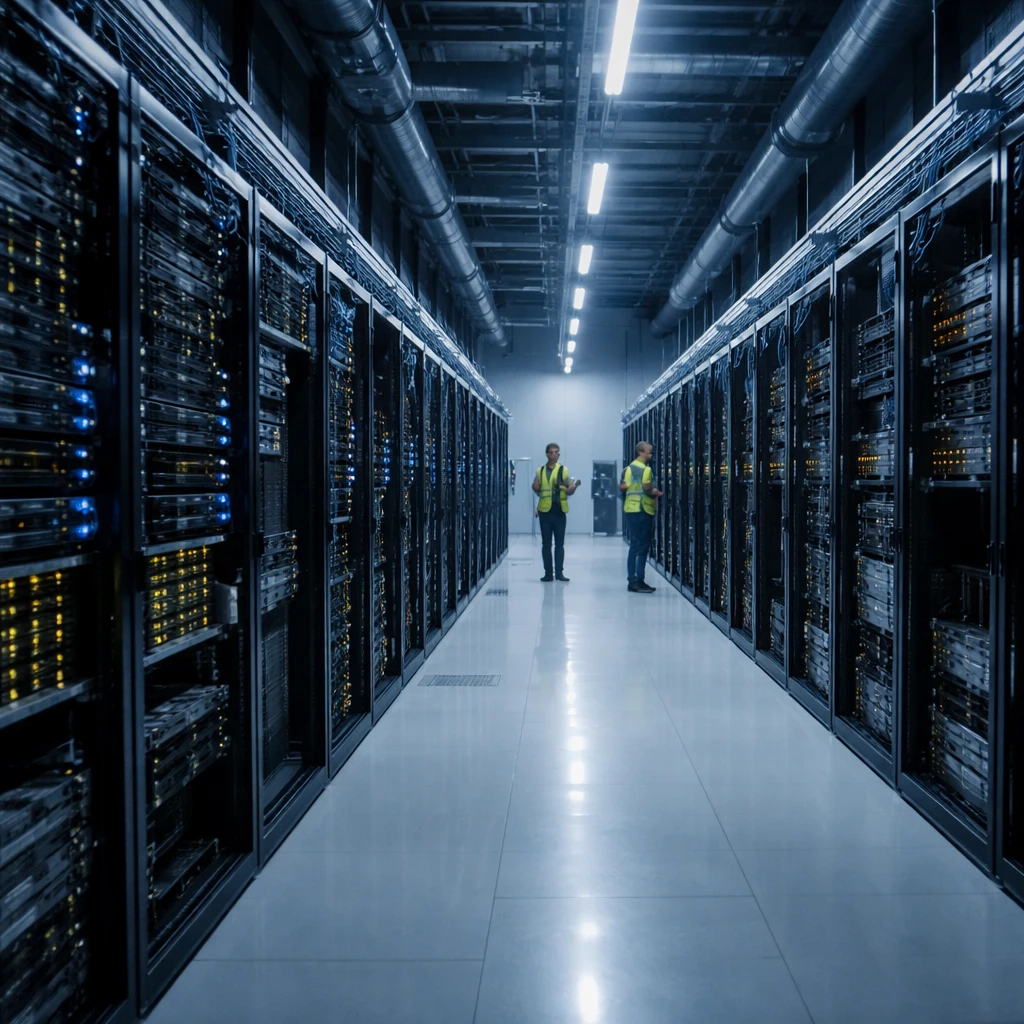
What began as a weekend essay has evolved into a market-moving event. Dario Amodei of Anthropic published "We Must Pace the Frontier" - a call to deliberately slow the advance of frontier AI model capabilities - and within 48 hours the idea had public support from OpenAI’s Sam Altman, Elon Musk and Demis Hassabis of Google DeepMind. Investors who had built valuations assuming a decade of steady AI infrastructure buildout are now re-pricing that baseline.
How a wind-down would propagate through the ecosystem
A structural wind-down would not be a single headline event. Instead it would act as a cascade across a chain of interdependent activities and contracts:
- Frontier labs slow training runs - the most compute-hungry workloads would contract first.
- GPU cluster demand drops - neoclouds that rent GPU capacity at premium pricing would see utilization fall sharply.
- HBM memory orders evaporate - because HBM tends to be purchased per training run rather than stockpiled.
- Cloud backlog quality deteriorates - Bernstein notes frontier labs such as Anthropic and OpenAI account for more than half of approximately $2 trillion in cloud commitments, yet those labs remain loss-making and are financed in part by the infrastructure vendors they contract with.
- Rural and Tier 3-4 data centers are left stranded - Bernstein’s pipeline analysis shows 70% of U.S. capacity was built for latency-insensitive training workloads.
The structural risk has an almost circular character: many of the people advocating a slowdown are also major customers for companies most exposed to a pullback in frontier training.
Market moves as of 3:16 PM EDT
| Stock | Price | 1D Move | 52W High | % Off High | Vulnerability |
|---|---|---|---|---|---|
| Lumentum (LITE) | $838.92 | -9.50% | $1,085.68 | -22.7% | Extreme |
| CoreWeave (CRWV) | $83.77 | -5.87% | $153.20 | -45.3% | Extreme |
| Intel (INTC) | $97.95 | -4.85% | $142.35 | -31.2% | High |
| Digital Realty (DLR) | $179.69 | -4.72% | $208.14 | -13.7% | Moderate |
| Equinix (EQIX) | $1,001.26 | -3.51% | $1,128.68 | -11.3% | Lower |
| NVIDIA (NVDA) | $212.19 | -2.80% | $236.54 | -10.3% | Moderate |
Intraday tape headlines also showed a cluster of selloffs across chip and infrastructure names: INTC -4.75%, ORCL -4.59%, NVDA -2.83%, MU -5.01%, AMD -4.03%, EQIX -3.75%, DLR -4.66%, LITE -9.66%, CRWV -5.91%. Screener values are snapshots and may lag live prices.
The vulnerability ranking - company-by-company
CoreWeave - There is little room for insulation. CoreWeave rents NVIDIA GPUs to frontier labs at premium rates and built top-line growth on the assumption that compute demand would not pause: revenue moved from $229 million in 2023 to $1.92 billion in 2024 to $5.13 billion in 2025, while the business remains loss-making. Bernstein flags that 74% of CoreWeave’s contracted power is in Tier 3-4 rural markets - facilities purpose-built for training that hold little value for inference workloads. The stock is already 45% below its 52-week high and that may understate structural exposure.
Lumentum - Its earnings profile is highly sensitive to AI buildout velocity. Management guided to over 130% year-over-year growth for the current quarter, driven entirely by 1.6T optical transceivers destined for AI data centers. Any material slowdown in buildout pace hits Lumentum disproportionately, which helps explain the -9.50% move on the day.
Oracle - Beneath an enterprise-software veneer sits a large, leveraged AI infrastructure bet. Oracle Cloud Infrastructure GPU compute grew 151% year-over-year to $6.5 billion in a single quarter. The company carries $664 billion in Remaining Performance Obligations while running capex of $28.5 billion per quarter, producing -$5 billion in free cash flow and seeing credit default swaps widen from about 70 basis points to roughly 200 basis points. The combination of rapid GPU growth and heavy capex makes Oracle one of the market’s most leveraged AI infrastructure exposures right now.
Micron and AMD - Micron reported 167% revenue growth that is almost entirely driven by HBM demand. Because HBM tends to be ordered for specific training runs rather than stocked, a pause in model generations would cause orders to disappear quickly. AMD sits at a stretched 66.7x forward price-to-earnings ratio with gross margins at 52.5% - metrics the market has flagged as elevated as AMD competes for GPU share in a market that may not grow according to the bull case.
NVIDIA - The company represents the largest absolute-dollar exposure in this set - cited at $215.94 billion in revenue and a $5.27 trillion market capitalization - but its CUDA software ecosystem provides real switching costs. A slowdown would lower NVIDIA’s growth rate and could delay upgrade cycles such as Blackwell-to-Rubin, yet the incumbent moat offers material resilience compared with more leveraged, single-purpose GPU renters. Over the prior week the stock was down 7.89%.
Who stands to gain
Bernstein’s analysis points to Tier 1 metro data-center operators as relative beneficiaries under a slowdown. Inference workloads - particularly agentic, real-time voice and robotics applications - demand lower latency and therefore cluster in dense urban facilities.
- Equinix (EQIX) - 95% of U.S. capacity sits in Tier 1-2 metros; dense interconnection creates an inference tailwind.
- Digital Realty (DLR) - 92% of capacity in Tier 1-2 metros; better positioned than the day’s share-price move suggests.
Wall Street has started to frame an emerging pair trade - long enterprise software names and short chipmakers - on the premise that enterprise budgets follow different cycles than hyperscaler capex.
The key caveat
Bernstein’s Rezaei stresses that Amodei’s proposal "is not a call for a lowering of capex or stopping model training" - it is framed as a safety governance measure rather than an absolute freeze on activity. Many commercial contracts contain take-or-pay provisions that offer near-term revenue protection. The true test will arrive with third-quarter earnings and capex guidance from hyperscalers such as Microsoft, Alphabet, Amazon and Meta; if those companies maintain capex guidance, the recent turbulence could prove transitory. If guidance slips, the cascade described above could begin in earnest.
Bottom line
The market is actively repricing a formerly steady-state assumption about ongoing, uninterrupted frontier AI capacity buildout. That repricing has an internally consistent transmission mechanism from training-run cancellations to capacity stranding and evaporating component orders. The most exposed names are high-leverage, single-purpose infrastructure providers and suppliers whose near-term revenue depends heavily on frontier lab activity. Tier 1 metro operators and providers of inference-centric interconnection appear relatively better positioned should a slowdown take hold.