
The extension of the Iran war into its fourth month is creating a more challenging backdrop for U.S. retailers that had been relying on a resilient consumer. Recent quarterly results from chains including Dollar Tree, Walmart and Gap show consumers are still transacting, but behavior is shifting - purchases are becoming more selective, with essentials and value-oriented items favored over discretionary categories.
Evidence of that shift surfaced across this earnings season. Executives from discount chains and mass merchandisers reported that lower-income households are tightening budgets, while some higher-income shoppers are trading down into discount formats. Donny Lau, Chief Financial Officer of Dollar General, said during an earnings call that core lower-income customers are cutting back on expenses, including food.
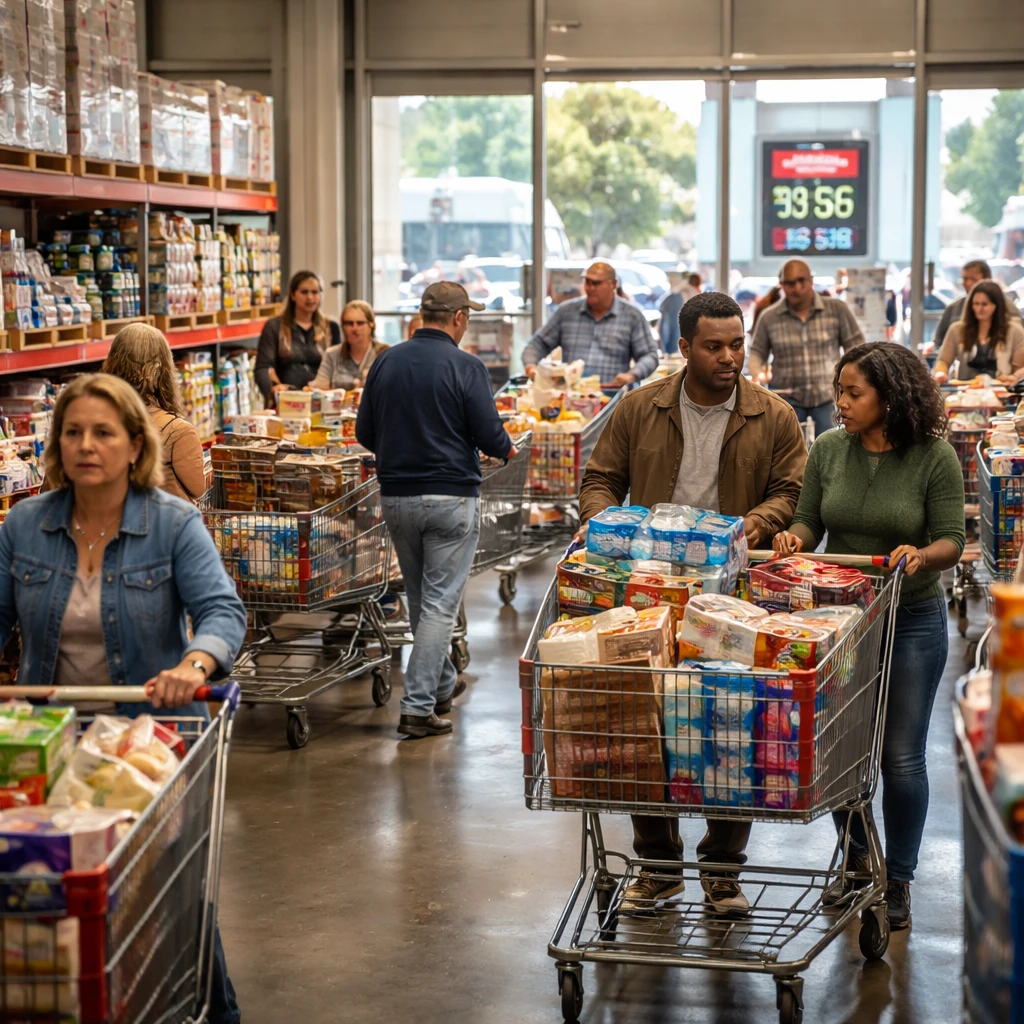
At the same time, dollar and membership formats are attracting a broader demographic. Several discount retailers report an increasing share of shoppers with household incomes above $100,000, a dynamic where consumers seeking value substitute into lower-priced channels. Membership clubs, notably Costco and Walmart’s Sam’s Club, are drawing traffic to fuel pumps and store aisles thanks to relatively lower fuel prices and everyday low-priced goods.
Consumer sentiment data for May reflected a modest weakening in confidence as concerns about inflation linked to the Middle East conflict and higher fuel costs offset improving labor market signals. Michael Gunther, CFA, senior vice president of Research & Market Intelligence at Consumer Edge, summarized the current state: "So far, consumers aren’t pulling back significantly, but they are clearly shifting behavior." He highlighted gas prices as a key variable, noting that sustained high prices through the summer and back-to-school season could put further pressure on discretionary categories.
Seasonality compounds the risk for apparel and department stores, which typically book a meaningful portion of annual sales in the second half of the year. Retailers generally capture roughly 50% to 60% of annual revenue in H2 - a window that includes summer back-to-school and the holiday selling season. Apparel players and department stores - such as Kohl’s and Macy’s - tend to sit near the upper end of that second-half concentration.
Analysts at Telsey Advisory Group flagged growing uncertainty around the long-term economic impact of the Iran conflict, asserting that expectations for consumer spending could moderate if the national average gasoline price remains above $4.00 per gallon. Market participants also warned that even were the conflict to end quickly, the existing damage to energy infrastructure and global supply chains could maintain higher prices into the latter half of the year.
Those dynamics show up in uneven earnings trajectories across retail categories. Despite broadly strong first-quarter results, the consumer discretionary sector’s earnings growth rate for S&P 500 constituents was projected to slow to about 5.2% for the second quarter of 2026, down from a 40.4% projection in the prior quarter, according to data compiled by LSEG.
Within apparel, the divergence is pronounced. Brands like Gap and American Eagle have faced softer demand among budget-constrained consumers and have suffered from missteps in key categories, including women’s wear, disappointing investors. Conversely, Abercrombie & Fitch, Bath & Body Works and Victoria’s Secret posted robust results, benefiting from fresh assortments and stronger full-price selling, which resonated with consumers pursuing affordable indulgences.
"Spending growth is positive, but cooling. People also are looking for cheap thrills, while necessities have gotten more expensive. Restaurants, beauty products, and personal care seem to be doing alright," said Brian Jacobsen, chief economic strategist at Annex Wealth Management.
Abercrombie’s chief executive Fran Horowitz emphasized resilience across customer cohorts, stating, "They (customers) keep showing up ... We’re not seeing any change in performance across cohorts." Walmart’s finance chief John Rainey struck a cautiously optimistic tone, observing that while there is no immediate cause for alarm, the pressure is uneven and warrants attention.
For investors and analysts assessing retail exposure, the evolving picture underscores a few durable themes without resolving the near-term trajectory. First, a K-shaped consumer recovery appears to be in place: higher-income households continue to spend on apparel, accessories and premium beauty, while lower-income households pare back. Second, fuel costs and travel-related expenditures operate as a flow-through on discretionary budgets, potentially amplifying seasonal softness if prices remain elevated. Third, membership and value formats are capturing incremental share from consumers repricing their purchases.
As this earnings season winds down, the pressure points are becoming clearer even if the overall topline strength persists. Retailers that have curated assortments to capture full-price demand and that offer perceived affordable luxuries are being rewarded, while those exposed to discretionary spending and merchandising execution risk are facing a tougher environment. The ultimate effect on the retail sector will depend on how long energy-related inflationary pressures persist and how consumers reallocate spending through the summer and into the holiday season.
Summary
Retail results indicate continued consumer activity but with distinct shifts toward essentials and value. Elevated gas prices tied to the Iran conflict are creating uneven pressure across income cohorts. Retailers dependent on discretionary spending face the most downside risk as the second half of the year, which typically concentrates a majority of annual sales, approaches.