
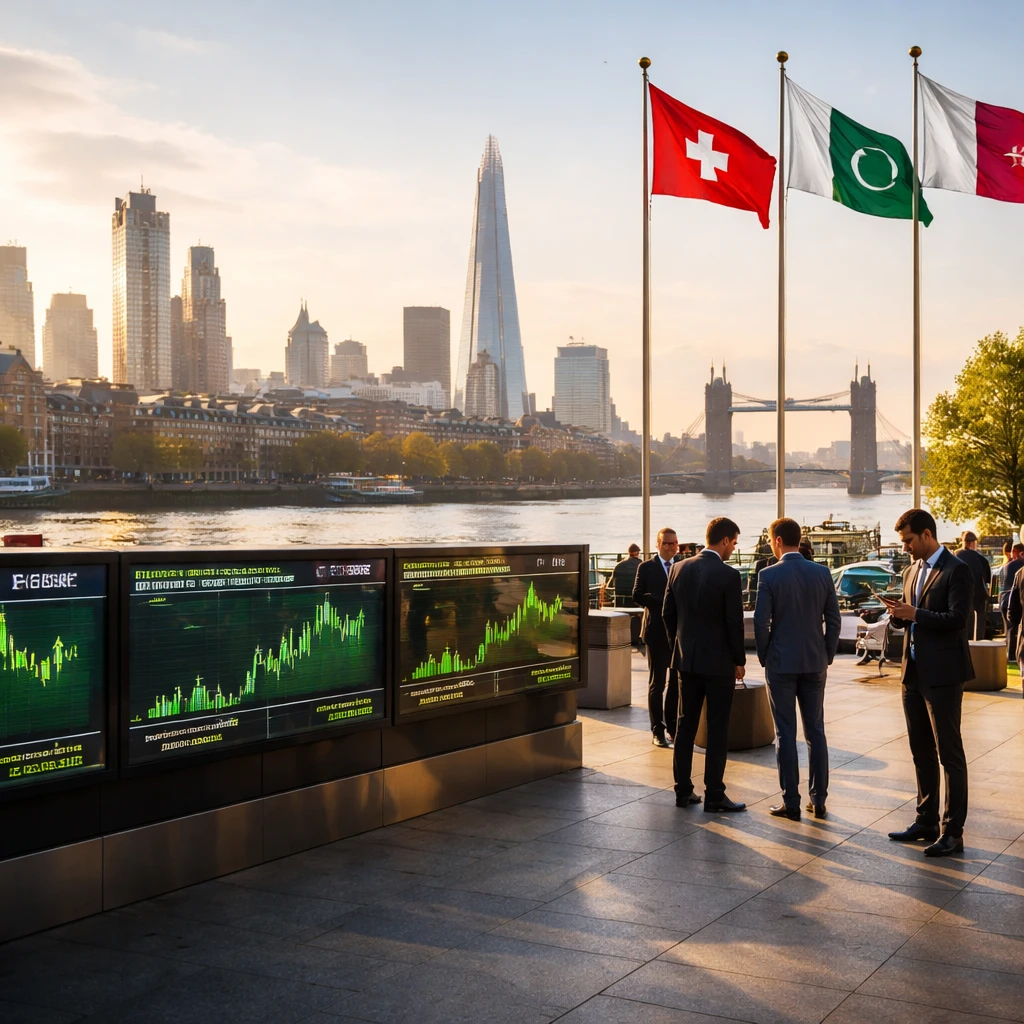
British stocks made modest gains on Tuesday as investors continued to assess the market implications of a recently agreed memorandum of understanding between the United States and Iran. With officials planning a formal signing ceremony in Geneva later this week, market participants remained cautiously optimistic, keeping moves in equities measured.
By 03:14 ET (07:14 GMT), the FTSE 100 had climbed 0.25%. Other major European indices also advanced: the DAX rose 0.23% and the CAC 40 increased 0.33%. Currency markets saw the pound slip 0.10% against the dollar to $1.3409.
Commodity prices moved lower amid indications that maritime traffic through the Strait of Hormuz is resuming. Brent crude fell 0.91% to $82.41 a barrel, while WTI crude dropped 0.74% to $80.15. Spot gold similarly eased, down 0.40% to $4,326.29 a troy ounce, reflecting reduced safe-haven demand.
Market attention centered on the U.S.-Iran framework, which was digitally signed by President Trump and Vice President Vance and is expected to be formally acknowledged in a coordinated ceremony in Geneva involving Switzerland, Pakistan and Qatar. The agreement ties sanctions relief and an economic reintegration pathway for Iran to verified cuts in enriched uranium stockpiles, acceptance of international inspections and limitations on support for regional militant groups.
Officials provided updates on implementation. President Trump said on Monday that vessels have already started transiting the Strait of Hormuz and that full clearance was anticipated by Friday. Vice President Vance stated that no funds have been released and dismissed various circulating monetary figures as misinformation.
Reactions from world leaders were mixed. French President Macron, speaking at the G7 meeting in Evian, described the deal as "a very important step towards peace and for the global economy." Israeli Prime Minister Netanyahu took a more cautious tone, insisting Iran must never be allowed to obtain nuclear weapons "with or without a deal." Iran’s Foreign Ministry said Lebanon remains included within the broader understanding, a point denied by Israeli officials.
In other international developments on the sidelines of the G7, the UK announced a £210 million UK Export Finance-backed arrangement to supply enriched uranium to Ukraine’s state nuclear operator Energoatom, intended to power the country’s nuclear plants for the next two years.
Separately, UK authorities are preparing another sanctions package that is expected to increase the number of shadow fleet and Russian LNG vessels sanctioned by the UK to more than 600. The UK has acted as an initial mover in imposing sanctions on several LNG vessels transporting sanctioned Russian cargo.
Domestic UK politics and infrastructure also factored into market sentiment. Environment minister Emma Reynolds raised concerns with Ofwat about a proposed £10 billion rescue plan for Thames Water, signaling that she views creditors’ proposals as "weak." Thames Water supplies 16 million customers and holds nearly £20 billion in debt, and could face nationalisation if a market-led resolution cannot be reached. Reynolds is scheduled to address Parliament on Tuesday.
The combined market reaction to the geopolitical agreement, shifting energy flows through the Strait of Hormuz, sanctions activity and domestic utility pressures produced modest gains for equity benchmarks while weighing on commodity prices, producing a cautious but not decisive market tone.