
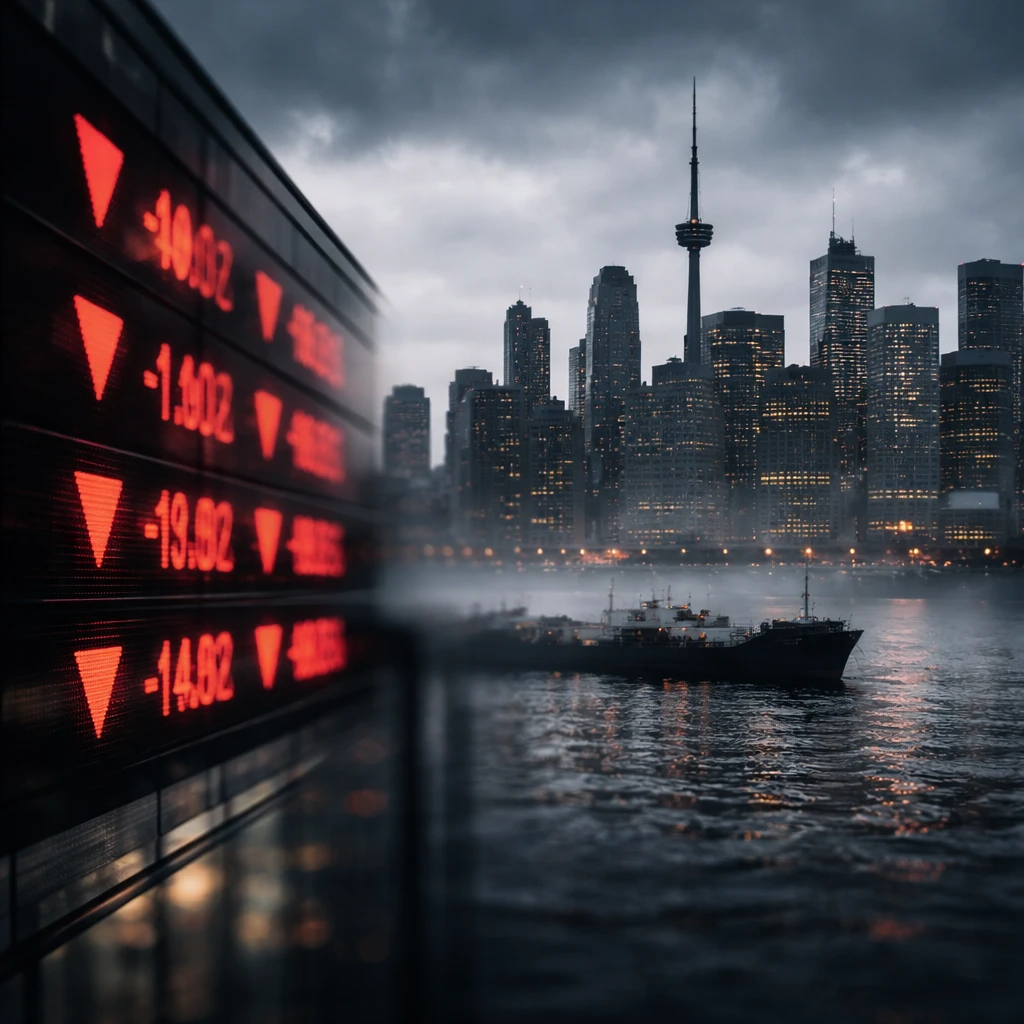
Canadian stock-index futures were trading weaker on Tuesday morning as heightened military activity in the Middle East and fresh hints of tighter U.S. policy prompted investors to pare back exposure to risk assets ahead of a key U.S. inflation report.
Contracts on the S&P/TSX 60 were down about 0.3% in early action, indicating a softer open for the Toronto exchange, which is heavily weighted toward resource companies.
The move downward followed a negative cash session on Monday, when the S&P/TSX Composite retreated roughly 0.15% amid notable weakness in materials, consumer discretionary and financials sectors.
Global energy developments are exerting strong influence on Canada’s equity landscape. International crude benchmarks surged, with Brent trading close to one-month highs, and domestic oil-related stocks felt that impact. The immediate driver was a U.S. decision to reimpose a full naval shipping blockade against Iran and to levy a mandatory 20% cargo fee on commercial vessels passing through the Strait of Hormuz - actions that pushed global oil prices noticeably higher.
While higher energy costs typically benefit companies in the TSX’s energy segment, the broader market sensitivity to a potential localized shipping crisis - amplified by a third consecutive night of strikes in the Gulf region - has increased macroeconomic unease among investors.
Precious metals displayed contrasting behavior within the commodity complex. Gold futures slipped sharply overnight toward the $4,006 level, prompting selling pressure on major domestic miners and adding to the materials sector’s volatility.
Toronto’s short-term path will also be shaped by developments in Washington. Markets entered a defensive posture ahead of the U.S. Consumer Price Index (CPI) release, a data point that will be parsed closely for signs of persistent inflationary pressure.
The inflation print arrives against a backdrop of central bank hawkishness. Fed Governor Christopher Waller warned that sticky price measures could prompt near-term rate increases. Over the coming two days, newly appointed Fed Chair Kevin Warsh is scheduled to present his semi-annual monetary policy report to Congress, a sequence of events that could further influence market expectations.
Given the strong trade relationship between Canada and the United States, any evident hawkish shift from the Federal Reserve would likely place additional downward pressure on rate-sensitive segments of the TSX, notably financials and real estate, which are vulnerable to higher interest-rate assumptions.
Market context - summary
- TSX futures slipped in early trade as geopolitical tensions and hawkish Fed signals pushed investors out of risk assets.
- Brent crude near one-month highs supported the energy complex, while a sharp fall in gold dragged on miners.
- Upcoming U.S. CPI data and testimony from the new Fed chair are set to be market focal points for Toronto-listed sectors tied to rates and commodities.