
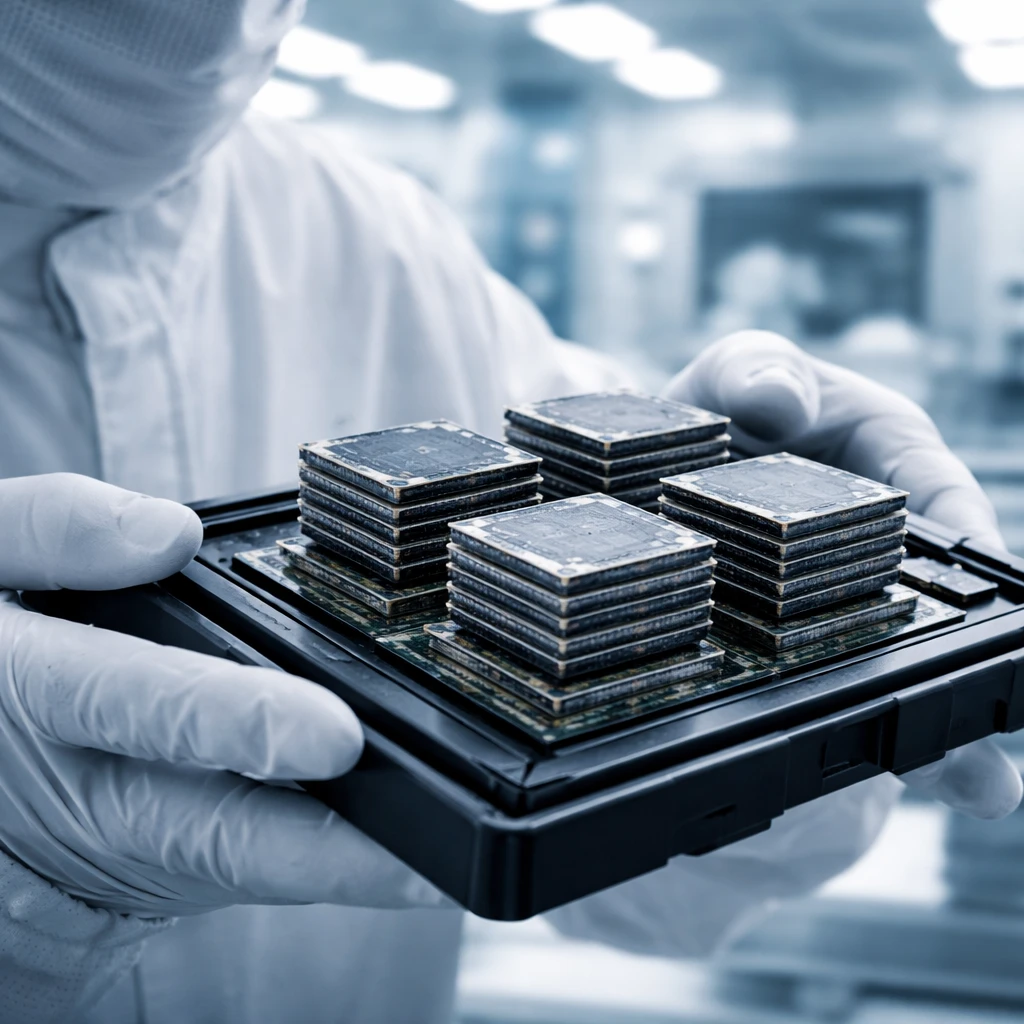
SK Hynix is exploring the possibility of using Intel Foundry to manufacture base dies for its HBM4E products, according to reporting in Korea's Herald Economy. This is a consideration in progress rather than a concluded agreement. On the surface, the potential loss of base die orders would not materially dent Taiwan Semiconductor Manufacturing Co.'s (TSMC) revenue. However, the strategic implications around vendor optionality and future packaging relationships are meaningful and deserve attention.
The revenue lens understates the issue
TSMC is a large-cap foundry, cited at a market capitalization of $1.95 trillion. HBM base dies are an expensive input relative to core DRAM dies - industry estimates put the cost at roughly 3-4 times that of the DRAM core die. Even so, base dies remain only a small fraction of TSMC's overall sales. A loss of SK Hynix's HBM4E base die volumes to Intel Foundry would not move TSMC's top line in any significant way.
But treating the matter purely as a short-term revenue issue misses the larger strategic question: whether memory manufacturers establish precedent for alternate advanced-logic foundries and thereby expand their sourcing options.
Why SK Hynix is looking for alternatives
The economic drivers are straightforward. The 12nm-class process used for HBM base dies carries a cost premium - commonly cited at 3-4 times the cost of the core DRAM die. For memory manufacturers scaling HBM4E production to supply customers like NVIDIA's Rubin Ultra, those input costs matter. SK Hynix shipped 12-layer HBM4E samples to major customers in June, and NVIDIA has committed $279 billion in multi-year memory purchases. When procurement commitments reach that magnitude, even modest differences in base die cost become economically significant.
Intel Foundry may be able to offer a lower-cost alternative on an established node that does not command the price power of TSMC's most advanced logic processes. From a supply-chain perspective, dual-sourcing is a basic risk-management tactic. SK Hynix's past HBM4 shipment delays, which opened the door for Samsung to gain market share, are part of the context for seeking contingency options.
Potential implications for TSMC
There are three channels through which this development could matter to TSMC beyond immediate revenue loss:
- The wedge effect - If Intel can deliver base dies at acceptable yield and cost for SK Hynix, Samsung and Micron may examine the same approach. An initial customer could become multiple customers evaluating the same alternative.
- Advanced packaging migration - Base dies can serve as an entry point. Relationships formed around base dies might extend into next-generation hybrid bonding and other advanced packaging work, an area where TSMC earns higher margins.
- Pricing leverage - Even without a full volume shift, the existence of a credible alternative provides memory makers with negotiating leverage when discussing future pricing with TSMC.
Why TSMC is not yet at risk
Several factors limit the immediacy of any threat. The Herald Economy described the Intel relationship as a plan under consideration, not a completed switch. Intel Foundry would need to demonstrate consistent volume manufacturing and yield at the nodes required by memory makers. Meanwhile, TSMC maintains a dominant position in the most advanced logic nodes - including the leading-edge processes that customers such as NVIDIA, Apple and AMD rely on - leaving few alternatives for the logic dies that drive AI accelerator performance.
TSMC shares declined 1.7% to NT$2,380 on the day the report emerged (August 31). That move occurred against a wider Asia technology sector selloff tied to hawkish signals from the U.S. Federal Reserve rather than being a TSMC-specific valuation reset.
Bottom line
The development is best viewed as a strategic nibble rather than an existential threat. Intel winning base die work for HBM4E would represent an important validation for Intel Foundry and a modest diversification success for SK Hynix. For TSMC, the episode is a reminder that even long-term customers hedge sourcing - but TSMC's competitive moat in advanced logic remains intact for now.