
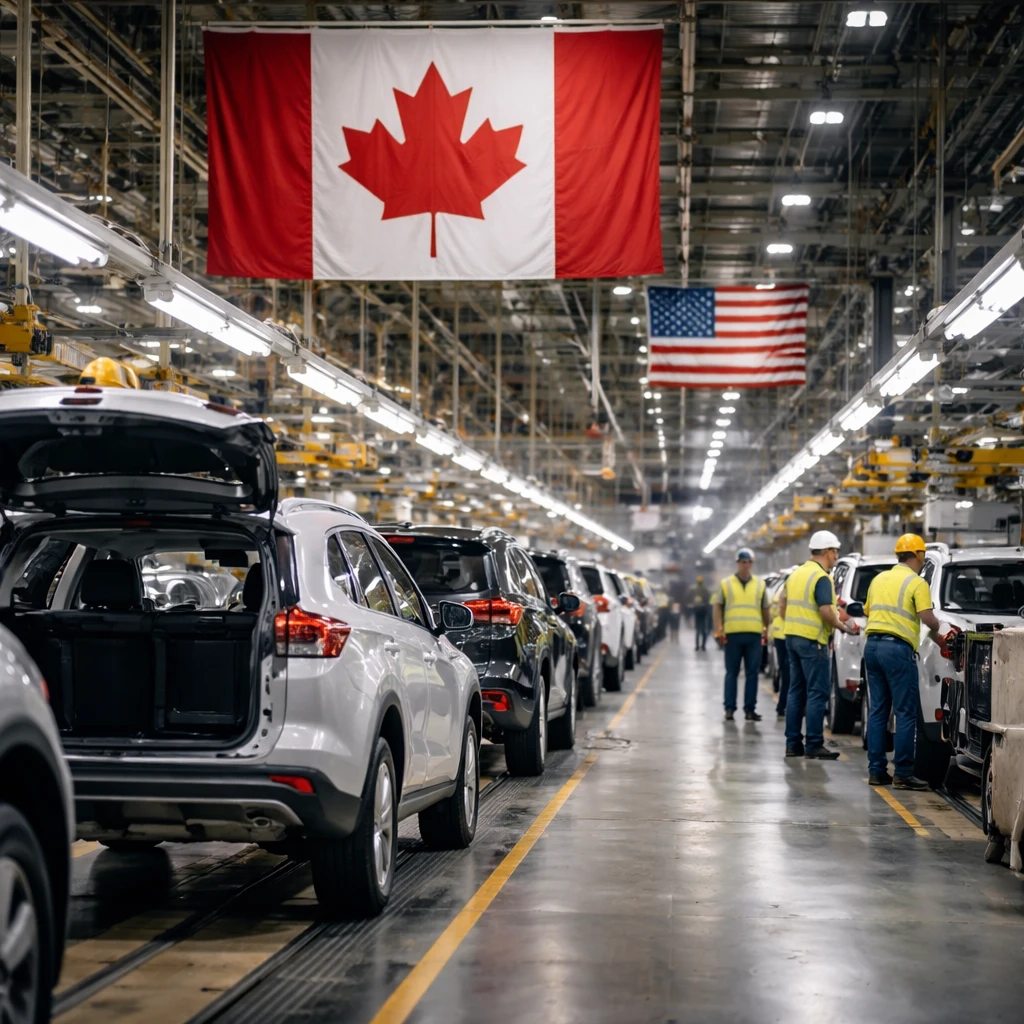
U.S. President Donald Trump has proposed a 50% tariff on cars imported from Canada, a move that risks leaving Toyota and Honda to shoulder a disproportionate portion of the economic pain if implemented. The two Japanese manufacturers make up more than three-quarters of car production in Canada and could be compelled to close assembly lines should the higher duty take effect on January 1 as proposed, analysts said.
While negotiations or a deal remain possible, the timing of the tariff proposal is particularly difficult for Japan's automakers. They are facing intensifying competition from lower-cost Chinese electric vehicle makers in markets including Southeast Asia, Europe and Latin America. The United States, however, remains Toyota and Honda's single largest market, and it is a territory where many Chinese competitors, such as BYD, currently do not operate.
Barclays analysts estimated that Canadian-built production accounted for almost a quarter of Honda's U.S. sales last year and 17% of Toyota's U.S. sales, the largest share among major automakers. Those proportions make Toyota and Honda the most exposed to a plan that would raise the duty from the current 25% to 50%.
"If you really wanted to destroy the Canadian auto industry, you could with these tariffs," said Julie Boote, an autos analyst at Pelham Smithers Associates in London. Boote added that both Toyota and Honda would likely have to shut some Canadian assembly lines under the proposed regime. Toyota and Honda declined to comment.
Canada's auto sector produces roughly 1.2 million vehicles annually and indirectly supports about 427,000 jobs. Key models exported from Canadian plants to the United States include Toyota's RAV4 and Honda's CR-V, both among the top-selling sport utility vehicles in the U.S. market. The concentration of those popular models in Canadian output helps explain why the tariff proposal has stirred particular concern among Japanese automakers.
The prospective tariff is the latest example of trade policy that has forced the global auto industry to reassess production and supply chain strategies. For decades, automakers and their suppliers from the United States, Europe, Japan and South Korea established manufacturing footprints across North America to take advantage of cross-border trade agreements and, especially in Mexico, lower labour costs. That calculus has been altered as tariffs and other policy moves change the cost environment.
U.S. tariffs have already had a measurable impact on Japanese manufacturers. Toyota recorded tariff-related costs of about 1.4 trillion yen, equivalent to $8.8 billion, in the last financial year. In response, Toyota has committed to boosting production in the United States. The automaker said last year it plans to invest up to $10 billion over five years to expand its U.S. operations, including building a new $3.6 billion vehicle plant in Texas where it intends to relocate Tacoma pick-up production from Baja California in Mexico.
Honda, which is working to turn around a car business that has been losing money, has found tariffs to be an added strain. A senior Honda executive told reporters recently that the company might pause plans for an eighth assembly plant in North America unless the USMCA free trade talks among the United States, Canada and Mexico are extended. USMCA, the revised successor to the 1994 NAFTA trade agreement, has been in place for six years. The U.S. decision on July 1 not to renew it has subjected the pact to annual review, even as discussions have continued.
Last year, Hyundai said uncertainty around USMCA was delaying its own investment decisions.
Analysts say that if the tariff were imposed, Toyota and Honda would seek to redirect Canadian-made vehicles to other international destinations and attempt to find alternative ways to supply the U.S. market. That would be complicated by the fact that U.S.-bound cars are often configured to meet specific market needs and regulations, and that other factories may already be operating at or near capacity.
"It would represent a major shift from the past," said Seiji Sugiura, a senior analyst at Tokai Tokyo Intelligence Laboratory.
A pair of Japanese suppliers interviewed for this story said they remain uncertain about the path forward. With the implementation of the tariffs still unclear, planning is difficult. "We're trying not to overreact," one supplier executive said.
At the current exchange rate used in reporting, $1 equals 160.0800 yen.