
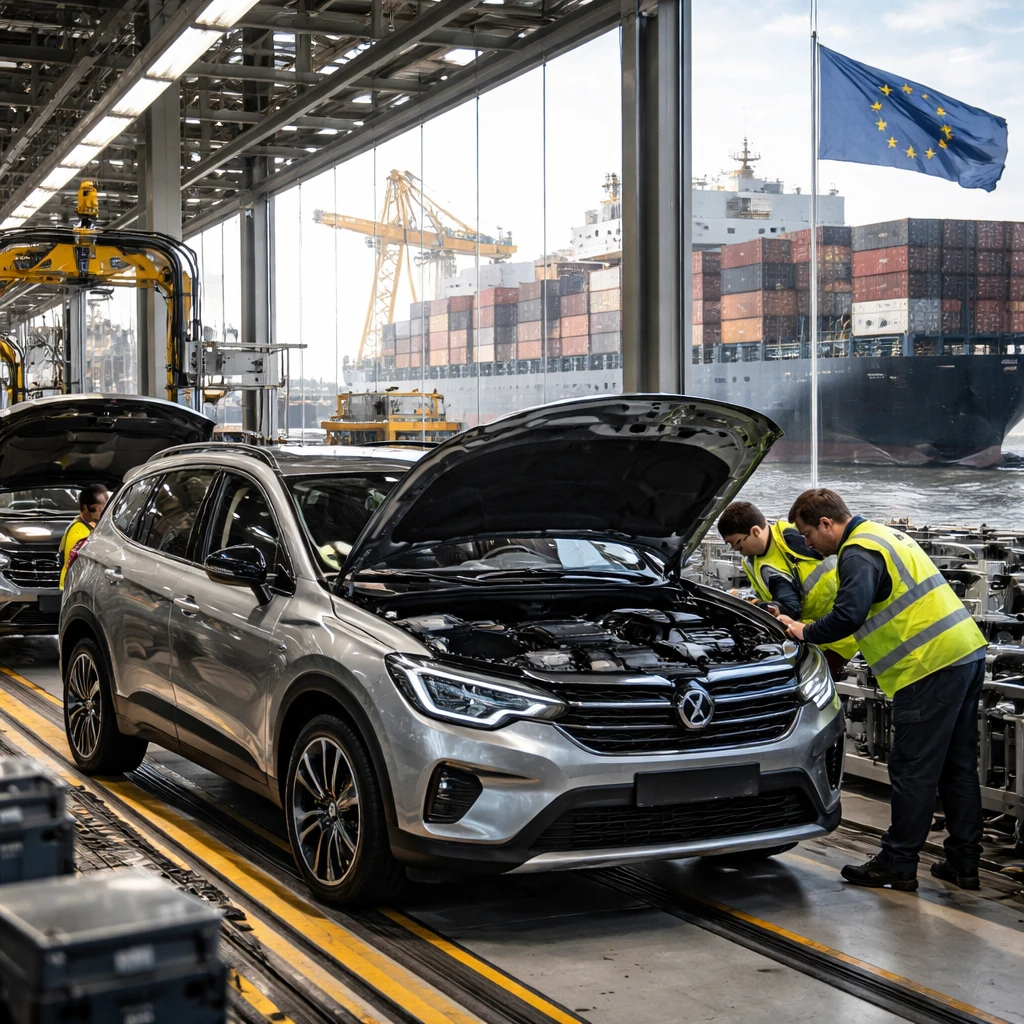
Renault shares rose sharply on the day the European Commission unveiled provisional safeguard measures limiting hybrid-vehicle imports into the EU. The stock advanced nearly 4.9% to close at €28.08 after regulators said they would cap hybrid shipments from major exporting countries - including China, Japan, the UK and the US - under country-specific quotas effective from December 1, 2026 through June 18, 2027.
European officials said the safeguard was prompted by a marked increase in hybrid imports, which had climbed by almost 50% in the year to June 2026 compared with 2023 levels. Investigators also found that those imported hybrids were selling at about an 18% discount to European-made equivalents, a gap that regulators indicated was putting pressure on domestic producers.
Market analysts said Renault appeared to be a primary beneficiary of the new trade barrier. Citi Research argued that Renault stands to gain more than other EU carmakers because of several structural factors: a higher share of revenue generated in Europe, lower average selling prices across its range, and an extensive manufacturing footprint in France. Those attributes, Citi said, made Renault especially exposed to competitive pressure from lower-priced imports, particularly from Chinese automakers.
Offsetting some of the positive sentiment, JPMorgan issued a same-day rating change on Renault, lowering its recommendation from Overweight to Neutral and trimming its price target from €45 to €35. The bank cited a reduction in Dacia's share of group deliveries and said it was cutting earnings forecasts through 2028 by around 8% to account for higher costs and spending to defend market share.
The EU action lifted the wider European auto sector as well. Major peers including Volkswagen and Stellantis also posted meaningful gains in the session, indicating a sector-wide response to the policy development. The strength in European autos contrasted with weakness across major U.S. equity benchmarks, where the S&P 500 fell 1.7% and the Nasdaq Composite declined 2.6% on the same trading day.
Taken together, the EU's provisional quotas provided a direct policy catalyst that outweighed both the negative analyst move and a soft global market backdrop. The combination drove Renault to its best single-session performance in recent weeks and pushed the share price back above its 50-day moving average.
Key points
- EU provisional safeguards cap hybrid imports from major exporters from Dec. 1, 2026 to June 18, 2027, with country-specific quotas applying.
- Citi Research identifies Renault as the most positively impacted EU carmaker due to its European revenue mix, lower average selling prices, and large French manufacturing base.
- The move buoyed the wider European auto sector even as U.S. indices weakened, underlining a policy-driven regional reaction.
Risks and uncertainties
- Analyst downgrades and reduced earnings estimates - exemplified by JPMorgan's cut to Neutral and a lower price target - could constrain upside even after the policy announcement.
- Higher costs and increased spending to defend market share, particularly for Dacia, may weigh on group profitability through 2028.
- Broader market weakness, such as declines in major U.S. indices, could offset some of the positive impact from the EU's trade measures on investor sentiment.