
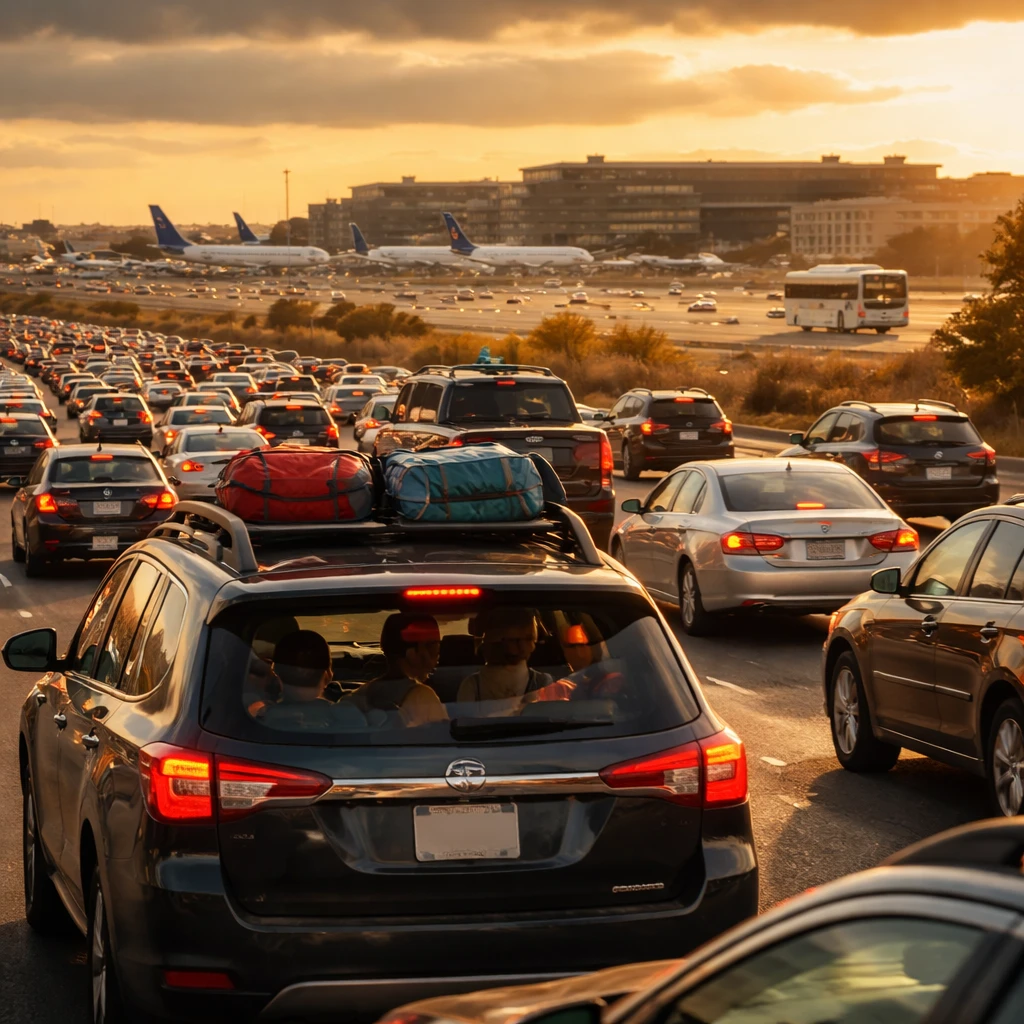
Rising prices and a spate of aviation-system failures have reshaped how many Americans are reaching holiday destinations this year. For some travelers, sticker shock at the ticket counter was only the beginning; a communication outage at the Federal Aviation Administration (FAA) and separate airline technology problems in mid-November compelled others to abandon flights entirely.
Dinese Jackson, a 51-year-old credit analyst, said she could not justify roughly $1,500 to fly herself and her two children from Raleigh, North Carolina, to Dallas, Texas - a fare more than double what she had paid for comparable trips in the past. She continued to monitor prices in hopes of a drop, but after the FAA imposed a nationwide ground stop on November 13, she finalized a different choice.
"When that happened on Friday, I was like, 'Yep, I'm keeping my car reservation. I'm going to go ahead and drive for sure,'" Jackson said. She is prepared to spend roughly 17 hours behind the wheel rather than risk a chaotic airport experience.
System failures and cascading delays
A router outage on November 13 caused communications failures across air traffic control centers and triggered a nearly five-hour nationwide halt that affected more than 18,000 flights and about 1 million passengers. In the days that followed, travelers faced further operational setbacks: United Airlines experienced a widespread technology outage, and Delta Air Lines' automated weight-and-balance system malfunctioned, delaying more than 2,000 flights nationwide. The cluster of incidents heightened unease about flying as the busiest holiday travel period approaches.
FAA Administrator Bryan Bedford said last week the agency was "very close" to being able to disclose the root cause of the router outage. The FAA has not provided a precise timeline for a further update. On November 17, the agency announced it had immediately paused deployment of additional routers.
Some passengers expressed concern about future upgrades. Retiree Liz Dougherty, 63, who expects to fly from North Carolina to Spain to board a holiday cruise, said the November 13 ground stop remained "definitely in the back of my mind" and that she hoped the government would avoid further upgrades while travelers are in transit.
Costs push some travelers off planes
Airfares for the Thanksgiving travel window are at their highest level in a decade, contributing to decisions by some Americans to cancel flights or opt not to travel. Two weeks before Thanksgiving, domestic airfares for the holiday period averaged about $469 in 2026, a roughly 57% increase from the previous year, according to data from travel search engine Kayak.
Travel booking app Hopper attributed part of the increase to months of elevated jet fuel costs linked to the conflict in Iran, saying those higher fuel prices helped push Thanksgiving and Christmas fares to 10-year highs.
Despite higher prices, U.S. carriers are operating more flights than a year ago. United Airlines said it expects to carry more than 6.6 million customers over a 12-day period, on par with last year. American Airlines said it plans to welcome 8 million travelers in the same period and intends to operate 4% more flights than in 2025. Industry analytics firm Cirium reported U.S. airlines are operating 2% more flights on average this Thanksgiving than last year, with seat capacity up 1%.
Shifts to other modes of transport and demand effects
With fares elevated and reliability concerns rising, a notable share of Americans have chosen alternative travel modes. The Transportation Security Administration (TSA) has seen fewer travelers this year compared with 2025: the last day it screened more than 3 million passengers was November 30, 2025, and it has not reached that level on any day in 2026, compared with eight such days in 2025. The agency expects to screen about 3% fewer passengers during the Thanksgiving holiday window year-on-year.
AAA estimates about 81.5 million Americans will travel at least 50 miles over a six-day period around Thanksgiving, a figure down marginally from last year’s 81.6 million. Still, other segments of the travel market are seeing gains as passengers seek alternatives to congested airports.
Bus and ticket search engine Wanderu reported that the ground stop produced its busiest day of the year so far, with bookings made that Friday up about 16% from the prior year. Bus operator Flix North America said Thanksgiving bookings were up 17% from last year. Amtrak also anticipates another record year in 2026 after logging 1.2 million customer trips during last year’s Thanksgiving holiday.
Personal stories illustrate the trend. Jennifer Shaw, 57, said her son chose to forgo a non-refundable airline ticket from college in Michigan in favor of a 10-hour drive to Monmouth County, New Jersey, with friends to avoid the risk of getting stranded during holiday travel disruptions.
Overall demand and airline projections
Industry projections indicate slightly softer air travel demand this season. Airlines for America forecast nearly 29 million passengers will travel by air between November 20 and 30, down from last year’s forecast of 31 million passengers. The combination of higher fares and recent operational disruptions appears to be shifting some demand away from air travel to other forms of transportation, while carriers still plan to increase flight counts modestly.
These dynamics - elevated ticket prices, recent technical failures, and modest increases in flight schedules - are shaping travel choices for millions during a concentrated holiday period. For some, that means longer drives, for others it may mean choosing buses, trains, or cruises over planes, and for airlines it means managing load factors and customer expectations amid tighter unit economics for holiday travel.
Summary
Record-high Thanksgiving airfares and a string of aviation technology failures, including a nationwide FAA ground stop and airline system outages, have persuaded some travelers to drive or shift to buses, trains and cruises. Airlines will operate slightly more flights this year, but passenger counts and TSA screenings are lower than last year’s peaks.
Key points
- FAA router outage on November 13 and subsequent airline system failures disrupted thousands of flights and undermined passenger confidence.
- Thanksgiving airfares averaged about $469 in 2026, roughly 57% higher than a year earlier, contributing to some travelers' decisions to avoid flying.
- Alternative travel channels - buses, trains and cruises - reported higher bookings; airlines plan modest capacity increases despite softer passenger screening volumes compared with 2025.
Risks and uncertainties
- Unresolved technical and infrastructure vulnerabilities at the FAA and airlines could trigger further disruptions during peak travel periods, affecting carriers and travel-dependent businesses.
- Persistently elevated jet fuel costs tied to geopolitical factors could keep holiday fares at elevated levels, weighing on airline unit economics and consumer travel decisions.
- Weather or additional operational failures during the holiday week could further reduce passenger throughput or shift demand to other transport sectors.