
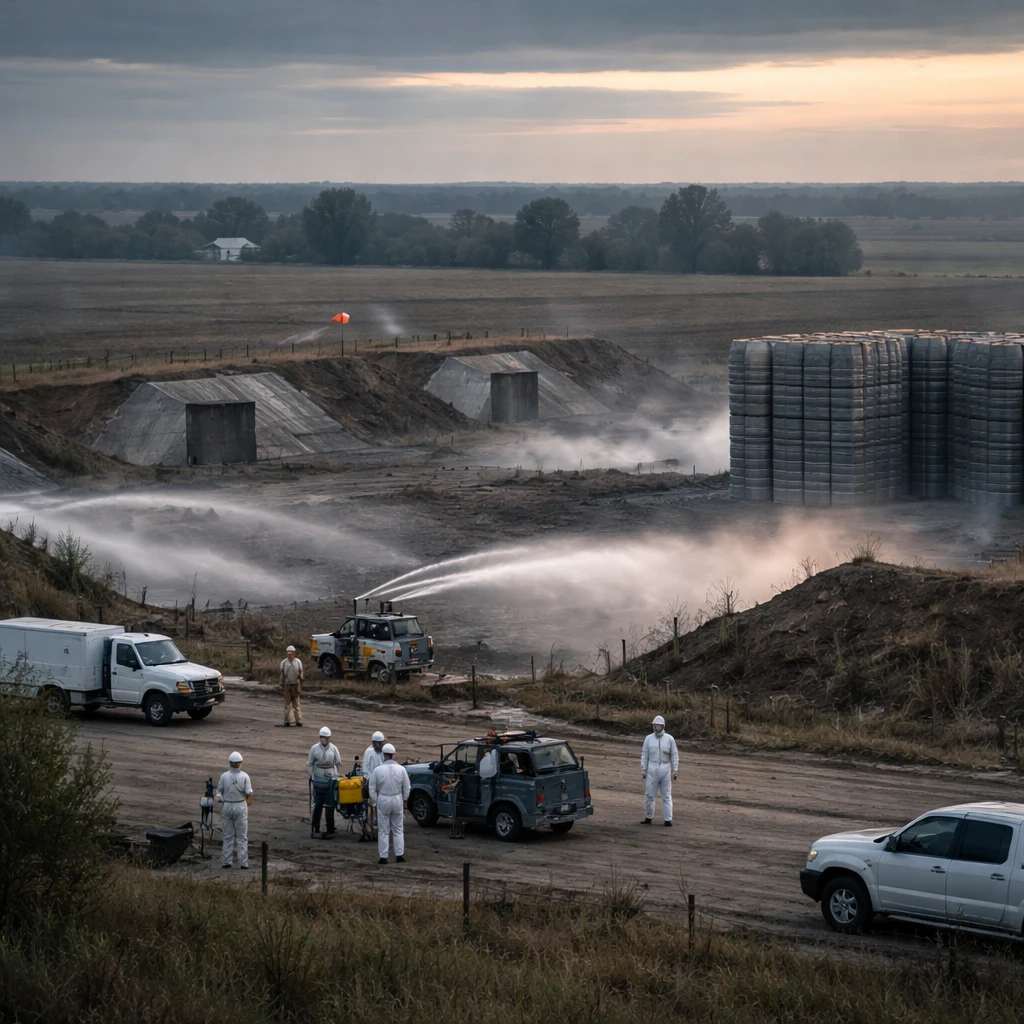
Residents of Middletown, Iowa and surrounding communities readied themselves for a scheduled disposal operation at the Iowa Army Ammunition Plant - a planned detonation intended to eliminate an aging stockpile of lead-based explosive material. The Army announced the operation would begin at 9 a.m. Central time (1500 GMT) to detonate nearly 5 tons (4,500 kg) of degraded lead azide stored in 68 failing plastic drums.
Officials said the open-air blast was chosen to avoid the far riskier prospect of the chemical drums blowing up on their own. Over recent days, the proposed plan sparked public outcry and legal challenges as officials worked to communicate safety measures and to deploy mitigation systems intended to limit the spread of lead particulates.
Public safety measures and monitoring
Federal, state and local authorities spent the day prior to the detonation notifying residents nearest the plant about evacuation protocols and reinforcing a suite of steps intended to limit exposure from the plume of lead dust expected to be generated by the blast. Officials released maps that modeled how the plume might travel, adjusting those projections based on changing weather forecasts, and collected hundreds of air, soil and water samples to compare with post-detonation testing.
Acting Army Secretary Adam Telle emphasized public safety at a news briefing, saying, "Our No. 1 priority here in Iowa today is the health and safety of the citizens of this region." He added, "We don’t believe that the public should be in a panic. We are very calm about this."
Why a controlled detonation was selected
Experts from the Army, the US Environmental Protection Agency, the Bureau of Alcohol, Tobacco, Firearms and Explosives and other agencies said they had reached a consensus that a "controlled, mitigated detonation" constituted the safest available disposal approach. Their rationale, as explained by officials, was that the lead azide had become increasingly unstable - with colder temperatures accelerating the risk of an unplanned explosion - and that alternative options, such as chemical neutralization or relocating the drums, could themselves trigger an uncontrolled blast.
In describing the containment strategy, officials detailed an array of engineered barriers and systems intended to limit the dispersal of lead particulates. Earthen berms had been constructed surrounding the two subsurface concrete bunkers where the material was stored. Two towering walls stacked with tanks of water were positioned for release onto the blast area, and a misting system was installed to dampen adjacent terrain. Engineers also set up a mechanism to flood the blast site with aqueous foam designed to capture dust created by the explosion.
About the stockpile and historical context
Lead azide, long used as a primary detonator in military ordnance, was deemed largely obsolete years ago. The Army consolidated unused stockpiles to the Iowa facility in 2009. During an inspection in March, officials observed crystallization of the storage drums and their contents - a sign the material had become dangerously unstable and prompted deliberations over disposal.
Army Colonel Aaron Teller, a munitions specialist, referenced a prior open-air disposal of lead azide: an event in Colorado in 1977 that detonated 7,000 pounds of the compound with what he described as "zero mitigation." That incident, he said, left about 75% of lead particulate at the incident site. Teller noted the mitigation strategy in Iowa is intended to improve on that outcome, saying, "We believe we can reduce that last 25% with the mitigation strategy that we have in place."
Officials highlighted lead's health risks: exposure can cause a range of ailments, particularly harming children's cognitive development, and once deposited in the environment lead does not break down.
Evacuations, advisories and projected plume reach
Federal Emergency Management Agency guidance called for evacuation of residents within 5 miles (8 km) of the blast site, while those living between 5 and 20 miles were advised to remain indoors with windows closed to limit exposure to airborne lead dust. Army projection maps released in advance indicated that lead could settle on surfaces as far as 40 miles southwest of the detonation site, extending through southeastern Iowa and into northern Missouri. The Army also projected that airborne particles could travel nearly 100 miles within eight hours under certain conditions.
To keep the public updated, the Army said it would publish updated projection maps hourly, beginning six hours before the scheduled explosion. Despite those communications, some residents reported confusion and frustration over shifting guidance regarding the timing of the blast and the anticipated route of the plume.
Local agriculture and economic concerns
Farmers and ranchers expressed concern about protecting crops and livestock from potential contamination. US and Iowa agriculture officials estimated roughly 350 farms could be affected by lead fallout based on the projected plume direction. The uncertainty over where particulates might settle heightened worries about food safety, animal health and the economic implications for local agricultural producers.
Officials collected baseline environmental samples before the detonation to enable comparison with post-detonation sampling intended to assess the degree and distribution of any lead contamination.
Information gaps and community response
While the Army and partnering agencies described extensive mitigation measures and continuous monitoring, community members voiced apprehension about short- and long-term implications for health and livelihoods. Officials acknowledged the public's concerns and repeatedly framed the operation as carefully planned to prioritize safety. Still, the shifting guidance and the unusual nature of an open-air detonation of this material contributed to local unease.
In summary, authorities proceeded with a planned, controlled explosion to remove a deteriorating stockpile of lead azide, citing the greater danger of an accidental detonation if no action was taken. The operation was accompanied by evacuation plans, environmental monitoring, and multiple containment systems aimed at reducing the dispersal of toxic dust. Residents, farmers and local officials awaited post-detonation sampling to determine what, if any, contamination had occurred and how far fallout might have reached.