
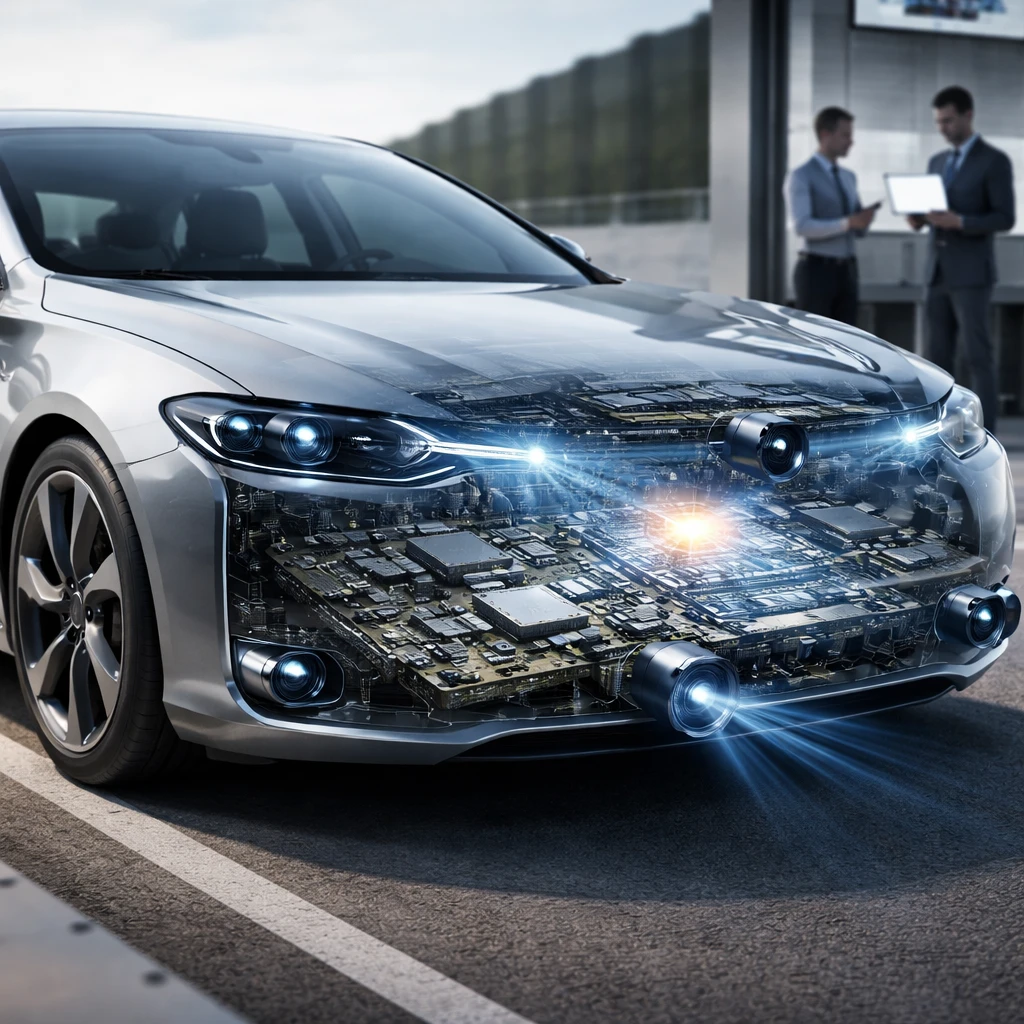
NXP Semiconductors appears to be targeting a narrowly defined strategic shortfall with reported interest in Ambarella: NXP is strong in the infrastructure that powers modern vehicles, while Ambarella supplies the specialized edge AI vision processors that let cars interpret camera data. The fit being discussed is essentially a chassis-level supplier acquiring a firm that builds the vision ‘‘brains’’ for camera-based ADAS and domain controllers.
Market snapshots cited with the discussions show NXP Semiconductors (NXPI) trading at $220.93, down 3.59% on the day and down 17.47% for the week, with a market capitalization of $55.7 billion. Ambarella (AMBA) was quoted at $83.89, down 2.45% on the day but up 22.97% for the week on deal speculation, and a market capitalization of $3.69 billion. The symmetry of the potential transaction is underscored by the scale of NXP’s automotive business, which already represents roughly half of its projected $15.1 billion in 2026 revenue.
Where NXP is broadly established across radar, V2X communication, secure microcontrollers and electrification management, it has lacked a best-in-class on-chip vision processing capability. Ambarella’s CV-series chips are purpose-designed, low-power systems-on-chip for camera-centric vehicle perception. The CV family named in the reports includes 5nm CV72 and CV75 devices, with a 4nm CV7 slated to enter production by the end of fiscal 2027 and a 2nm CV8 expected by the first half of fiscal 2028. These product nodes are positioned explicitly for camera-based ADAS and autonomous vehicle domain controllers, creating a vertical complement rather than overlap with NXP’s existing automotive silicon lineup.
Ambarella’s recent financial disclosures show rapid expansion in its edge AI business. One statement in the coverage notes that Ambarella’s Edge AI revenue surged 50% in fiscal 2026 and now comprises 80% of total sales. Elsewhere in the same coverage Ambarella is described as reporting record fiscal 2026 revenue growth of 37%, with Edge AI climbing to 80% of sales. Stifel had maintained a Buy rating with a $106 price target prior to deal rumors, a detail cited as context for valuations discussed around the possible transaction.
Further commercial validation of Ambarella’s platform includes a reported $800 million, 10-year commitment from Hanwha Group for AI SoC platforms. The coverage frames that contract as evidence of an enterprise-grade customer anchor that NXP’s B2B distribution strength could accelerate. Reporters also highlighted that each new Ambarella chip generation commands average selling prices above the current approximately $15 blended level, suggesting margin expansion linked to product cycles rather than only cyclical factors.
The semiconductor sector is described as being in a consolidation phase. The reporting points to an earlier agreement for Microchip Technology to acquire edge AI firm Hailo and mentions that an Oppenheimer analyst increased a price target on NXP to $325 in the prior week, citing a broad-based cyclical uptrend. From a deal sizing perspective, Ambarella at about $3.3 billion is characterized as approximately 6% of NXP’s market capitalization, which positions it as an accretive, manageable bolt-on rather than a transformational takeover.
Despite the strategic clarity of the match-up, market reaction and several operational variables temper enthusiasm. NXP shares fell on the day the reports circulated, with the weekly decline noted above, a movement that the coverage interprets as investor caution around deal discipline and integration risk. Ambarella itself is described as not yet profitable at scale, and its roadmap through CV7 and CV8 introduces execution risk tied to advanced-node production and timing. The reporting also allows for the possibility of competing bidders surfacing, which could increase purchase price pressure. Crucially, the discussions are reported rather than finalized, leaving open the possibility that talks could end without a transaction.
Summing up the strategic rationale, the reporting frames NXP as seeking to own a broader slice of the vehicle perception-to-decision stack by folding Ambarella’s edge AI vision capabilities into its automotive distribution moat. The automotive perception market is characterized in the coverage as a multi-decade growth opportunity measured in the tens of billions by the end of this decade, and the proposed deal is presented as a means for NXP to control sensor-to-silicon integration and associated software value capture.
Key points
- NXP’s automotive business is roughly 50% of its projected $15.1 billion in 2026 revenue, and Ambarella provides low-power edge AI vision SoCs that would fill a capability gap.
- Ambarella’s Edge AI revenue is cited as having surged 50% in FY2026 and Ambarella reported overall FY2026 revenue growth of 37%, with Edge AI representing 80% of sales; Stifel had a Buy with a $106 target prior to deal rumors.
- Commercial traction includes an $800 million, 10-year Hanwha deal and a roadmap of chips (5nm CV72/CV75, 4nm CV7, 2nm CV8) that could lift average selling prices above the current ~ $15 blended level.
Risks and uncertainties
- Integration and execution risk: Ambarella’s CV7 and CV8 roadmap involves advanced-node execution risk that could affect timing and margins.
- Market and deal risk: NXP shares dropped on the news, reflecting investor concerns about deal discipline; talks are reported and not confirmed, and competing bidders could drive up price.
- Profitability and scale: Ambarella is noted as still not profitable at scale, which creates uncertainty about near-term contribution to NXP’s earnings.
Bottom line
The reported interest by NXP in Ambarella is presented as a tightly focused strategic maneuver: not for Ambarella’s current stand-alone scale, but for the future value of its edge AI vision portfolio when combined with NXP’s automotive reach. While the business rationales cited in the coverage point to structural margin opportunity and an enlarged role in vehicle perception, investor reaction, roadmap execution and the non-final status of talks leave material uncertainty about whether and how this reported tie-up would be completed and realized.