
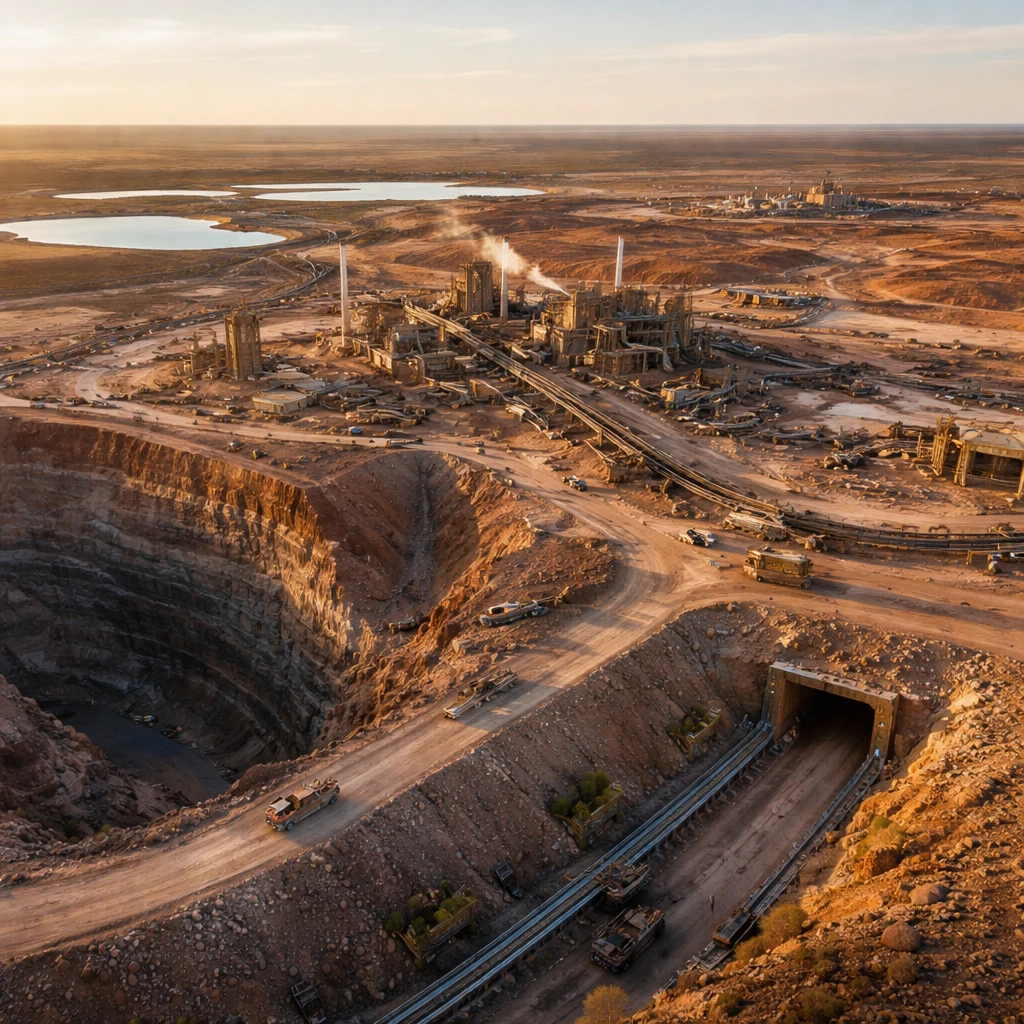
BHP shares rose 1.9% to A$52.38 after the miner laid out an expansive copper growth plan during an investor site tour of its South Australian operations. The package, designed to lift copper output substantially over the coming decades, carries an estimated capital cost in the range of $14.2 billion to $18.1 billion, with a final investment decision targeted in the first half of next year.
The expansion is organised in two distinct phases. The initial phase is intended to increase Copper South Australia production to about 500,000 tonnes per year by 2035. A subsequent phase would take capacity further, pushing annual production to 650,000 tonnes by 2040. In conjunction with the proposed build-out, BHP disclosed a maiden block-cave mineral resource at Olympic Dam estimated at 10.73 billion tonnes, adding scale to the long-term production case.
On a company-wide basis, BHP signalled an ambition to raise attributable copper production from roughly 1.4 million tonnes today to approximately 2 million tonnes a year by 2035. The South Australian hub is expected to represent about one-third of that growth. The company explicitly cited electrification, renewable energy deployment and artificial intelligence infrastructure as structural drivers that support sustained demand for copper.
Today's stock strength came in the context of a challenging market environment. The ASX 200 opened sharply lower, dropping as much as 0.75% at the session start, pressured by a Wall Street sell-off linked to AI-related selling on Friday that had pushed the index down 1.6% in the prior session. The benchmark finished the day down roughly 0.3%, with bank and technology names among the weakest performers.
That broader weakness contrasted with BHP's share price performance. The miner's ability to gain ground in this environment underscored the company-specific nature of the catalyst. The move was particularly noteworthy given that BHP had declined about 13% in the preceding week amid a wider rout across the mining sector, and was trading well below its 52-week high of A$68.77.
Market participants pointed to a combination of factors behind the bounce. The detailed, large-scale copper announcement provided tangible substance for investors to assess. The presence of a credible timeline - capped by an expected final investment decision in the first half of next year - gave markets a near-term milestone to watch. Finally, BHP's deeply oversold technical position following the prior week's sharp fall created the conditions for a recovery when a clear strategic update was supplied.
Nevertheless, the company’s targets are long-dated and execution risks remain relevant considerations for investors. The extended timeframe to reach the 2035 and 2040 milestones means the outcomes depend on successful project delivery over many years. The site tour offered investors a more concrete basis to re-evaluate BHP's copper growth credentials, but it did not remove the time and execution risk inherent in such large-scale developments.
Summary
BHP unveiled a two-phase plan to expand copper output in South Australia, aiming for 650,000 tonnes a year by 2040 at an estimated cost of $14.2 billion to $18.1 billion. The company also reported a maiden 10.73-billion-tonne Olympic Dam block-cave mineral resource, and reiterated an ambition to grow attributable copper production to about 2 million tonnes annually by 2035. The news helped lift BHP shares to A$52.38 despite a weak ASX session.
Key points
- BHP stock rallied 1.9% to A$52.38 after the South Australia investor site tour.
- The copper expansion is split into two phases: roughly 500,000 tonnes per year by 2035, then 650,000 tonnes by 2040; overall attributable copper production target is about 2 million tonnes by 2035.
- Market context: ASX 200 opened down as much as 0.75%, closed down around 0.3%, and BHP had fallen about 13% the prior week; BHP remains below its 52-week high of A$68.77.
Risks and uncertainties
- Execution risk - the expansion spans multiple decades, and delivery depends on successful long-term project execution, affecting the mining sector and capital markets.
- Timing risk - the targets are long-dated, and a final investment decision is not expected until the first half of next year, leaving near-term uncertainty for investors and commodity-focused sectors.
- Market volatility - broader equity weakness, particularly in banks and technology stocks, can influence investor sentiment toward resource stocks despite company-specific catalysts.