
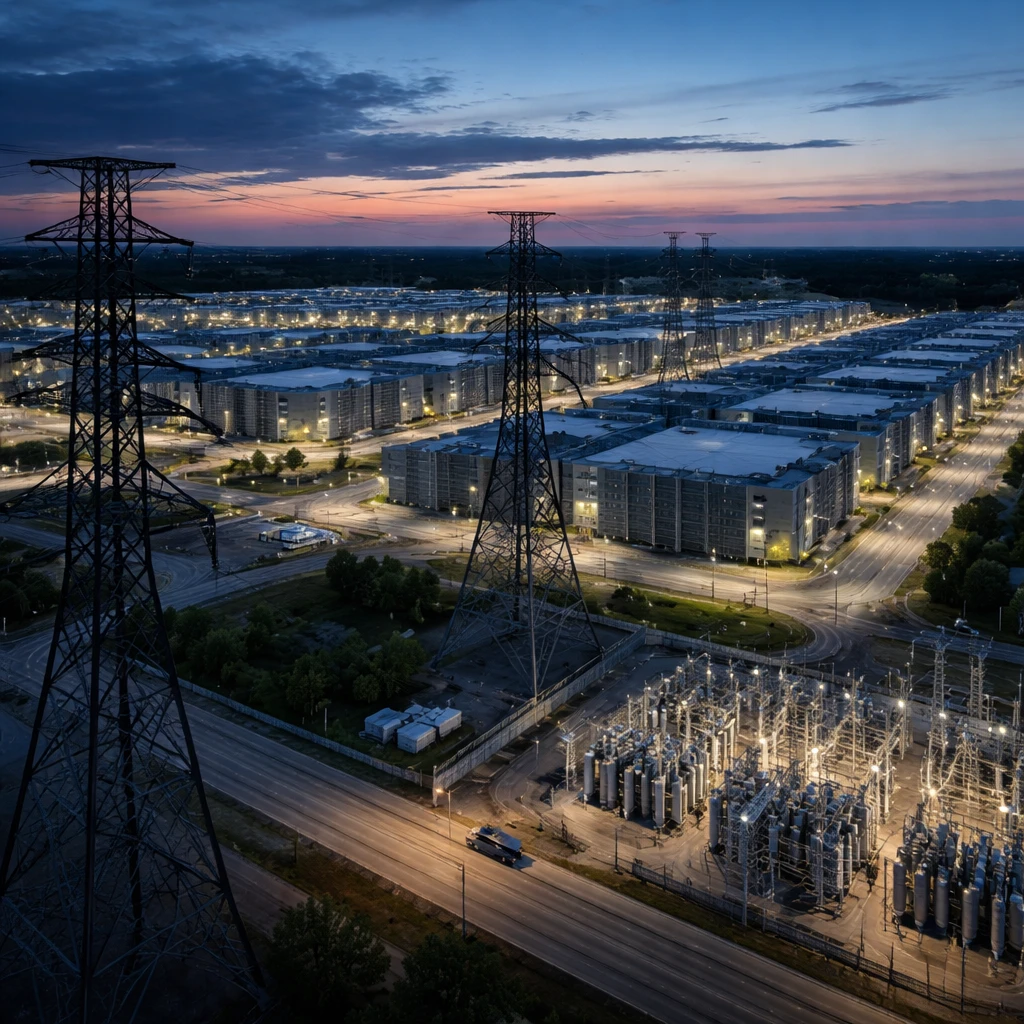
Barclays has compiled a universe of more than 400 companies that are central to the buildout of digital and power infrastructure and singled out utilities that it views as strategically placed to supply the electricity required by a growing wave of AI data-center construction. The bank noted that spending from Western hyperscalers and AI labs could exceed $1 trillion annually before reaching a peak in 2028, and that utilities will play a critical role in delivering that incremental power.
How Barclays assessed opportunities
The bank’s review emphasized utilities with contracted large-load pipelines, signed data-center service agreements, access to generation and transmission capacity in key markets, and balance-sheet activity that supports investment in grid expansion. Barclays identified several names where large enterprise customers and hyperscalers are already driving new load commitments.
Utilities highlighted
Below are the companies Barclays listed as among those best positioned to capture rising AI infrastructure demand, with the details Barclays provided:
- Southern Company - Barclays noted the utility reported a total large-load pipeline in excess of 75 GW, which included 10 GW of fully contracted electric service agreements as of Q4 2025. Southern Company’s first-quarter adjusted earnings per share of $1.32 topped consensus estimates and the company reported a 42% increase in data-center usage, supported by stronger customer growth.
- Duke Energy - Duke has about 4.5 GW of data-center service agreements with customers that include Microsoft and Amazon, and Barclays cited projected enterprise load growth of 3% to 4% for 2027-2030. In addition, Duke was selected to receive up to $61.8 million in grant funding from the U.S. Department of Energy for projects at its coal-fired plants and recently raised its quarterly dividend to $1.085 per share.
- American Electric Power - Barclays reported that AEP has signed letters of agreement for 36 GW with large industrial customers, including hyperscalers and major data-center developers. The company also obtained a loan of up to $3.26 billion from the U.S. Department of Energy to expand transmission infrastructure on the Texas grid and priced a $2.6 billion common stock offering.
- Dominion Energy - Dominion serves Northern Virginia’s so-called Data Center Alley, which Barclays described as handling roughly 70% of world internet traffic, giving the utility strategic positioning for the AI buildout. Dominion announced the sale of $1.5 billion in junior subordinated notes and received several analyst rating changes, including an upgrade to Buy from Jefferies, tied to a proposed merger with NextEra Energy.
- Vistra - Barclays pointed to Vistra’s large nuclear and gas generation fleet located in important data-center markets such as ERCOT and PJM. Vistra reported first-quarter earnings per share of $1.31 and revenue of $5.64 billion, with both figures exceeding analyst expectations.
- Entergy - Entergy has secured a special rate contract for an Alphabet data center and, as Barclays noted, manages concentration risk from a small number of data-center customers that account for significant new load. Entergy also completed settlements of forward sale agreements that generated about $672 million in cash proceeds from delivery of its common stock.
- Public Service Enterprise Group - Barclays described PSEG as exploring power sales from its nuclear fleet to large power users through long-term agreements. PSEG reported strong first-quarter financial results that exceeded earnings and revenue forecasts.
- WEC Energy - WEC forecasted 3.9 GW of new electric demand by 2030, highlighted by a $20 billion Microsoft data-center investment and a 1.3-GW Vantage Data Centers campus. WEC reported first-quarter earnings per share of $2.45 on revenue of $3.4 billion, with both metrics surpassing Wall Street expectations.
- NRG Energy - Barclays noted that NRG signed 295 MW of high-margin data-center contracts and expanded gas turbine orders to support up to 5.4 GW of new-build opportunities. The company reported first-quarter earnings per share of $1.49, which fell short of analyst forecasts, while revenue for the period exceeded expectations.
- DTE Energy - DTE negotiated a 1.4-GW contract with Oracle for an AI data center, a development Barclays said contributed to a 20% increase in the company’s five-year capital plan to $36.5 billion. DTE completed a $1 billion debt offering of junior subordinated debentures and appointed Renee Tomina as president and chief operating officer of its DTE Gas unit.
Other names to watch
In addition to the top-10 list, Barclays flagged several other utilities as names to monitor for exposure to AI-driven load growth. Those firms include Ameren, CMS Energy, NiSource, Alliant Energy, Talen Energy, and Pinnacle West Capital.
Implications for markets and sectors
Barclays’ screening highlights how utilities, transmission owners and merchant generators could capture incremental earnings and capital deployment opportunities from large data-center projects and hyperscaler contracts. The bank’s focus on contracted pipelines, grant funding, financing activity and customer commitments underscores the intersection of energy infrastructure and cloud-scale computing demand.