
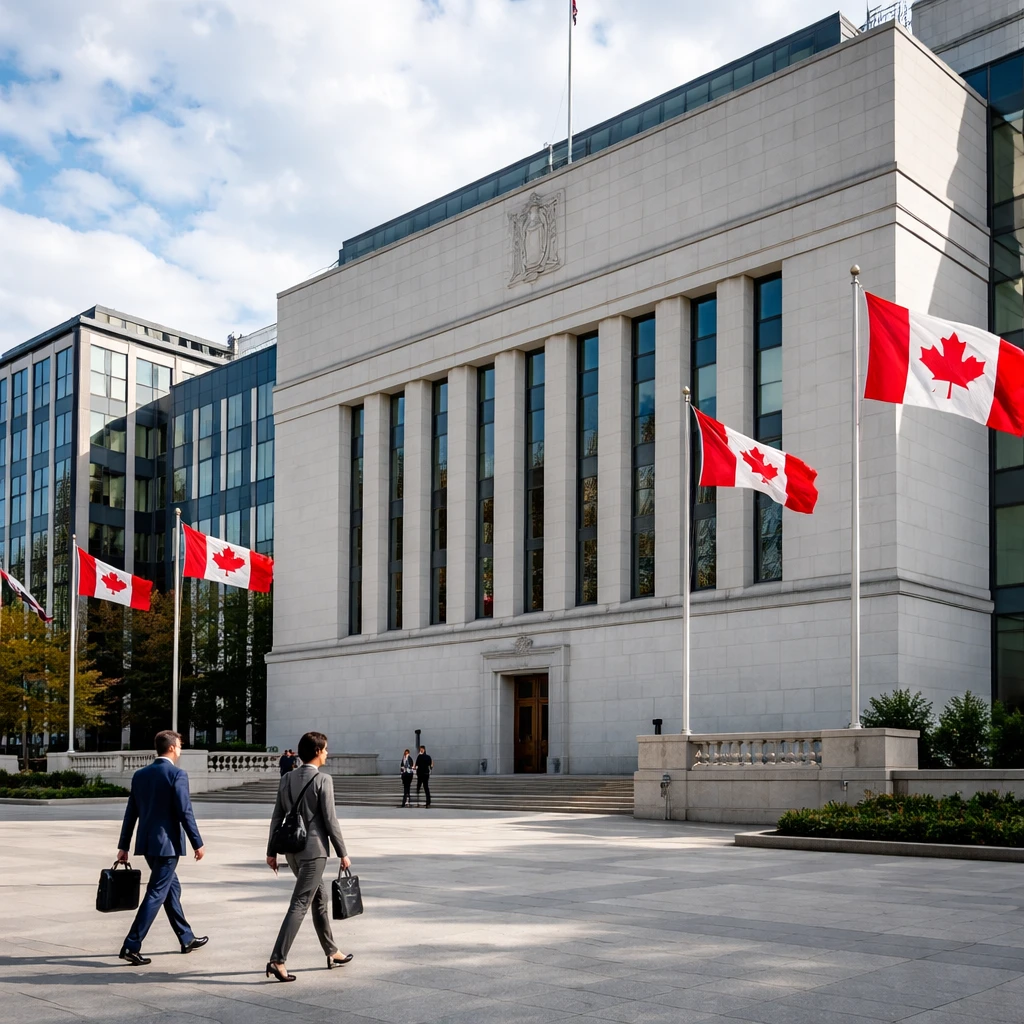
The Bank of Canada maintained its policy interest rate at 2.25% on Wednesday, continuing a streak of six consecutive meetings without adjustment. Governor Tiff Macklem and his colleagues said the current stance of monetary policy remains appropriate to support the economy's recovery and to guide inflation back toward the 2% target.
In its monetary policy report the central bank noted that "After a year of weakness, Canada's economy is showing signs of improvement." The institution added that "Growth is expected to pick up, and inflation eases gradually from its recent peak. Uncertainty is still high."
Growth and outlook revisions
The Bank of Canada now expects economic expansion to accelerate to an annualized 2.5% in the second quarter and to 1.5% in the third quarter. Policymakers trimmed the 2026 growth forecast to 0.7%, reflecting weakness recorded at the start of the year, while boosting their projections for 2027 and 2028 to 1.8% each. Officials also raised their outlook for exports, attributing some of the improvement to increased energy-related activity.
Inflation projections and drivers
Headline inflation is projected to average 2.5% in 2026, up from the prior estimate of 2.3%, before returning to the 2% target by early next year. Policymakers pointed to a combination of factors behind the near-term upward pressure on prices: higher oil prices, elevated gasoline refinery margins and a weaker Canadian dollar.
At the same time, the bank said core inflation should remain subdued, observing that underlying price pressures appear to be narrowing. Officials interpreted this as evidence that recent increases in oil costs are not yet broadly feeding through into the prices of other goods and services.
Risks highlighted by policymakers
The central bank identified several upside risks to the inflation outlook. One key concern is the potential for businesses to pass higher input costs on to consumers, which would put additional upward pressure on prices. Officials also warned that if productivity proves weaker than assumed, the output gap could be smaller than anticipated and inflationary pressures could be stronger as a result.
On oil, the bank's baseline assumes Brent crude will decline to $70 a barrel by the end of 2027, based on the July 9 futures curve.
Communication and market timing
Governor Macklem and Senior Deputy Governor Carolyn Rogers are scheduled to speak to reporters at 10:45 a.m. Ottawa time to discuss the decision and the projections. In its statement the bank concluded that "Despite some volatility, recent data suggest that the economy is evolving broadly in line with the outlook in the April report."
The decision to hold at 2.25% reflects the institution's assessment that the current policy rate is consistent with both fostering a recovery after a weak year and steering inflation back toward target, while acknowledging that uncertainty around the path remains elevated.