
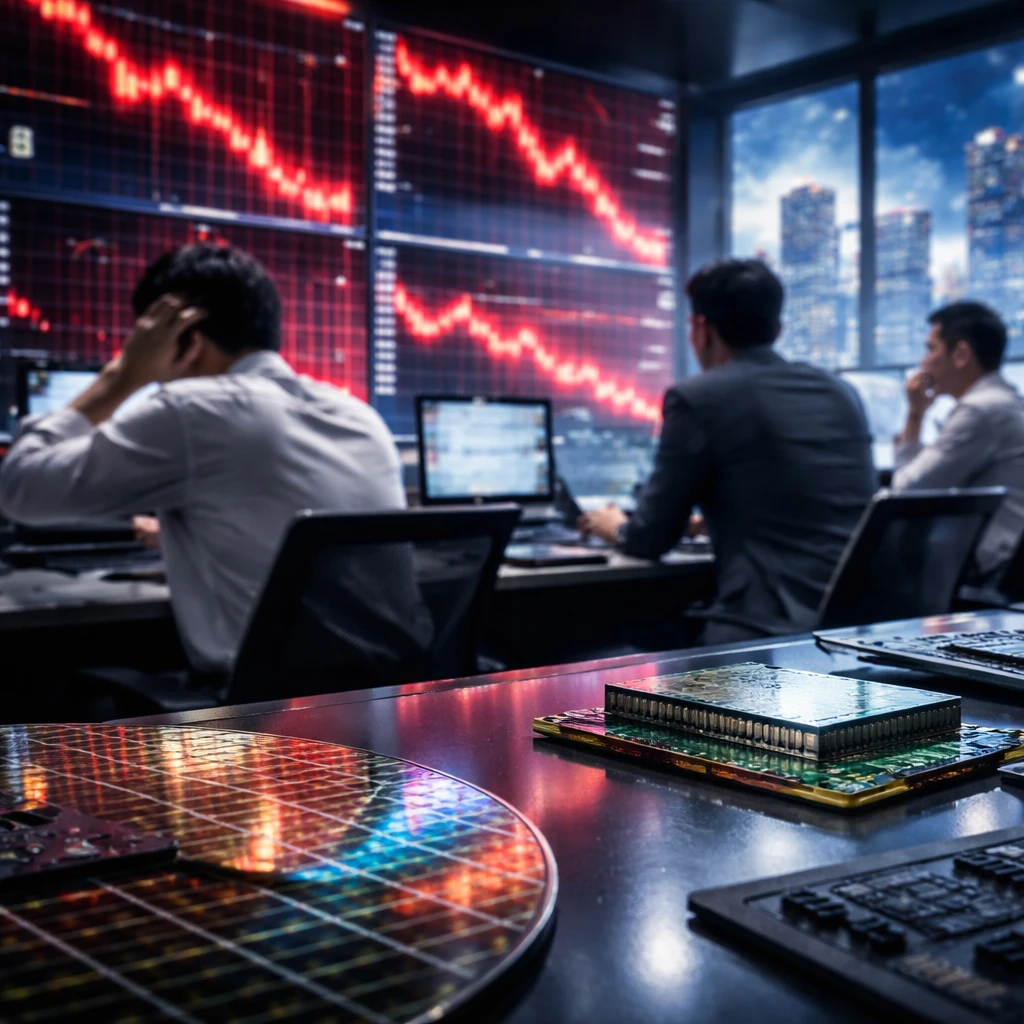
Asian markets were dominated by losses in technology and semiconductor shares on Thursday as investors reacted to renewed doubts about the durability of AI-driven demand. South Korea led declines, with the benchmark KOSPI plunging as much as 7% - its steepest drop in months - after heavyweight chipmakers extended overnight weakness out of the United States.
Samsung Electronics Co Ltd (KS:005930) and SK Hynix Inc (KS:000660) recorded further declines following a weak session in U.S. markets, amplifying pressure on the wider Korean market. The selling followed reports that Meta Platforms Inc (NASDAQ:META) is exploring a cloud infrastructure business to sell AI computing capacity, a development that has raised investor concern that spending by hyperscale AI customers may become more disciplined. Additional reports that Apple Inc (NASDAQ:AAPL) is evaluating memory chips from Chinese suppliers further weighed on sentiment toward South Korea's dominant memory producers.
The weakness in memory and storage names in the United States also fed into the rout in Asia. U.S. memory maker Micron Technology Inc (NASDAQ:MU) and storage company SanDisk Corporation (NASDAQ:SNDK) both fell by more than 10% overnight, and those moves appeared to cascade through regional supply chains even as some U.S. futures showed limited movement - Nasdaq 100 futures gained about 0.2% and S&P 500 futures edged up roughly 0.04% as the market awaited fresh U.S. economic data.
AI selloff ripples through semiconductor suppliers
The selloff concentrated heavily on technology and chip-related stocks. SK Hynix slipped to its weakest level since June 17, while Samsung Electronics moved to its weakest since June 8, highlighting investor caution about whether the rapid AI-related rally can be sustained.
The pressure extended beyond Korea into Japan, where the Nikkei 225 fell about 1.5% even as the broader TOPIX marginally rose by 0.2%. Memory producer Kioxia Holdings plunged by more than 14%, representing one of the benchmark's largest declines for the session, while chip-packaging supplier Ibiden Co Ltd (TYO:4062) dropped in excess of 10%. Other electronic components and materials suppliers such as Murata Mfg Co (TYO:6981), Furukawa Electric Co., Ltd. (TYO:5801) and Mitsui Mining and Smelting Co. (TYO:5706) also saw sharp losses as investors pared exposure to firms tied to AI hardware supply chains.
Taiwan's chip-related names also came under pressure. Taiwan Styrene Monomer Corp (TW:1310) extended recent losses alongside other AI supply-chain names as investors re-evaluated lofty valuations after a strong rally earlier in the year.
Mainland China and regional data
By contrast, mainland Chinese markets were relatively resilient on the day. The Shanghai Composite rose about 0.4%, while the Shanghai Shenzhen CSI 300 slipped roughly 0.4%. Stronger manufacturing activity indicators and expectations for further policy support helped cushion those markets from the regional technology-driven selloff.
Several regional economic releases did not derail the market focus on technology. Australia's trade surplus widened more than expected in May as imports rebounded strongly while exports eased only slightly, pointing to continued resilience in external demand. Despite that, the S&P/ASX 200 was essentially flat, up about 0.1%, as investors continued to weigh global technology developments more heavily than domestic data.
Other regional moves included a 0.9% rise in Indonesia's Jakarta Stock Exchange Composite Index and a roughly 0.2% gain in Nifty 50 futures. Earlier factory surveys across China, Japan and much of Southeast Asia had painted a broadly resilient picture of manufacturing activity. South Korea's latest inflation print met expectations, indicating that price pressures remained broadly stable, and export growth continued to point to the resilience of the country's external sector. Still, Thursday's sharp declines were driven more by a shift in global technology sentiment than by any immediate deterioration in domestic fundamentals.
Markets were also cautious ahead of remarks from U.S. President Donald Trump later in the day, with investors watching closely for any comments on trade or economic policy that could influence global risk appetite.
What this means for investors
The session illustrated how quickly sentiment toward AI-linked hardware can reverse and how such reversals transmit through a complex global supply chain that includes memory and packaging suppliers, materials firms and electronics component makers. Even with pockets of resilience in regional economies, technology sector sentiment dominated market moves on Thursday.
Reporting based on market moves and company-level performance referenced in trading updates and overnight sessions.