
Economy June 13, 2026 08:06 PM

UK and Japan to Forge Deep Economic Partnership with £18 Billion Clean Energy Pact

London and Tokyo are set to unlock major cross-border capital flows aimed at accelerating offshore wind development and bolstering strategic industry cooperation ahead of the G7 summit.

By Caleb Monroe
Share
Twitter Reddit Facebook LinkedIn

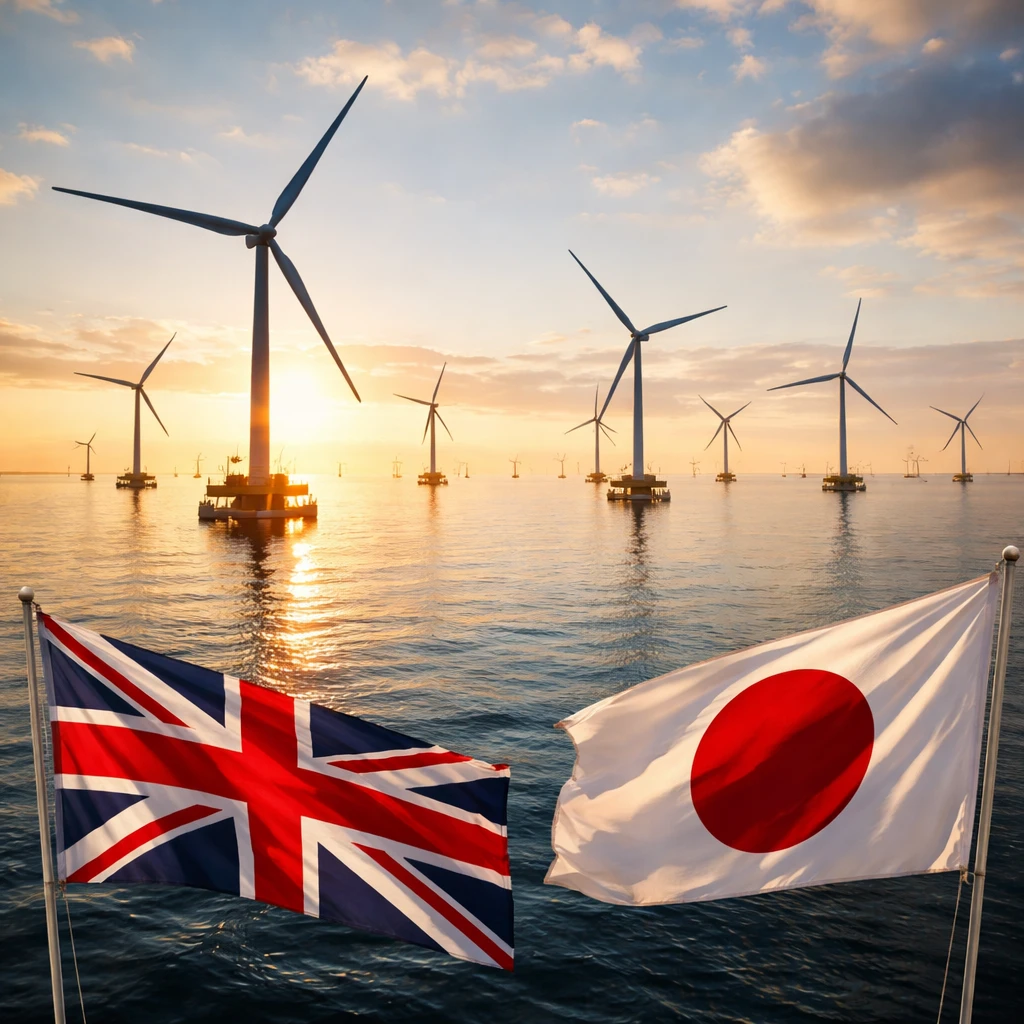
The United Kingdom and Japan are preparing to formalize an £18 billion investment agreement that will channel funds into clean energy, infrastructure, and financial services. This deal, expected to include up to £9 billion from Japanese sources for 5.9 gigawatts of floating offshore wind projects in the UK, aligns with both nations' macroeconomic goals. London is prioritizing long-term energy security and renewable capacity expansion, while Tokyo is seeking overseas growth avenues to support its corporate transition toward sustainable global markets.

UK and Japan to Forge Deep Economic Partnership with £18 Billion Clean Energy Pact
Summarize with
ChatGPT Perplexity Claude Grok Gemini

Key Points

  • The £18 billion agreement channels up to £9 billion into 5.9 gigawatts of UK floating offshore wind, directly impacting the renewable energy and infrastructure sectors.
  • The pact is designed to stimulate job creation across offshore wind, infrastructure, and financial services, highlighting broader macroeconomic integration between London and Tokyo.
  • Both nations are leveraging the deal to secure long-term growth and energy security, with Japan expanding overseas investments and the UK attracting foreign capital for renewable expansion.

The United Kingdom and Japan are advancing toward the signing of a landmark £18 billion investment pact, a move designed to deepen bilateral economic integration across clean energy, infrastructure, and financial services. According to reports from Bloomberg, the agreement is poised to include approximately £9 billion in Japanese capital allocation specifically earmarked for the development of 5.9 gigawatts of floating offshore wind capacity within British waters. The UK government projects that these renewable projects will eventually generate enough electricity to power around 8 million households.

This announcement arrives just before a scheduled meeting on Sunday at Downing Street between UK Prime Minister Keir Starmer and Japanese Prime Minister Sanae Takaichi. Business executives from both nations are anticipated to participate in the discussions, which will take place ahead of the Group of Seven summit in France. The British government indicated that the broader investment package is structured to stimulate job creation across the offshore wind, infrastructure, and financial services sectors.

The pact reflects a coordinated strategy by both nations to fortify economic linkages and expand cooperation within strategic industrial domains. The UK government has been actively pursuing greater foreign direct investment into its clean energy sector, a policy direction driven by long-term energy security mandates and objectives to expand domestic renewable power generation. Japan, conversely, has escalated its overseas capital deployment into energy and infrastructure projects, as its corporations seek sustainable long-term growth opportunities and contribute to the global energy transition.

In an official statement, Starmer emphasized that the partnership will facilitate deeper collaboration on technology, research, and industrial development. He noted that as G7 economies and close security partners, the two nations are jointly working on some of the world's most innovative technologies. The investment announcement occurs against a backdrop of escalating public and private capital expenditure on renewable energy projects across Europe and Asia, including offshore wind developments, as governments strive to meet climate commitments and reduce reliance on fossil fuels.

Risks

  • : The article does not specify regulatory hurdles or execution timelines for the £9 billion capital deployment, leaving uncertainty regarding project delivery schedules and potential delays in the offshore wind sector.
  • The reliance on foreign capital from Japan for critical UK infrastructure raises questions about geopolitical alignment and potential market sensitivity to shifts in Japanese corporate investment priorities.
  • The broader renewable energy push is contingent on meeting climate targets, but the article does not detail how policy frameworks will adapt if fossil fuel dependence reduction targets are not met in the financial services or energy transition sectors.

More from Economy

Barclays Sees AI-Driven Job Disruption Bolstering Individual ACA Market; Upgrades Oscar Health Jun 13, 2026 Why a U.S.-Iran Deal Could Tighten, Not Ease, Fed Policy Jun 13, 2026 Bernstein: Data center growth may not translate into a copper boom Jun 13, 2026 Drone strike kills one and ignites fire at Temryuk port terminal Jun 13, 2026 UBS Sees Private Market Data Industry Scaling Toward $35 Billion by 2030 Jun 13, 2026