
Economy July 2, 2026 09:33 AM

San Francisco Fed President Calls Policy Slightly Restrictive as AI Investment Clouds Next Move

Mary Daly highlights competing inflation and growth scenarios while noting oil price decline and labor-market strength

By Jordan Park
Share
Twitter Reddit Facebook LinkedIn

San Francisco Federal Reserve President Mary Daly described U.S. monetary policy as slightly restrictive and said uncertainty about artificial intelligence-driven investment and a steady labor market complicate the Fed's near-term rate decision. She outlined two possible economic paths and welcomed a fall in oil prices after a ceasefire in the Iran war. Market participants pared back expectations for imminent rate hikes after recent labor data showed a marked slowdown in job growth.

San Francisco Fed President Calls Policy Slightly Restrictive as AI Investment Clouds Next Move
Summarize with
ChatGPT Perplexity Claude Grok Gemini

Key Points

  • San Francisco Fed President Mary Daly characterized policy as slightly restrictive and said AI-driven investment and a stable labor market add uncertainty to the Fed's next decision - impacting monetary policy and financial markets.
  • Daly outlined two scenarios: persistent inflation or a weakening economy/less investment - relevant for growth-sensitive sectors and investors.
  • The drop in oil prices following the Iran war ceasefire is positive for consumers and may relieve some inflation pressure, affecting energy and consumer-facing sectors.

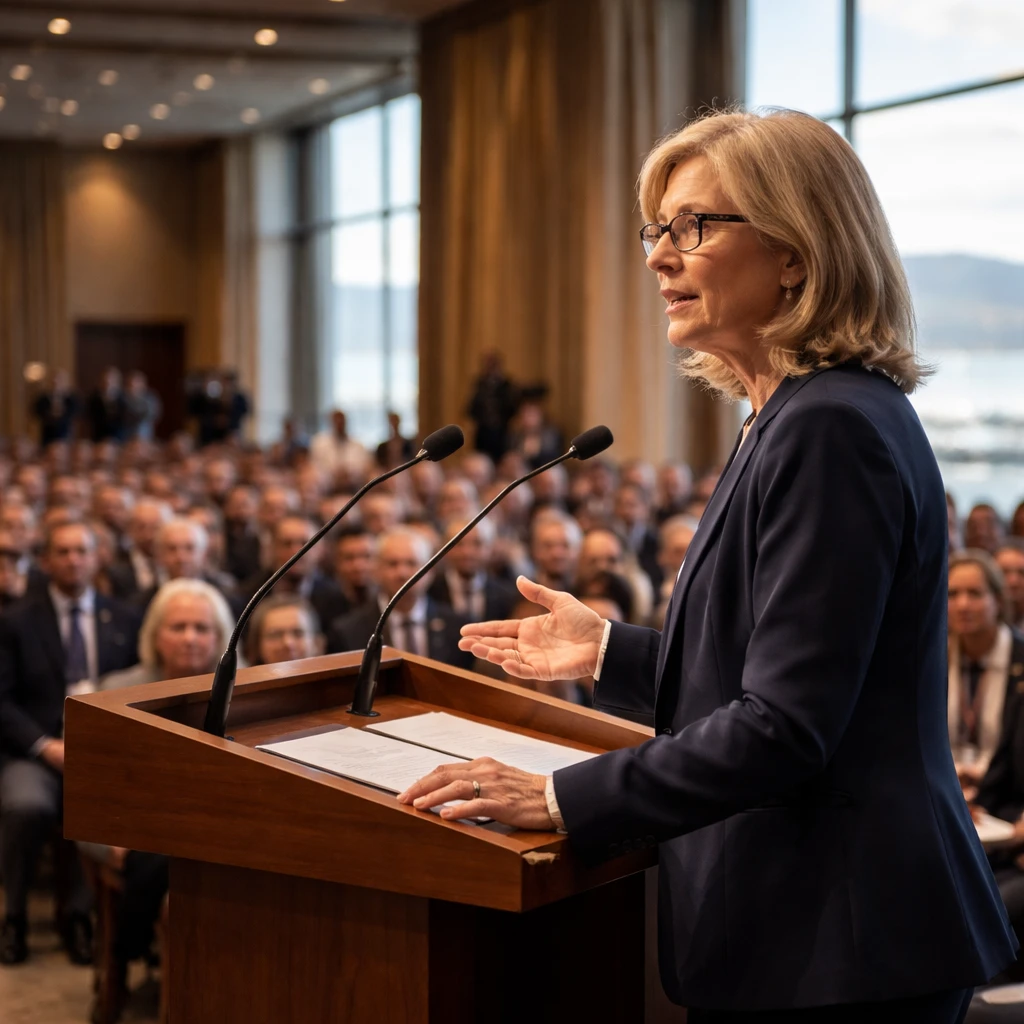
San Francisco Federal Reserve President Mary Daly said on Thursday that U.S. monetary policy is currently slightly restrictive, and she emphasized that the central bank's next policy step is unclear because of strong investment in artificial intelligence and a stable labor market.

Daly made her remarks at a Banco de España conference in Santander, Spain. She laid out two alternative scenarios confronting the Fed: one in which inflation proves more persistent than anticipated, and another in which economic expansion falters or investment diminishes because returns become less attractive.

She also noted that the recent decline in oil prices, which followed a ceasefire in the Iran war, is constructive for both the broader economy and for consumers.

Daly's comments arrived as the U.S. Bureau of Labor Statistics released figures indicating that job growth slowed sharply last month. That evidence of cooling labor-market momentum prompted traders to scale back their chances of a rate increase this month and in September.

Earlier, Daly had attended a global central banking conference in Sintra, Portugal, where Fed Chairman Kevin Warsh addressed the challenge of keeping inflation under control and said he would disappoint anyone expecting the U.S. central bank to fail in containing inflation. Warsh noted that inflation has remained above the Fed's 2% target for six years.

Warsh also discussed the economic effects of artificial intelligence, saying that AI is presently lifting demand but ultimately should raise supply, creating countervailing pressures on inflation.

Daly returned to that theme in Santander, saying the uncertainty around AI's net economic impact makes it difficult for her to move quickly on interest rates.


Context and implications

  • The combination of strong AI-related investment and a steady labor market leaves the Fed weighing whether inflation risks or growth risks will dominate.
  • A fall in oil prices after the Iran war ceasefire offers relief to consumers and could ease inflationary pressure.
  • Recent labor-market data showing a sharp slowdown in job gains has already altered market expectations for near-term policy moves.

Risks

  • Inflation could prove more persistent than expected, which would sustain upside pressure on interest rates and affect bond and equity markets.
  • Economic growth may fail to sustain itself or investment could cool if returns wane, posing downside risks to cyclical sectors and business investment.
  • Uncertainty about how artificial intelligence will influence demand and supply creates policy ambiguity, complicating decisions for market participants and industries exposed to tech investment.

More from Economy

Mann Signals Readiness to Raise Bank Rate if Inflation Expectations Stay Elevated Jul 2, 2026 Some EU Governments See Fees for Ships Crossing Hormuz as Inevitable, Officials Say Jul 2, 2026 Merkel Successor’s Reform Package Could Revive Investment if Enacted Swiftly Jul 2, 2026 Daly: U.S. Policy 'Slightly Restrictive' as AI Investment and Labor Data Cloud Next Fed Move Jul 2, 2026 Slower Job Growth Reduces Odds of Fed Move in July, Traders Say Jul 2, 2026