
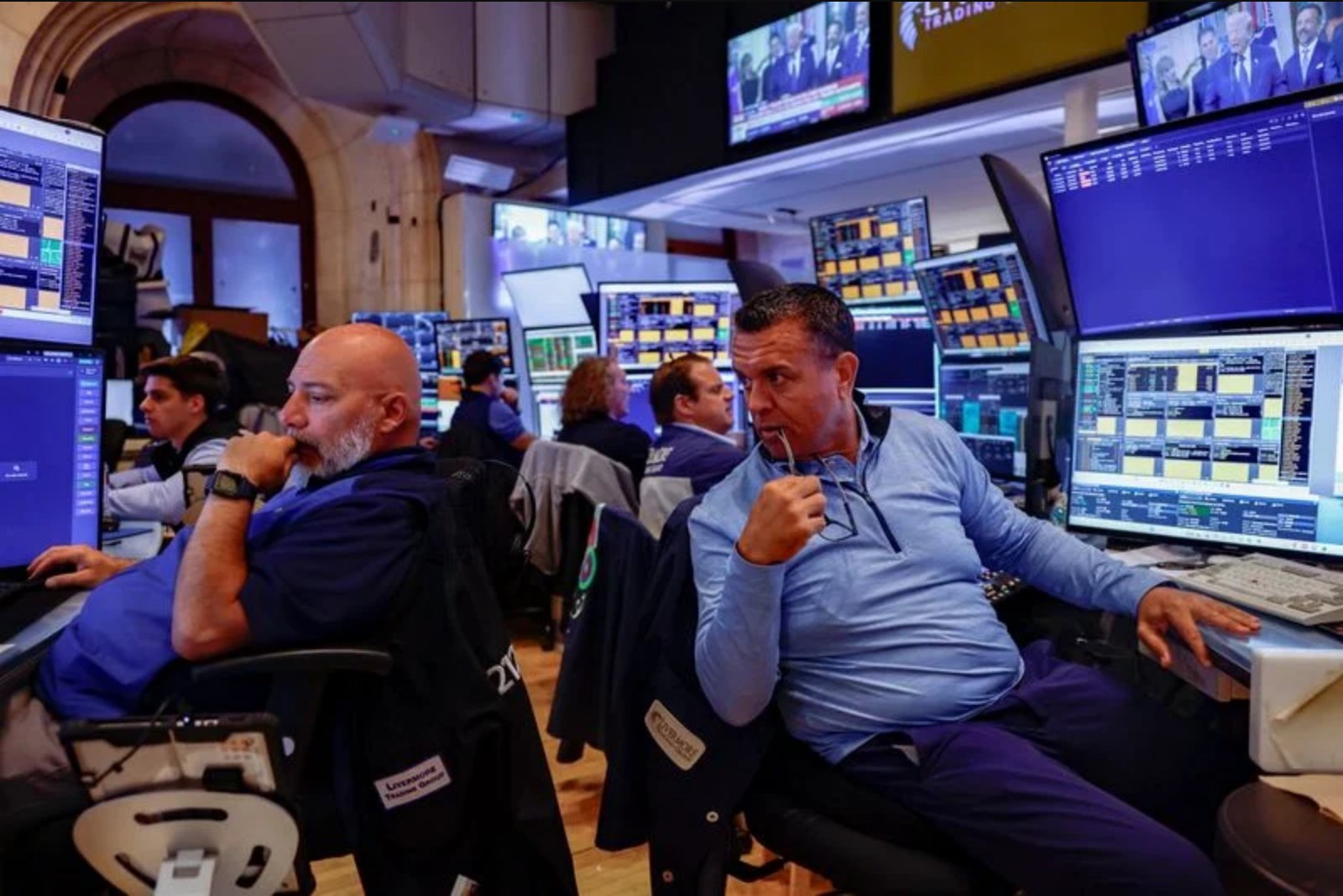
Global financial markets navigated a day defined by geopolitical friction and shifting policy expectations on Wednesday. The S&P 500 and the Dow Jones Industrial Average concluded their sessions in negative territory, mirroring the downward trajectory observed in global counterparts. However, the technology sector provided a counterweight for the Nasdaq Composite, which managed to eke out a modest gain despite the broader risk-off sentiment dominating equity markets. Meanwhile, Europe's STOXX 600 index recorded its most significant one-day drop since March, underscoring the severity of the sell-off in European equities.
A primary catalyst for the market's directional move was a sharp escalation in diplomatic tensions in the Middle East. U.S. President Donald Trump formally declared that the interim accord intended to end the war on Iran was "over." This statement followed a sequence of tit-for-tat airstrikes between the involved parties, introducing immediate volatility into energy markets. Crude prices surged in response to the remarks, with front-month contracts for both WTI and Brent crude settling up by 4.4% and 5.2%, respectively. The rally in oil prices extended a spike that had begun on Tuesday, pushing benchmarks to a two-week high.
In the foreign exchange and fixed income arenas, the dollar eased from a one-week high as the stability of the Iran deal faltered. U.S. Treasury yields spiked, though they pared back slightly following the release of recent Federal Reserve meeting minutes. The minutes revealed that policymakers were increasingly concerned about inflationary pressures during the June meeting. While "most participants" acknowledged scenarios where inflation would eventually cool without intervention, a significant portion of the committee also identified conditions where inflation remained sufficiently high to warrant a near-term rate hike. This divide contributed to a broader, evenly debated outlook among central bank officials.
Political developments also played a role in shaping market narratives. President Trump engaged in contentious diplomacy at the NATO summit, initially demanding that the United States sever trade ties with Spain and resurrecting previous claims regarding Greenland. He characterized Madrid as a "terrible partner" and criticized allies for their lack of support regarding the conflict with Iran. However, the tone shifted later in the summit, with the President emphasizing themes of "love" and "a lot of unity" among allied nations.
Domestically, political rhetoric is intensifying ahead of the November midterm elections. Over the past two weeks, the administration has sharply escalated anti-communist messaging. Data from public comments and social media posts indicates an acceleration in the use of the term "communism" following a series of primary victories by left-wing Democrats in New York. This rhetorical shift appears to be a strategic test of resonance with the electorate as the election cycle progresses.
On the technological and military front, developments in artificial intelligence and warfare continue to intersect. Reports indicate that Chinese authorities are planning to permit top AI companies to purchase a limited quantity of Nvidia’s H200 chips. Concurrently, there are considerations by Chinese officials to restrict the access of leading tech firms to China’s most advanced artificial intelligence models. In parallel military developments, Russian forces are deploying powerful jamming systems to disrupt Starlink satellite internet services. This countermeasure aims to mitigate the threat of Ukrainian mid-strike drone attacks, which have proven capable of accurately hitting targets dozens of kilometers behind front lines using camouflaged cargo and low-cost systems.
The International Monetary Fund also updated its macroeconomic outlook, lowering its 2026 global growth forecast to 3.0%. The revision cites risks stemming from the Middle East conflict and trade uncertainties. However, the Fund expects a rebound in growth projections for 2027.
Looking ahead, market participants will monitor a variety of economic data releases and geopolitical developments that could influence trading dynamics. Key indicators to watch include U.S. weekly jobless claims, existing home sales data, and the Germany trade balance for May. European data points such as Sweden house prices for June, Norway's PPI and manufacturing output, the Denmark trade balance, the Czech Republic unemployment rate, and CPI figures from Greece, Ireland, Mexico, and Mexico's PPI will also be in focus.