
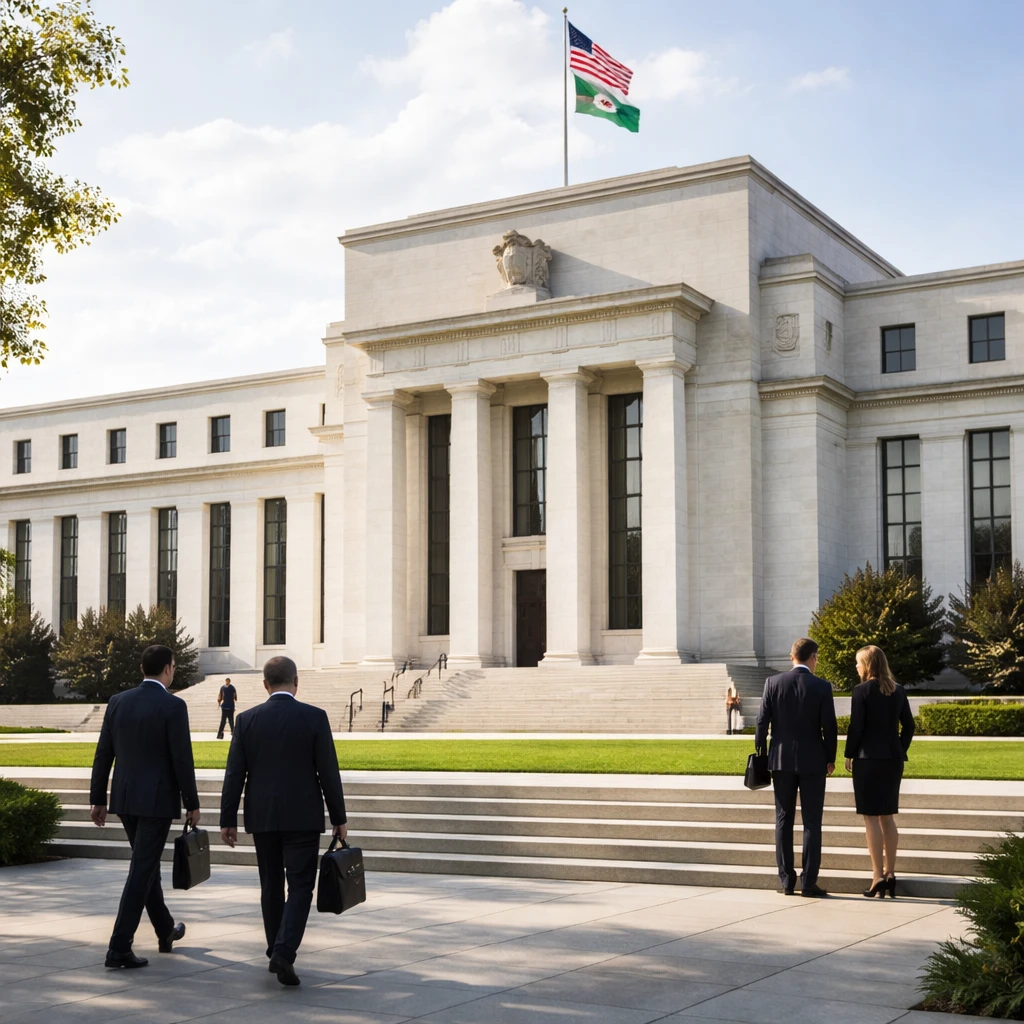
The Federal Reserve appears poised to deliver its first interest-rate increase since 2023, a likely quarter-percentage-point rise that will push the policy rate into the 3.75%-4.00% band. The change comes amid persistently elevated inflation and a global upswing in borrowing costs. Equally consequential, market participants say, will be how Fed Chair Kevin Warsh explains the decision - his words could determine whether investors accept the action as a credible response to inflation or read it as merely a small technical adjustment.
Context and the political backdrop
President Donald Trump had publicly signaled a different expectation when he nominated Warsh earlier this year, saying he expected his appointee to pursue lower rates. The president has recently warned of new import tariffs if the Fed does not reduce borrowing costs. Despite that political pressure, a 25 basis point increase has become a probable outcome given inflation that has not returned to the central bank’s 2% objective and a generalized rise in global interest rates that complicates the Fed’s policy stance.
Why Warsh’s framing matters
Beyond the numerical change, observers emphasize that the post-meeting explanation from Warsh will be closely scrutinized. Credit market participants, economists, and investors will be listening for clues about whether this is an isolated tweak or the first of multiple further increases. Robert Sockin, chief U.S. economist at PGIM, said a unanimous decision to hike would send a strong signal, especially if the Fed’s updated economic projections indicate officials expect an additional rise later this year and perhaps another move in 2027. Sockin also noted that language from Warsh’s recent speech at the Jackson Hole symposium could be read to support a readiness to do more if inflation does not retreat quickly enough.
"If they hike and it is unanimous - that is a strong signal," Sockin said, adding that projections showing another hike this year and possibly one in 2027 would magnify that signal. He also cautioned that if Warsh sounded dovish and described the move as a modest calibration, markets might respond negatively.
Inflation remains above target
The Fed will publish its policy statement at 2 p.m. EDT (1800 GMT) together with updated quarterly economic projections that include officials’ estimates for the appropriate year-end policy rate. In June, the policymakers’ projections were split: nine of 19 officials expected rates would need to be at least a quarter point higher by the end of 2026, while nine projected rates could stay the same or fall by a quarter point. Warsh opted not to submit a personal dot on that chart, reflecting his stated discomfort with the dot plot format.
Support for tighter policy has built in recent weeks. At the July 28-29 meeting, three policymakers dissented in favor of a rate increase, and several officials have since indicated they were prepared to lift rates unless inflation began to show a clear downtrend. The Fed’s preferred inflation gauge, the Personal Consumption Expenditures Price Index, rose at a 3.7% annual pace in both June and July after climbing steadily through much of the prior year. The data expected on September 30 is not projected to show a meaningful change in that trend.
Warsh himself has signaled caution. In his Jackson Hole address he said policymakers must be confident "that underlying inflation is moving to our objective, clearly and at sufficient speed," and he observed that recent data "do not tell me that underlying trends have meaningfully improved." The comments underline why officials may feel compelled to act despite political pressures and long-standing public sensitivity to higher borrowing costs.
External factors nudging policy
Several developments outside of core inflation readings are weighing on the Fed’s deliberations. Oil prices have climbed back above $100 a barrel. The president recently introduced new tariffs on Canada and threatened further import duties. At the same time, the economy continues to expand, supported in part by elevated spending tied to artificial intelligence investments. Taken together, those elements present upside risk to inflation and have contributed to officials’ readiness to consider a rate increase.
Bond markets and their influence
Global bond yields have also been moving higher, a dynamic that pressures the Fed toward tighter policy. The yield on the 10-year U.S. Treasury crossed above 5% on Tuesday, marking a 19-year high. Many market observers interpret the broad-based increase in yields as evidence of a secular shift toward higher borrowing costs that is not solely explained by inflation or issuer-specific risk. If longer-term yields have indeed reset higher, short-term policy rates may need to rise simply to preserve the Fed’s effective monetary stance.
Some analysts note that administration officials could accept, or even tacitly welcome, a Fed lift because undoing already strong market expectations could raise questions about Warsh’s credibility on inflation. If investors concluded the Fed was not committed to fighting inflation, long-term rates might climb further as markets priced in greater inflation risk and demanded higher yields.
Longer-term interest rates matter for consumers and businesses. Yields on benchmark government debt like the 10-year Treasury help set borrowing costs for mortgages and other consumer credit, which remain elevated despite political promises to ease household financing. That tension between policy decisions and public expectations is likely to shape debate in the run-up to November’s midterm elections.
Market expectations and pushback
At present, market pricing places the probability of a rate increase on Wednesday above 90%. Warsh has cautioned against allowing market expectations to create a feedback loop, warning of a "hall of mirrors" in which officials adopt financial markets’ views that themselves reflect signals from central bank comments. Some external analysts argue the Fed should wait rather than move this week, saying market moves may have outpaced the underlying data.
John Davies and Steve Englander of Standard Chartered wrote that "There seems to have been a market echo chamber pushing up expectations despite a limited amount of incoming data," and they added, "There is a very low cost to waiting." Their view is that the Fed could hold policy steady without significant downside risk, given current data flows.
The press conference risk
Whether the decision is viewed as a technical calibration or the opening of a sequence of hikes will depend heavily on Warsh’s remarks at the post-meeting press conference. Robin Brooks, a senior fellow at the Brookings Institution, warned that the press event carries substantial risk. With investors currently pricing in four hikes between now and next June, Brooks wrote that Warsh will repeatedly be asked about that expectation, and there may be no straightforward way to answer without disappointing some segment of the market. If Warsh appears dovish relative to market pricing, the result could be a renewed selloff in long-term bonds even after the Fed raises rates to try to anchor those yields.
What market participants will watch
- The tone of Warsh’s opening statement and his assessment of whether inflation is clearly moving toward the 2% goal at a sufficient pace.
- Whether the decision is unanimous and how that unanimity, or lack of it, is portrayed.
- The updated economic projections, including any changes in the distribution of officials’ views on the year-end policy rate.
- Responses to questions at the press conference about the likelihood and timing of additional rate moves.
The interaction between the policy decision and its communication will be critical in shaping market reaction. Many in markets are prepared for a rate hike; the defining issue now is whether the Fed’s words will convince global investors that the central bank is committed to bringing inflation back to target, or whether markets will interpret the move as incomplete, prompting further volatility in long-term yields.
Note: This article reflects available data and commentary provided around the Fed decision and subsequent public statements by officials. It does not include any additional external analysis or interpretation beyond those sources.