
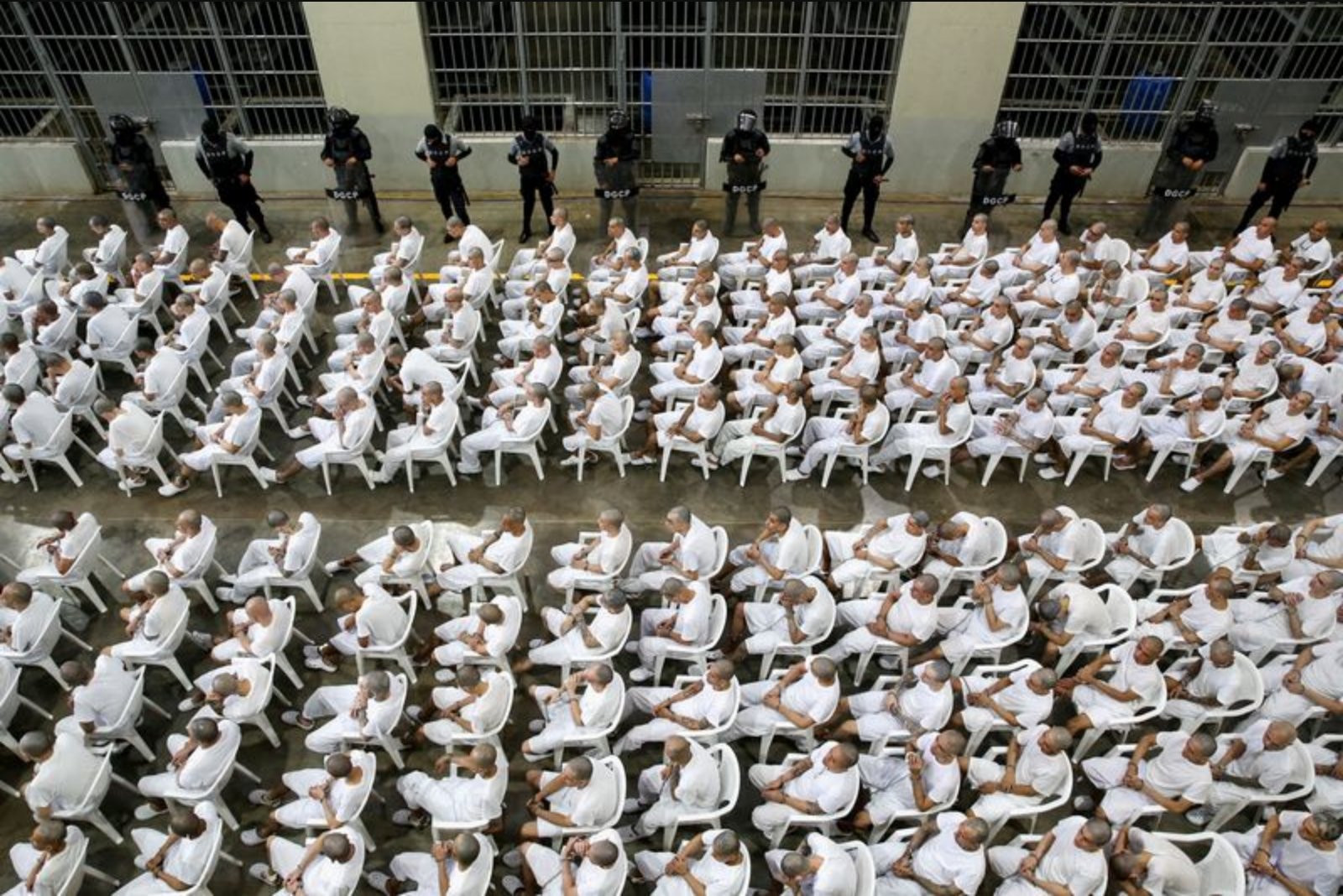
Inside a high-security prison in El Salvador, rows of detained men sat in uniform, wrists cuffed and ankles shackled, watching court proceedings displayed on a large screen that will determine the outcome for hundreds facing charges.
The session was part of a mass trial involving 486 people accused of being gang members - the largest such judicial proceeding yet in the roll-out of President Nayib Bukele's aggressive campaign against gangs. More than one hundred of the accused viewed the hearing from within a mega-prison housing defendants from multiple facilities.
Officials are holding the suspects across five detention centers, including the maximum-security CECOT complex that opened in 2023 and has become emblematic of the administration's zero-tolerance approach. At CECOT, detainees wear all-white clothing and have had their heads shaved; some present visible tattoos associated with MS-13. Heavily armed guards stood by as the viewing took place.
Prosecutors have linked the suspects to more than 47,000 crimes alleged to have occurred between 2012 and 2022, citing offenses ranging from extortion and arms trafficking to homicide. The defendants in the current mass trial, however, face charges of gang membership, and any sentences would be based on affiliation rather than on convictions for the full range of alleged offenses prosecutors have attributed to the broader investigation.
The state of emergency first enacted in April 2022 allowed the government to suspend certain constitutional rights and has been used to detain more than 91,000 people, predominantly those suspected of ties to MS-13 and Barrio 18. Parliament passed a law enabling collective trials, making El Salvador the only country in the region to permit mass trials under its current legal framework.
The president has publicly highlighted the ongoing trial and authorities allowed media access to the prison where some defendants were gathered to observe the proceedings on screen. Outside regular office hours, a spokesperson for the president and a representative for the attorney general's office did not respond to texted requests for comment.
Critics and human rights organizations have raised alarms about the secrecy surrounding criminal proceedings in the country. All criminal court sessions in El Salvador are closed to the public, and observers have argued that such restrictions prevent independent verification of prosecutorial claims. "There is no way to see and verify that the information the prosecutors present is true. Secrecy is now the norm in El Salvador," said Ana Maria Mendez, director for Central America at the Washington Office on Latin America.
Defense lawyers and legal advocates say the scale and mechanics of mass trials erode the right to defense. "Mass trials are just formalities," said Salvadoran criminal defense lawyer Roxana Cardona. She added that the format undermines the ability of defense attorneys to confer privately with their clients and to develop individualized defense strategies, a core component of the right to a fair defense.
Given the sheer number of individuals detained and the length of pre-trial incarceration under the state of emergency, some legal observers expect mass trials to become a recurring feature of El Salvador's criminal justice response. Backers of the measures say they are necessary to confront gangs that at times exercised control over large areas of the country.
The government has pointed to a steep decline in the homicide rate as evidence of the effectiveness of the emergency measures. Officials have credited the crackdown for reducing the national homicide rate to 1.3 per 100,000 people last year, down from 7.8 per 100,000 in 2022.
The use of emergency powers and the expansion of mass prosecutions have also drawn scrutiny from regional human rights bodies. The Inter-American Commission on Human Rights reiterated concern about rights violations under the state of emergency and called for an end to its use as a tool in the fight against crime.
While authorities present the trials and detentions as part of an effective public-security strategy, legal advocates emphasize that secrecy and the scale of prosecutions raise significant questions about due process and the preservation of basic legal protections for the accused.