
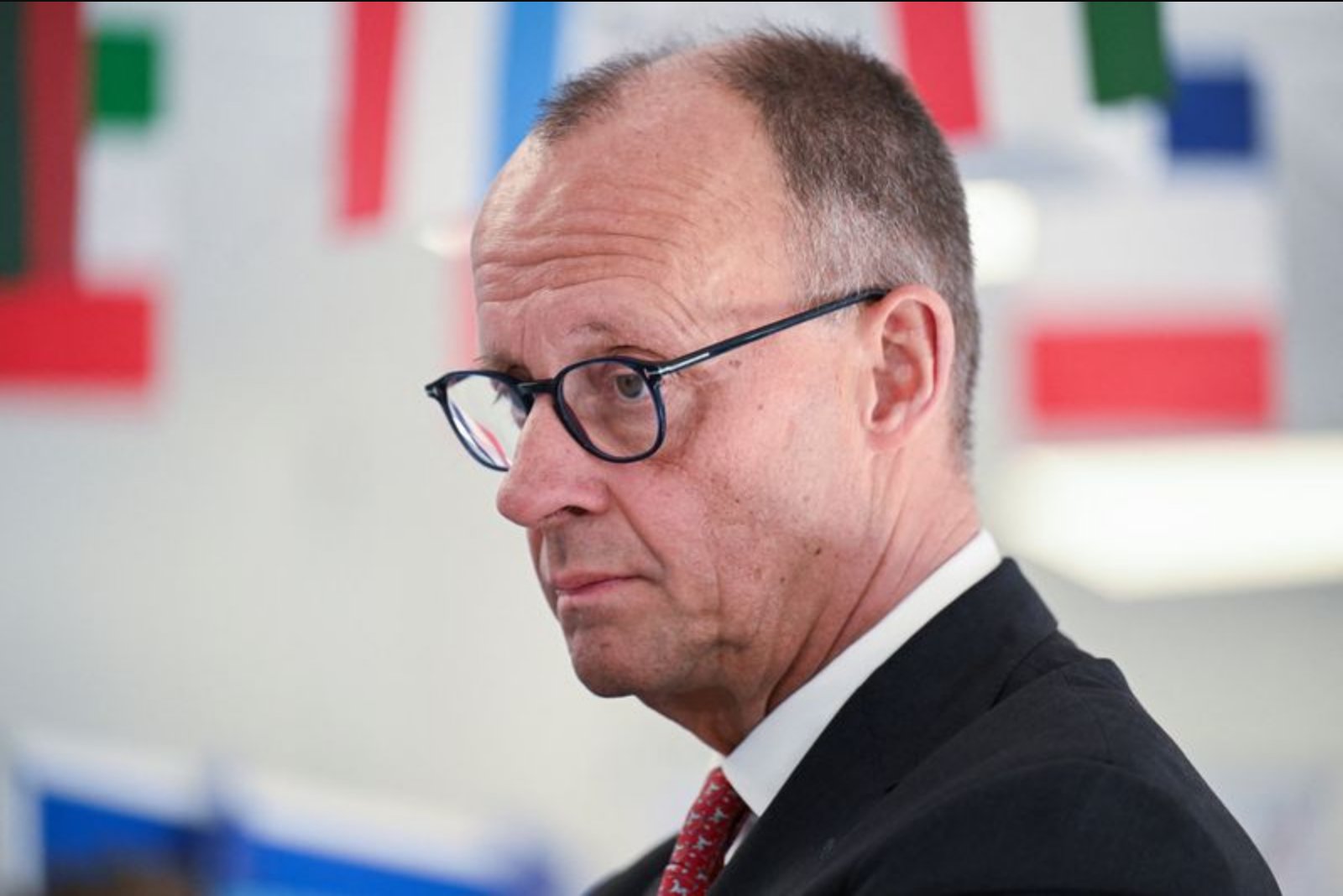
German Chancellor Friedrich Merz delivered a blunt assessment of recent events involving Iran and the United States, saying on Monday that Tehran's leadership was effectively humiliating U.S. officials by drawing them to Pakistan only for those delegations to depart without agreement.
Speaking to students in Marsberg in the state of North Rhine-Westphalia, Merz characterized Iran's negotiating approach as highly effective at avoiding negotiation, singling out the country's Revolutionary Guards for their role. "The Iranians are obviously very skilled at negotiating, or rather, very skilful at not negotiating, letting the Americans travel to Islamabad and then leave again without any result," he said. He added: "An entire nation is being humiliated by the Iranian leadership, especially by these so-called Revolutionary Guards. And so I hope that this ends as quickly as possible."
Merz’s comments underscored widening tensions between Washington and its European NATO partners, tensions that had been building in relation to Ukraine and other matters before the current crisis. He went on to say he did not see a clear exit strategy being pursued by the U.S. in the confrontation with Iran.
The chancellor reiterated that German and broader European authorities were not consulted prior to the strikes that, according to his account, began on February 28 when U.S. and Israeli forces started attacking Iran. He said he had expressed his scepticism directly to U.S. President Donald Trump after those actions. "If I had known that it would continue like this for five or six weeks and get progressively worse, I would have told him even more emphatically," Merz stated, drawing a parallel in tone with previous protracted U.S. engagements in other conflicts.
Diplomatic efforts to revive negotiations appeared to lose momentum after President Trump called off a planned visit by his envoys, Steve Witkoff and Jared Kushner, to Islamabad on Saturday. Merz referenced those aborted talks as part of the broader pattern of unsuccessful diplomacy. He further noted that Iranian Foreign Minister Abbas Araqchi travelled to Russia on Monday after talks in Pakistan and Oman failed to produce a breakthrough.
The chancellor also confirmed evidence that the Strait of Hormuz had been at least partially mined. "We have offered, also as Europeans, to send German minesweepers to clear the strait, which has obviously been mined in part," he said. Merz warned that the disruption was carrying a heavy cost for Germany: "The conflict was costing Germany a lot of money, a lot of taxpayers' money and a lot of economic strength."
His remarks linked the diplomatic impasse, the operational state of the vital shipping lane and the economic consequences for Germany. By highlighting both the perceived diplomatic failures and the concrete impact on navigation through the Strait of Hormuz, Merz framed the situation as one with both political and material dimensions.
Context and immediate developments
- Merz addressed students in Marsberg, North Rhine-Westphalia, outlining his perspective on recent diplomatic interactions involving U.S. envoys and Iran.
- He reported being uninformed before U.S. and Israeli strikes on Iran began on February 28 and said he communicated his reservations to President Trump.
- Diplomatic missions to Pakistan did not achieve results; Iran's Abbas Araqchi travelled to Russia after unsuccessful talks in Pakistan and Oman.