
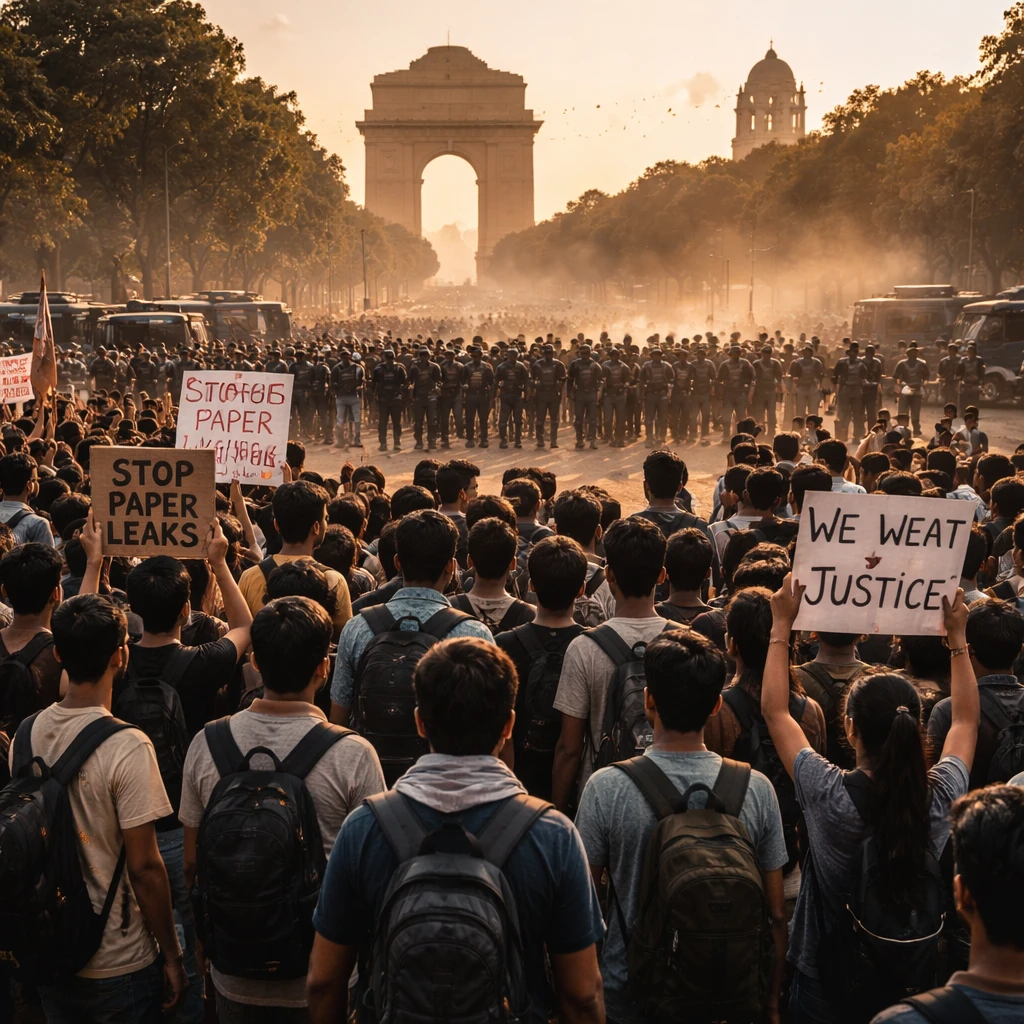
Leaders of the youth-led Cockroach Janta Party (CJP) have agreed to sit down with government officials on Friday to attempt to defuse a confrontation over a spate of national examination paper leaks, the group said. Despite the planned talks, CJP spokespeople made clear that mass demonstrations across the country will carry on.
The announcement followed the end of a prolonged fast by activist Sonam Wangchuk, who broke a 26-day hunger strike overnight. His ending of the protest fast has prompted cautious hopes that the government and the movement may be moving toward engagement, even as large crowds of protesters remain in the capital.
Tens of thousands of young people have congregated in Delhi to press demands that include the resignation of the education minister over the scandals involving exam leaks. The surge in mobilization is being described by some observers as the most significant youth-led challenge Prime Minister Narendra Modi has faced since 2014. Opposition parties have taken up aspects of the movement’s demands and have disrupted the monsoon session of parliament that began this week.
Details of the planned meeting were provided by CJP spokesperson Saurav Das, who told reporters that talks between government ministers and movement leaders will be held at a neutral venue. "We hope that the government comes with an open mind and it will listen to the people of this country who have been out on the roads for so long," he said. "We will explain our demands to them in greater detail. And we hope that the government will listen to us." Das reiterated the movement’s insistence that public demonstrations would not be suspended: "We are not backing out," he added. "Because, real awakening starts from the grassroots and that is what we really need."
The protests originated as an online satire and initially involved only a few hundred participants, but they have since expanded rapidly with millions of online followers and far greater street turnout than authorities expected. Demonstrators breached a ban and marched on parliament, where tens of thousands pushed against police lines and were met with tear gas and baton charges. Violent clashes were reported again when more than 10,000 people gathered at the Jantar Mantar protest site in central Delhi on Wednesday night.
Analysts point to broader undercurrents behind the protests, noting frustrations among young Indians over issues such as job shortages and repeated exam leaks. Those concerns have driven the movement’s popularity, according to those assessments, and have intensified pressure on the government to respond.
Authorities have taken a range of measures in central Delhi where protesters have camped, aiming to curb demonstrations while disrupting daily life. On Thursday, officials shut 16 metro stations, restricted mobile internet services and curtailed business activity in areas around the protests. The Delhi Metro Rail Corp. said it would close 17 stations again from early on Friday until further notice, marking the third large-scale shutdown of the transit system this week. The closures have affected commuters and businesses that rely on the metro as the lifeline of the capital.
In an effort to address the immediate scandal, the federal cabinet will meet on Friday to discuss a draft amendment of laws designed to punish those responsible for exam paper leaks and to seek early parliamentary approval, Prime Minister Modi said late on Thursday. Protesters, however, have rejected a legislative focus on punishment alone, maintaining that reforms should aim at fixing systemic vulnerabilities in the examination process to prevent leaks from occurring in the first place.
Wangchuk, who ended his fast in the presence of two government ministers, is expected to lay out details of his discussions with the officials via a video likely to be released on Friday. Until those statements are made, participants and observers will be watching whether the scheduled meeting yields concrete commitments and whether the movement’s street actions shift in response.