
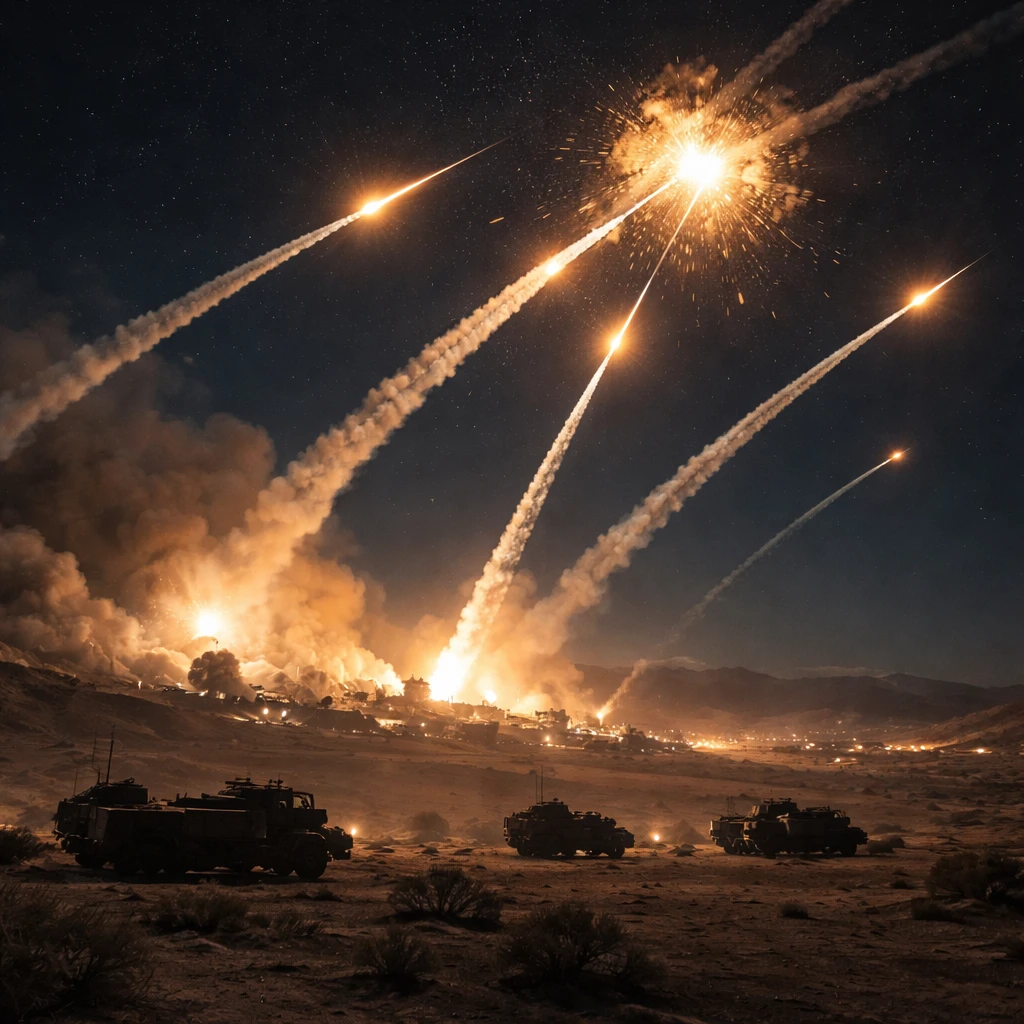
The U.S. military reported on Tuesday that it intercepted several ballistic missiles that were launched from Iran toward American forces stationed in the Middle East, and said U.S. personnel remained vigilant.
In its statement on X, U.S. Central Command declined to identify the precise site that Iran had attempted to target. The command said the launches were carried out by Iran's Islamic Revolutionary Guard Corps in what it described as an attempt at a surprise attack on U.S. forces in the region.
"Islamic Revolutionary Guard Corps forces launched multiple ballistic missiles from Iran in an attempted surprise attack on U.S. forces based in the Middle East. All Iranian missiles were successfully intercepted,"
Earlier reporting by Axios, citing an unnamed U.S. official, stated that ballistic missiles had been fired toward a U.S. base in Jordan and that those missiles were intercepted. U.S. Central Command's statement did not confirm that specific location.
The incident occurred against a backdrop of recent military and diplomatic activity involving the United States and Iran. President Donald Trump, who recently called off a planned two-week U.S. bombing campaign, has said there have been "good talks" with Iran while warning he could resume strikes if the negotiations do not produce results. Iran has denied that it is seeking to resume talks with Washington.
The public account follows the outbreak of hostilities that began on February 28, when the United States and Israel attacked Iran and Iran responded with strikes on Israel and Gulf states that host U.S. bases.
U.S. Central Command emphasized that American forces remain vigilant in the region as investigations and assessments continue. The command's brief statement provided limited operational detail about the interception and did not disclose which air defenses or allied assets were involved.
Given the limited information available from official sources, some reports rely on anonymized U.S. officials for additional context, while the central military statement has remained concise in its description of the event.
Clear summary: Multiple ballistic missiles launched from Iran toward U.S. forces in the Middle East were intercepted successfully, according to U.S. Central Command. The command did not specify the intended target; an earlier report cited a U.S. official who said a U.S. base in Jordan was targeted. The episode follows recent pauses and threats of renewed U.S. strikes and is set within ongoing hostilities that began on February 28.
Key points:
- U.S. Central Command stated Iran's Islamic Revolutionary Guard Corps launched multiple ballistic missiles that were intercepted successfully.
- There is uncertainty about the precise target - the command did not specify a location, while an earlier report cited a U.S. official saying a U.S. base in Jordan was targeted.
- Sectors likely to be sensitive to such developments include defense and regional security, with potential implications for markets that monitor geopolitical risk.
Risks and uncertainties:
- Unclear target details - U.S. Central Command did not identify the exact location or sites the missiles were aimed at, leaving operational details unresolved.
- Conflicting accounts - separate reporting cited a U.S. official who named a Jordanian base as the target, creating uncertainty over which report fully reflects the situation.
- Potential for renewed strikes - President Trump has warned he could resume bombing if negotiations do not produce acceptable results, representing a continuing risk of escalation.