
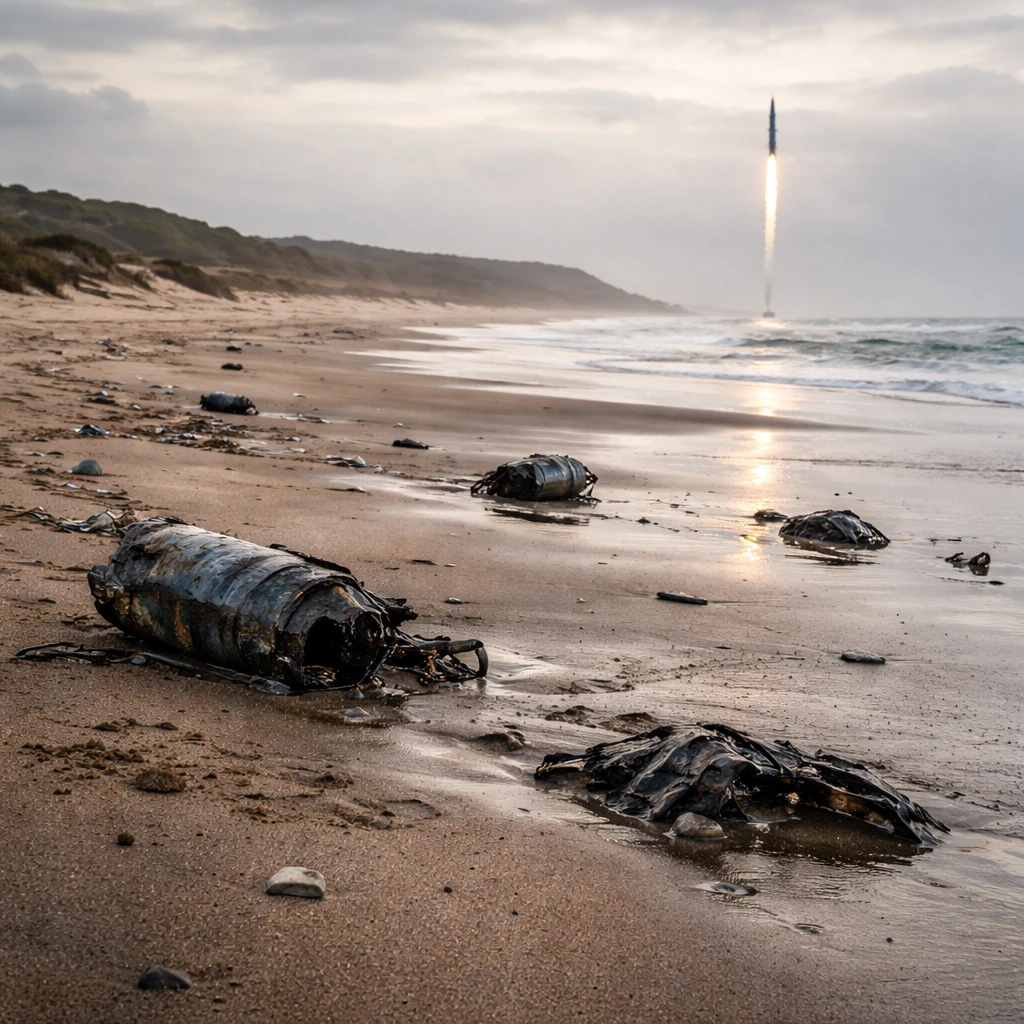
Mexico has moved to open formal talks with U.S. aviation and space regulators about how and when SpaceX may operate in or near Mexican airspace, and whether launches should be moved away from border-adjacent locations, President Claudia Sheinbaum said during a government press briefing.
Sheinbaum said the request is being handled through the Mexican Embassy and is aimed at securing a joint agreement between U.S. and Mexican space authorities on permission protocols for the use of Mexican airspace. The discussions would cover how frequently overflights or launch trajectories that enter Mexican airspace would be allowed and would include consideration of relocating the launch site if required.
"What we’re seeking through the Embassy is a meeting between the US and Mexican space authorities to establish permission for the use of Mexican airspace, how often that would be permitted, and, if necessary, the relocation of the launch site," she said. Sheinbaum added briefly that there is also a separate concern around debris: "And then there’s the issue of the debris."
The president framed the development against a backdrop of escalating political attention to SpaceX activities close to the U.S.-Mexico border. Mexican officials have accused the company of producing contamination and other environmental impacts when fragments from rockets launched in Texas fall onto Mexican territory. Authorities have also cited disruptions to national airspace as a point of concern.
Mexican officials have reported instances of rocket debris landing on Mexican soil. Earlier this month, authorities said parts attributed to the company washed up on a beach in the northeastern state of Tamaulipas. In response to that incident, SpaceX said it deployed specialists to help identify materials and to lead any necessary cleanup work. The company also stated that independent tests performed on materials recovered from Starship and the Super Heavy booster - including toxicity analyses - indicated they posed no chemical, biological, or toxicological risks.
Neither the U.S. State Department nor SpaceX had provided an immediate public reply to Sheinbaum’s announcement. The U.S. Embassy redirected inquiries to the State Department, which had not responded at the time of the president’s remarks. SpaceX has previously contested reports that its operations have caused environmental contamination.
The Mexican request seeks to formalize procedures for binational coordination over space launch activities that affect Mexican airspace and territory, to define permissible frequencies of use, and to explore relocation of operations if deemed necessary by Mexican authorities.
Key points
- Mexico has asked for a meeting between U.S. and Mexican space authorities to set rules for SpaceX use of Mexican airspace and to consider relocating launch operations.
- Allegations focus on environmental contamination and debris from rockets launched in Texas landing in Mexican territory, including debris reported on a Tamaulipas beach.
- Sectors potentially affected include aerospace and aviation regulation, environmental remediation services, and cross-border regulatory relations.
Risks and uncertainties
- Uncertainty over whether the United States will engage in the requested bilateral talks - the U.S. State Department had not issued an immediate response at the time of the announcement. This creates regulatory and diplomatic uncertainty for aerospace operators.
- Allegations of environmental contamination and debris landing on Mexican territory present a risk of further political and regulatory action by Mexican authorities, with possible impacts for launch operations and environmental services demand.
- Potential relocation of launch sites remains an open outcome pending discussions between the two countries, creating operational uncertainty for affected launch providers and regional planning.