
Lebanon plans to open a second international airport next month at Kleiat, a coastal airfield roughly 20 km (12 miles) from the Syrian border crossing, in an effort to stimulate economic activity in the country’s north. The move will create a second point of entry alongside Beirut international airport, whose operations have been disrupted in recent years by conflicts between Israel and Hezbollah.
Officials describe the Kleiat project - also designated Rene Mouawad Airport in honor of the president assassinated in 1989 - as driven by economic necessity and regional development goals. Fayez Rasamny, the minister of public works and transport, called the initiative "a national economic need" and said the private sector will put in $5 million to $6 million while the government improves the surrounding road network.
Initial operations and route plan
At launch, Kleiat Airport is expected to handle flights to Turkey, Egypt and Jordan, according to Rasamny. The government has granted Sky Lounge, a private operator, a four-year concession to run the facility under a public-private partnership arrangement. Sky Lounge’s chairman, Ziad Monla, said the administration wants the airport operational "as fast as possible," and that the company has secured an agreement with a local airline to operate services from the new facility while talks with regional and international carriers continue.
Monla has projected that the government could generate up to $20 million in revenue from the airport over a four-year period. He sees the airport serving both Syrian and Lebanese travelers and said it addresses long-standing neglect of the north. "The north has been forgotten for 30 or 40 years," he said.
Economic context and local expectations
Political leaders from Akkar had advocated for converting the disused Kleiat airbase into a civilian airport for years, arguing it would help lift an area widely regarded as Lebanon’s poorest. Akkar, a predominantly Sunni region that borders Syria, is home to more than 300,000 people and local politicians and business figures have framed the airport as a development priority.
Hamed Zakaria, a local political activist and businessman, said he had pressed officials for more than a decade to open Kleiat and voiced optimism that the facility will bring investment and attention to a neglected area. "Akkar is for development, for prosperity," he said.
Political shifts behind the project
The decision to move forward with Kleiat signals shifts in Lebanon’s internal power dynamics. The airport idea had encountered strong resistance from Hezbollah, an armed Shi’ite group backed by Iran, which objected to the plan in earlier parliamentary discussions. Hadi Hobeich, a former Akkar lawmaker, said he and a group of MPs from the region attempted to advance the project in 2022 and secured broad approval from other parties, but faced fierce opposition from Hezbollah, which raised questions about security arrangements and displayed "intense hostility" toward the proposal at the time.
Hezbollah’s media office did not respond to a request for comment. Political actors cited changes in the country’s balance of power since 2024 as a factor enabling the airport’s opening. That year, Israel engaged Hezbollah in two wars in under two years, and Syria’s president, Bashar al-Assad, a Hezbollah ally, was ousted, developments that senior political figures say significantly weakened Hezbollah’s sway over Lebanese government affairs. A politician close to Hezbollah said Assad had opposed the airport earlier, concerned it might come under the control of a hostile security force.
Since taking office in early 2025, Prime Minister Nawaf Salam has pursued an agenda that includes working toward Hezbollah’s disarmament and advancing the Kleiat airport project as part of broader government priorities.
On-the-ground preparations
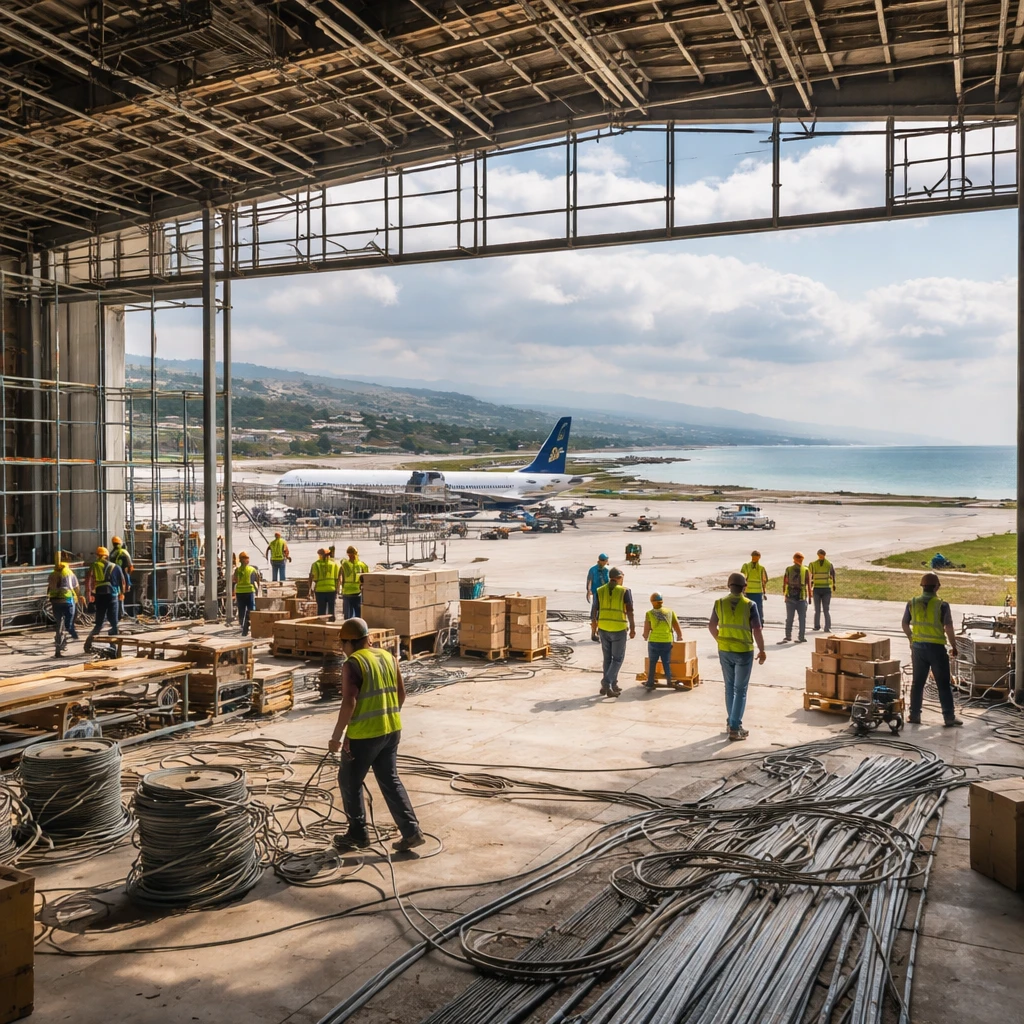
When the airport was inspected in early November, work was visibly underway to convert a hangar into a passenger terminal. Dozens of workers moved about the space where cables lay across the floor and scaffolding stood against unfinished walls, signaling rapid efforts to ready the facility for commercial operation.
The government has pledged infrastructure upgrades to link the airport with the surrounding region, while private investors contribute the initial capital for the airport operator. The combination of public upgrades and private investment is presented by officials as a practical route toward opening the airport quickly and maximizing immediate economic benefits for the north.
Implications and constraints
Local advocates and political backers portray the airport as a tangible step to reduce the long-term marginalization of Akkar. At the same time, the project’s progress reflects a notable reduction in the ability of Hezbollah and allied regional actors to block large infrastructure initiatives that have political and security dimensions.
Details remain limited about the full set of carriers that will commit to the new airport beyond the signed deal with a local airline and ongoing negotiations with other carriers. The concession to Sky Lounge is for four years, and the longer-term operational and commercial performance will determine the airport’s contributions to regional growth.
Summary
Kleiat Airport is set to open next month as Lebanon’s second international airport, aiming to stimulate development in Akkar. The project involves $5-6 million in private investment, government road upgrades, a four-year concession to Sky Lounge, and initial routes to Turkey, Egypt and Jordan. Its advancement signals a change in Lebanon’s political landscape after events that weakened Hezbollah’s influence.