
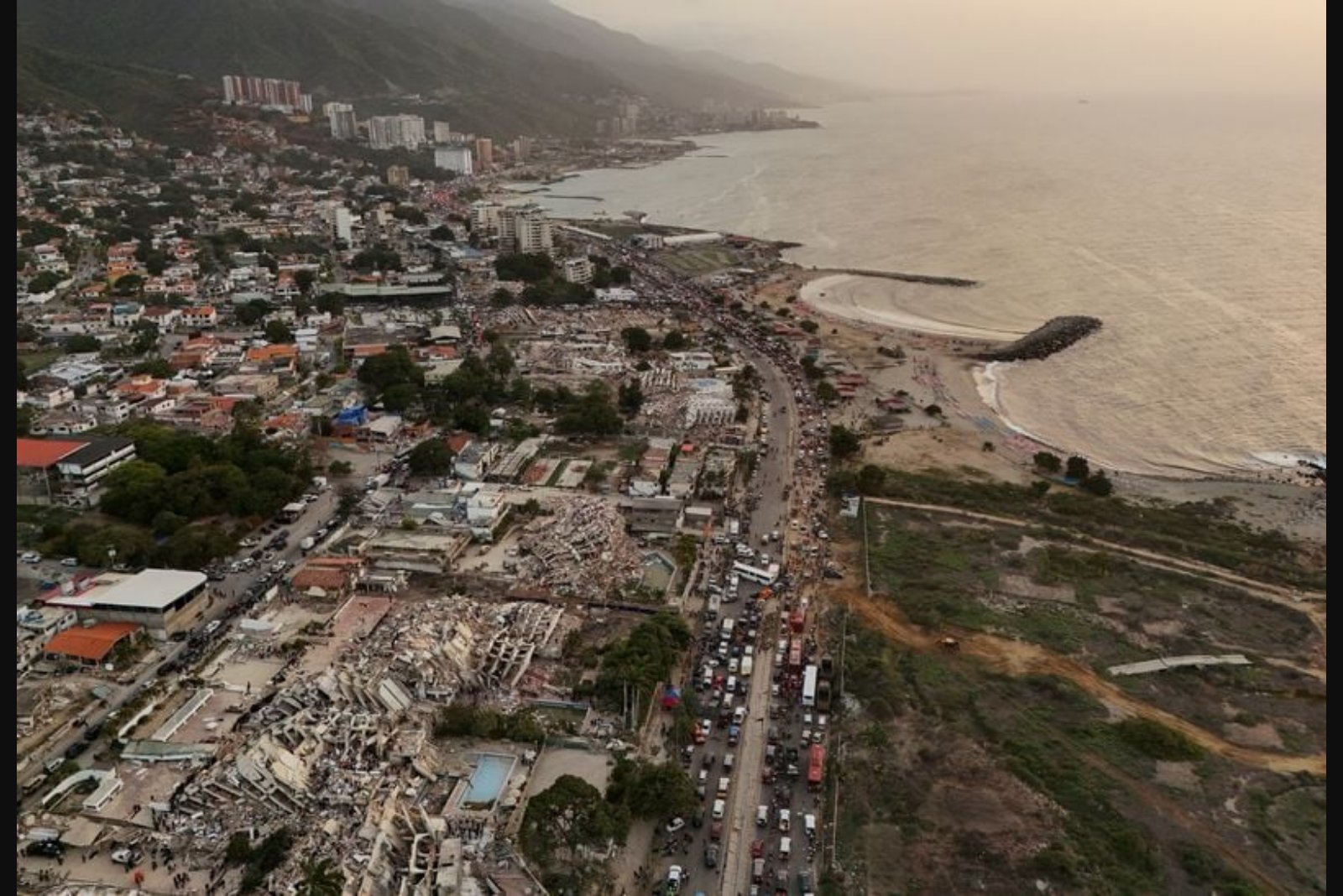
Rescue operations across Venezuela intensified over the weekend after two powerful earthquakes struck the country, with international teams arriving in the hardest-hit coastal state of La Guaira. Authorities reported 33 people rescued so far during the weekend, including children, while official and opposition-linked tallies show tens of thousands still unaccounted for. The official death count climbed above 1,400 as of Saturday.
Foreign rescue personnel poured into La Guaira, where families and local volunteers had been laboring for days to pull survivors and bodies from collapsed buildings. More than 1,600 foreign rescue workers arrived to assist. Volunteers frequently complained about a shortage of heavy machinery and a limited official presence prior to the international teams' arrival, and hundreds of aftershocks continued to damage structures and keep residents on edge.
The government, which is headed by interim President Delcy Rodriguez since her predecessor was removed by the U.S. in a January raid, initially thanked civilian volunteers who were ferrying aid into La Guaira. Authorities then sharply tightened access to the main road into the coastal state - citing traffic that they said was preventing the efficient movement of emergency vehicles - and announced that only accredited personnel would be permitted to use the roadway.
A website promoted by the country’s political opposition listed just under 50,000 people as unaccounted for on Sunday, a slight decline from Saturday when roughly 55,000 were marked as missing. The government has described the number of people missing or trapped in various locations as numbering in the hundreds, while the opposition-linked list reflects a much larger total of unaccounted-for residents.
Limited time to find survivors
Rescue teams warned that the window for finding people alive in the rubble is rapidly closing. The U.S. Geological Survey estimated that more than 10,000 deaths were possible from the magnitude 7.2 and 7.5 earthquakes, a projection that would place these quakes among the deadliest in Latin America over the last century. Responders emphasized that the probability of saving live victims drops sharply after roughly three days.
"There exists a window of roughly three days, 72 hours, where the probability afterwards decreases that you can save people alive,"
said Sebastian Eugster, the leader of the Swiss rescue team, on Saturday. His 80-strong team had detected multiple people alive under debris with the help of eight search dogs, he said, but in several cases they were unable to extract them in time to save them. Saturday evening marked 72 hours since the quakes struck.
Eugster said the Swiss team would coordinate with other foreign teams and local authorities to determine when active rescue operations would conclude, and that his personnel planned to remain on the ground to support other relief tasks once rescue work ended.
Children and survivors pulled from rubble
Several rescues drew international attention. U.S. rescue crews posted video showing the extraction of an infant wrapped in a blanket and crying after being removed from the debris. A Colombian rescue team used a scanner to locate an 11-year-old boy named Moises, who had been trapped roughly three meters deep. He was carried out on a stretcher with a broken arm and his eyes covered with cloth to shield him from the shock of daylight; his mother and sister were killed, officials said.
Mexican teams also reported saving an 11-year-old boy in the town of Caraballeda, a rescue that interim President Rodriguez shared on the social platform X late on Saturday with footage of crews carrying what appeared to be a small figure on a stretcher. Rodriguez said, "In these hours each life is hope for Venezuela," and the government circulated video of her meeting with international rescuers and of a young man being removed from ruins.
The government has said more than 3,000 people were injured and a similar number were living in temporary shelters following the quakes.
On-the-ground conditions and search methodology
In Caraballeda, U.S. rescuers were reported to be working alongside remaining civilian volunteers, many of whom were still searching for their own relatives. Early in the response, rescuers had spray-painted debris with the name of the apartment building that had stood on the site. By Saturday evening, teams had begun marking ruins with codes indicating they believed no living people remained in those particular structures.
Hundreds of aftershocks complicated efforts, increasing the danger for search teams and further damaging already weakened buildings. Volunteers and some officials described a scarcity of heavy equipment during the initial days following the earthquakes, an issue international teams sought to address as they moved in.
International response and funding
Global actors moved to coordinate aid. European Union foreign policy chief Kaja Kallas said on X that the EU had mobilized 5 million euros in emergency assistance and that the Copernicus satellite system was being used to map damage and guide relief to the hardest-hit areas. A senior U.S. official said on Saturday that a U.S. funding package worth hundreds of millions of dollars was expected to be announced within the next day or so, in addition to $150 million that the Trump administration had already committed.
Pope Leo on Sunday told worshippers gathered for the Angelus prayer in Rome that he wanted "to express my closeness to the Venezuelan sisters and brothers affected by the recent earthquakes" and he expressed gratitude to rescue workers.
Political and infrastructure implications
Officials and analysts have warned that the disaster could carry political consequences for interim President Rodriguez, who has presented herself as an agent of change even though she previously served as vice president under predecessor Nicolas Maduro. The government’s handling of access to the affected zones, casualty figures and coordination with foreign teams will remain under scrutiny.
Power was gradually being restored across the region after widespread outages. The article notes that Venezuela’s power grid has been crippled by years of underinvestment and economic sanctions, and that it regularly experiences problems that lead to daily, hours-long blackouts in some areas. That systemic fragility has bearing on relief operations, shelter conditions and the capacity to deliver sustained aid.
As international teams continue to search damaged neighborhoods and coordinate with local volunteers and officials, responders face narrowing timelines, persistent aftershocks and logistical constraints. The next phase of activity will likely shift from urgent rescue to broader relief, recovery and reconstruction tasks as teams on the ground reassess where live rescues remain feasible and where the needs are primarily humanitarian and infrastructural.