
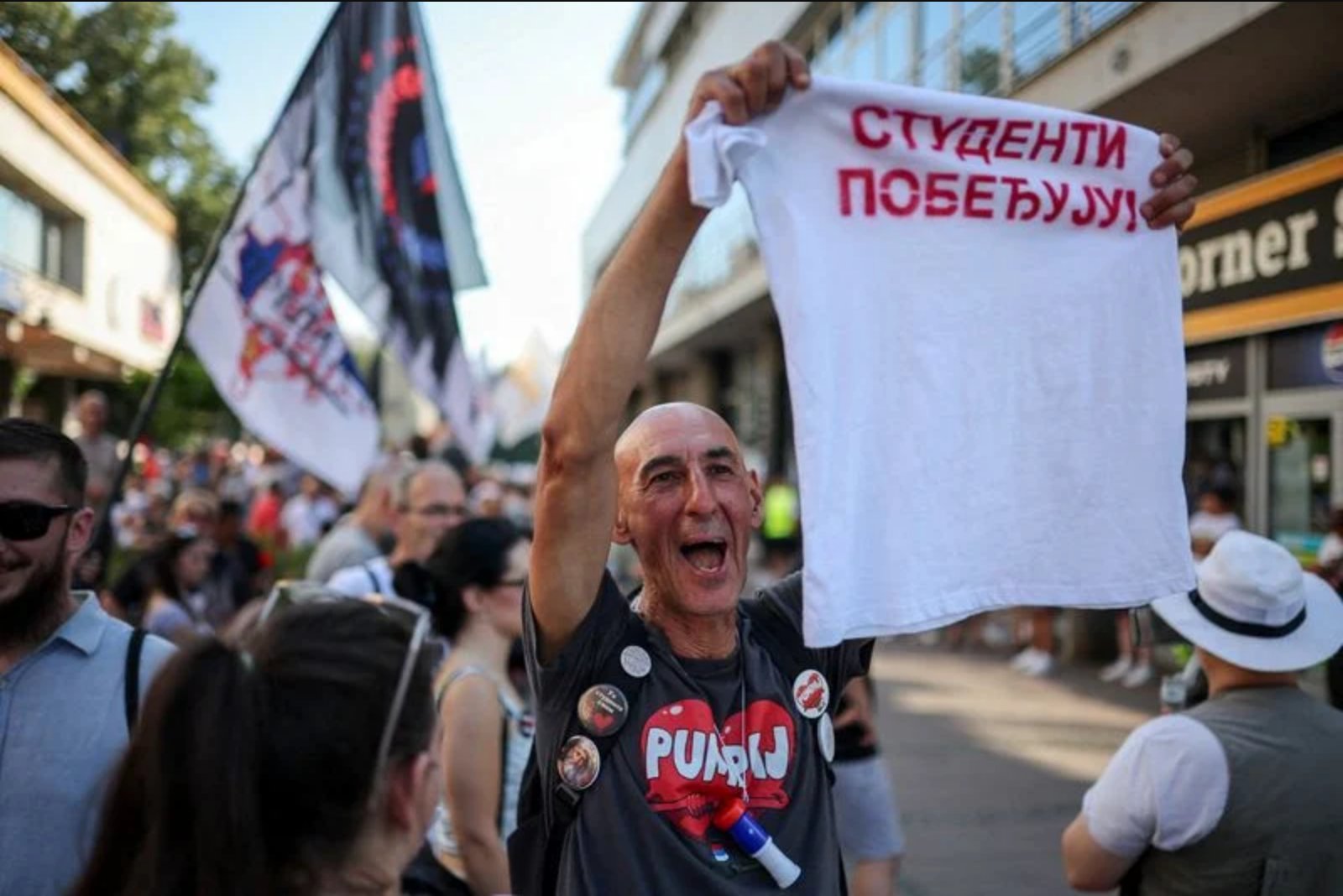
On June 28, thousands of people were set to gather in the Serbian city of Kraljevo, one day after President Aleksandar Vucic said he would step down - a move that clears the way for early presidential and parliamentary elections.
Vucic has held top government office for 12 years, serving as either prime minister or president. The latest wave of demonstrations has been driven largely by students and was sparked by a fatal incident in late 2024: the collapse of a concrete awning at a railway station in Novi Sad that killed 16 people. That tragedy has been widely cited by protesters as emblematic of perceived government mismanagement and corruption under Vucic.
Organisers and participants said the protests have grown into the largest in Serbia since the overthrow of Slobodan Milosevic in 2000. Vucic, for his part, denies any corruption.
In Kraljevo on Sunday, people braved hot conditions to attend rallies in the city centre. Sellers were present offering T-shirts bearing slogans associated with the movement. What began with demands for accountability and justice for the victims of the Novi Sad incident expanded into calls for Vucic to step down and for early elections.
"This is not just a political struggle but a fight between good and evil," said Jelena Danicic, a Serbian language professor who met friends in the city centre before the rally.
Many demonstrators said they were heartened by Vucic's announcement but remained skeptical that he would exit the political stage altogether. Analysts cited by participants said Vucic might pursue another route to retain power - potentially running for prime minister and placing an ally in the presidency - which would allow him to continue exerting influence.
"I cannot imagine that he will step down and leave power to someone else," said Marko Djokic, a 41-year-old IT expert who returned to his home city for the protests.
The developments are being observed closely beyond Serbia's borders. The country, located on the eastern edge of Europe, remains a candidate to join the European Union while maintaining strong ties with Russia and China. That balancing act has been a recurring theme in domestic politics and foreign policy under Vucic.
Before accession to the EU can proceed, Serbia must demonstrate improvements in rule of law, including ensuring conditions for free and fair elections, and take steps to root out corruption and organised crime. The country also needs to align certain foreign policy positions with the bloc and establish relations with Kosovo, which declared independence in 2008.
Brussels and Moscow were reported to be watching events closely in the days following the president's announcement. The EU has also publicly criticised the use of force against peaceful protesters and flagged concerns about press freedom and the independence of the judiciary.
As protesters continued to mobilise, the immediate picture remained one of uncertainty: a sizable public movement seeking political change and an announcement by the incumbent president that may or may not signal a complete transfer of power.