
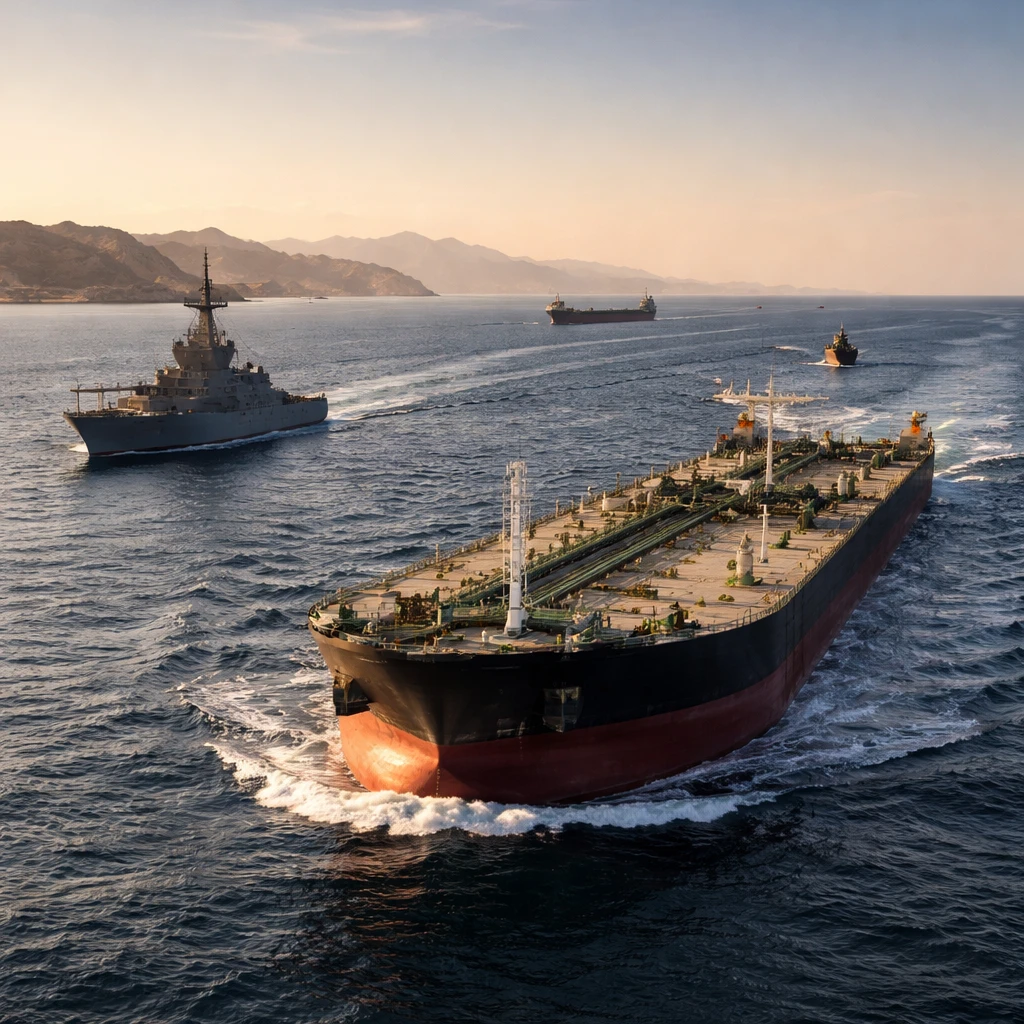
Iran's attempt to use the Strait of Hormuz as leverage over global oil supplies is weakening as U.S. actions help Gulf exporters keep crude shipments moving, even amid ongoing hostilities, according to reporting based on recent shipping and market data.
A U.S. naval blockade has restricted Iran's ability to ship oil from the Persian Gulf since July. At the same time, Washington has assisted Gulf Arab countries in transporting sizable quantities of crude through the strait despite repeated Iranian missile and drone strikes on regional shipping and facilities.
Data from TankerTrackers.com shows that about 5 million barrels a day of crude - almost none of it Iranian - traversed the Strait of Hormuz on average during the most recent 28-day period. In addition, roughly 2.5 million barrels a day were moved through ports in the Gulf of Oman, including Fujairah in the United Arab Emirates. Those flows constitute more than 40% of the region's prewar oil throughput.
Global crude prices have so far remained below $100 a barrel, a level that has been supported in part by China tapping domestic reserves and curbing imports. The continuation of substantial volumes through Hormuz has undercut Tehran's earlier expectation that closing or constricting the strait could trigger a broader economic shock worldwide. At the same time, U.S. naval measures have not compelled Iran to reverse its restrictions on the waterway or led to changes in the Iranian government's wider conduct.
Inside Iran, economic indicators point toward mounting pressure. The rial has depreciated, inflation is rising, and gasoline shortages are increasingly common. President Masoud Pezeshkian has stated that the country's trade has fallen between 25% and 35% - a contraction that aligns with other signs of domestic strain. Tehran's earlier estimate that it could tolerate about five months of intense economic pressure is approaching its limit, raising difficult strategic choices for the government.
Iran has continued to target tankers and U.S. military assets in the region, yet it has so far refrained from carrying out larger strikes directed at Saudi Arabia or the UAE. The United States, for its part, has likewise avoided attacks on major Iranian cities or direct strikes against the country's present leadership.
Other Gulf economies are feeling the effects as well. Shipments of liquefied natural gas, fertilizer and other commodities remain constrained, a problem particularly acute for countries that lack alternative sea outlets.
Facing the end of its estimated tolerance for severe economic pain, Tehran confronts a narrow set of options: return to negotiations or escalate militarily to try to increase pressure on Washington. The upcoming U.S. midterm elections in November could complicate Tehran's calculus; Iranian leaders may see limited incentive to ease restrictions and reduce energy prices before voters go to the polls, potentially leaving oil markets vulnerable to renewed escalation around Hormuz.
Summary
U.S. naval support and alternative shipping through the Strait of Hormuz have allowed significant Gulf crude volumes to continue moving, limiting Iran's ability to force a global energy shock while domestic economic conditions in Iran deteriorate six months into the conflict.