
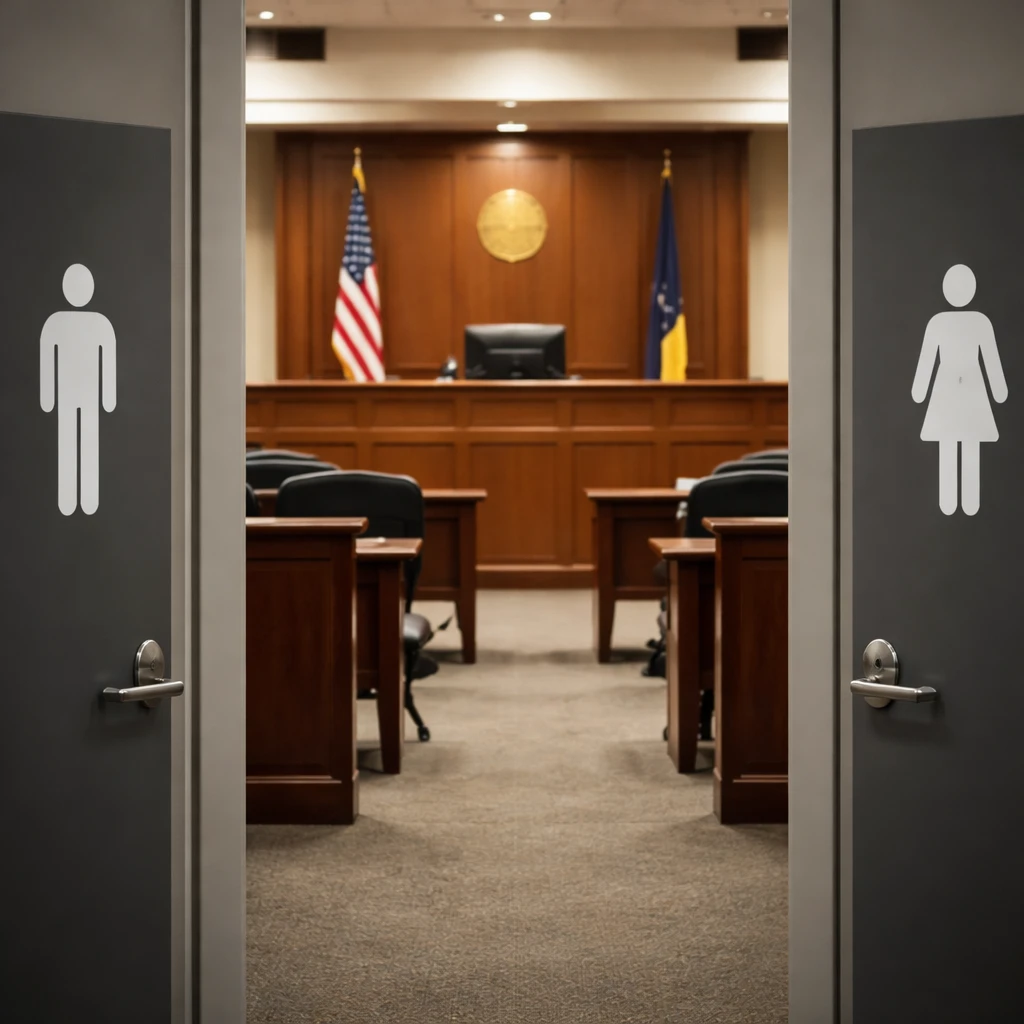
A federal judge in Boise on Tuesday moved to restrict Idaho’s ability to implement a new state law that would make it a crime for transgender people to use public restrooms that do not correspond with the sex they were assigned at birth. The statute, which carried criminal penalties including up to five years behind bars for repeated violations, had been scheduled to take effect on July 1.
U.S. District Judge Amanda Brailsford issued a preliminary injunction in a class-action lawsuit challenging the measure’s constitutionality, limiting the state’s ability to enforce key portions of the law while litigation continues. Brailsford’s order specifically permits transgender individuals to continue using single-stall restrooms that align with their gender identity. It also allows use of a multi-stall restroom when a single-stall facility is not available on the same floor of a building.
Beyond those narrow permissions, the court’s injunction does not block Idaho from enforcing the statute in other respects. The state remains able to enforce the law as it applies to multi-user bathrooms and to portions of the statute that address public locker rooms and shower facilities, areas that were not part of the legal challenge before the court.
The plaintiffs in the case had sought a more narrowly tailored temporary bar on what they described as the most burdensome components of the statute, but they are pursuing a final judgment that would strike down all restroom restrictions in the law. Their complaint contends the statute infringes on rights guaranteed by the 14th Amendment - specifically due process, equal protection and privacy.
In a 30-page opinion, Judge Brailsford ruled in favor of the plaintiffs on the due process claim. She found that the law’s law-enforcement provisions are likely unconstitutionally vague, a determination she said was sufficient to warrant an injunction even before the court addresses the plaintiffs’ claims under privacy and equal protection theories.
State safety rationale and the court response
Supporters of the law have argued its purpose is to enhance safety in public restrooms and prevent instances of sexual assault or voyeurism allegedly committed by men who would pose as transgender women. In her opinion, Brailsford acknowledged the state’s legitimate interest in "promoting bodily privacy and protecting women and children in public restrooms from those who may seek to do harm," but she concluded those public-safety concerns can be addressed by existing criminal laws "without infringing upon plaintiffs’ constitutional rights."
The plaintiffs counter that the statute, rather than improving safety, will expose transgender people to "likely violence, harassment and psychological harm." Their complaint further asserts that the Republican-controlled Idaho legislature "relied on inaccurate beliefs and stereotypes about transgender people" when drafting the law, "conflating transgender people with sexual predators."
Scope of the Idaho statute and related measures
The Idaho law had stood out among similar measures enacted in roughly 20 states by making criminal penalties a mechanism for enforcement. According to a count cited in the litigation, only three other states - Utah, Kansas and Florida - employ incarceration as a potential enforcement tool for comparable statutes. Idaho’s measure is broader in scope and carries stiffer penalties than those other laws.
Under the Idaho statute, it would be a crime to enter a restroom, changing room or shower that is designated for the opposite biological sex in locations such as government buildings, restaurants, stores and other private businesses when those facilities are open to the public. The first offense would be classified as a misdemeanor, punishable by up to one year in jail. A second offense within five years would be elevated to a felony, with a maximum sentence of five years imprisonment.
Idaho had previously enacted two separate laws that restrict access to bathrooms on public school campuses and college campuses in cases where a student’s birth sex corresponds to the gender designation of the facility. Those statutes permit students to seek enforcement through civil suits if they encounter a transgender person they believe is in violation. Both of those earlier education-focused laws are themselves the subject of legal challenges and remain in effect while they proceed through the courts.
Next steps
The court’s preliminary injunction will remain in place while the class-action lawsuit advances toward a final determination on the constitutional claims. The judge’s finding on vagueness leaves undecided the plaintiffs’ privacy and equal protection arguments, which the court has not yet ruled upon. Meanwhile, portions of the statute not covered by the injunction may be enforced by state authorities.