
Stryker Corporation’s October guidance revision looked at first like a headline problem - management reduced full-year organic growth expectations to a 6.5%–7.0% range from a prior 8.3%–9.3% forecast. The market reacted immediately: Stryker shares fell 12.3% in after-hours trading to $273.45 on October 29. Yet the decline proved short-lived. From that late-October entry point the stock climbed 19.4% to trade near $325.87, including an 11.7% gain during November alone.
The sharp rebound reflects contrasts that often appear inside healthcare: insurers face rising medical loss ratios and compressed forward profit outlooks, while specialized device makers collect high-margin revenues on each procedure without underwriting insurance risk. The article cited CVS Health as an example of an insurer contending with elevated loss ratios; device manufacturers like Stryker, by contrast, earn hardware and consumables revenue every time a procedure is performed.
Market reaction and model-driven positioning
Quantitative selection models highlighted the stock’s relative appeal even before the guidance cut. InvestingPro’s ProPicks AI placed Stryker into a Healthcare Heroes strategy on October 1 at $272.96. That positioning—together with a focused portfolio of resilient healthcare operators—meant the name was already being held in active strategies when the guidance revision occurred.
Investors who viewed the sell-off as an overreaction could point to structural factors that limit downside: installed robotic systems create recurring consumable demand, margins have widened despite operational headwinds, and management has continued to convert earnings into cash and shareholder returns.
The economics inside the operating room
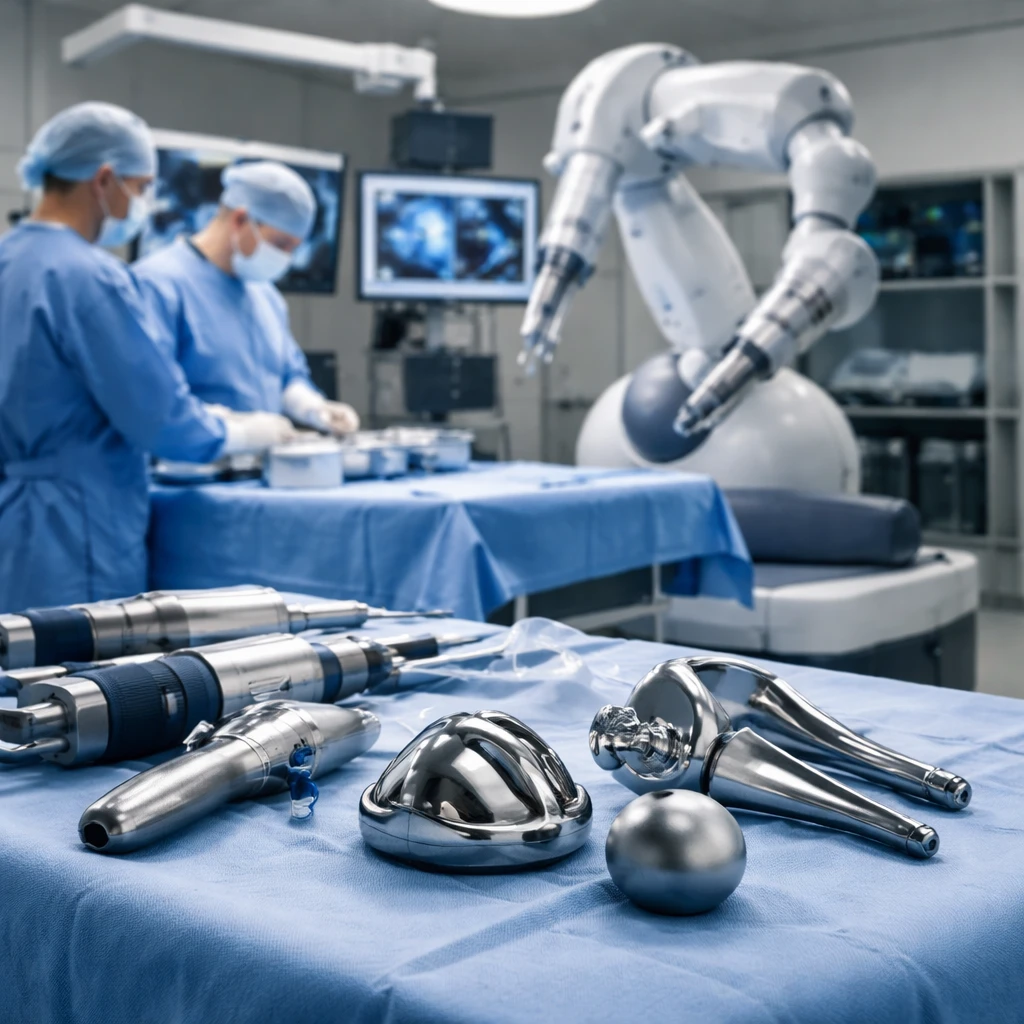
Stryker’s revenue model in orthopedics creates a durable annuity once hospitals or ambulatory surgery centers install systems such as the Mako robotic arm. Each robotic placement increases the probability that subsequent procedures will use Stryker’s proprietary implants for knees, hips and shoulders. Management reported more than two million procedures completed worldwide, and each installed unit supports multi-year, high-margin consumable sales.
That installed base dynamic was evident in the third quarter. While broader industry hip and knee procedural growth slowed to roughly 2.5% amid greater pre-authorization friction and higher patient deductibles, Stryker’s Ortho Tech division delivered 18% U.S. organic growth driven by Mako adoption and orthopedic power tools. At the same time, Stryker’s MedSurg and Neurotechnology businesses grew organically by 9.1%, helped by a 13% increase in U.S. Endoscopy sales. Consolidated quarterly revenue reached $6.52 billion, equal to 7.7% organic growth.
Strategic expansion and product breadth
Stryker is not limiting itself to joint replacement robotics. In October the company announced a $400 million preferred equity investment in CMR Surgical that secures exclusive U.S. commercialization rights to the Versius robotic platform and includes an exclusive option to acquire the company outright. The structure was presented as a capital-efficient way to de-risk a push into soft-tissue procedures and to position Stryker against Intuitive Surgical in that segment.
Additionally, the acquisition of ZuriMED expands Stryker’s shoulder portfolio by adding soft-tissue augmentation technology. These moves broaden the company’s addressable market beyond hard-tissue joint replacements and reinforce recurring consumable streams tied to installed robotic platforms.
Margins, earnings and cash conversion
Despite near-term supply chain and systems transition friction, Stryker reported margin expansion in the quarter. Adjusted gross margin widened 40 basis points year-over-year to 65.4%. Adjusted operating margin increased by 60 basis points to 26.2%, and adjusted earnings per share rose 10.3% to $3.52.
Cash flow performance further supported shareholder returns and the balance sheet. Stryker generated $3.3 billion in operating cash flow through the first nine months of the year, a 14% increase versus the prior year. That liquidity funded a $1 billion share repurchase in the third quarter, accompanied by a new $3 billion buyback authorization, and sustained an unbroken 16-year dividend growth streak. The company’s Piotroski Score was noted as a 9, signaling favorable fundamental indicators across profitability, liquidity and operating efficiency.
Valuation, analyst revisions and upside potential
Even after the October sell-off and the subsequent rebound, valuation multiples remain tied to cash-flow expectations. The stock traded at 19.4 times forward earnings in the reported comparison, compressing to 17.7 times in 2027 and 15.7 times by 2028 when applying consensus EPS projections of $14.91, $16.32 and $18.40.
Analysts responded to the guidance change with downward estimate revisions: 17 analysts lowered forward earnings estimates over the 90 days following the guidance reset, bringing the median analyst price target to $341.37. At the same time, InvestingPro’s valuation aggregation of discounted cash-flow and relative-multiple frameworks produced a Fair Value estimate of $352.99 per share. Based on that benchmark, there remained an implied additional 8.3% upside from the post-earnings advance, suggesting the sell-off had left shares below modeled intrinsic earnings power.
How this matters beyond Stryker
The episode highlights a broader distinction in healthcare: manufacturers of high-margin medical devices convert procedural volume into recurring revenue without assuming insurance underwriting risks. That creates a different cash-flow profile from payers, who can face deteriorating medical loss ratios and compressed profitability when utilization or costs rise.
For investors, the Stryker example underscores the importance of examining installed-base economics, consumable revenue durability, margin trends and free cash flow when assessing resilience after a headline guidance change. At the same time, concentration risk exists: leadership within healthcare sub-sectors can shift as hospital capital budgets and insurance dynamics evolve, which can affect capital allocation and growth opportunities for device makers.
Access and data
The article noted that detailed schedules for Mako robotic placements, procedural volume recovery metrics and operating margin forecasts are available inside the Stryker Pro Research Report. It also referenced InvestingPro’s data-driven strategies as an example of a systematic toolset that evaluates thousands of balance sheets monthly to identify undervalued leaders and rotate capital into fresh opportunities. For investors seeking high-conviction ideas in the active November portfolios, full access to all ProPicks AI strategies was listed at $9 a month.
All data and financial metrics in this piece are reported as of November 9, 2026.