
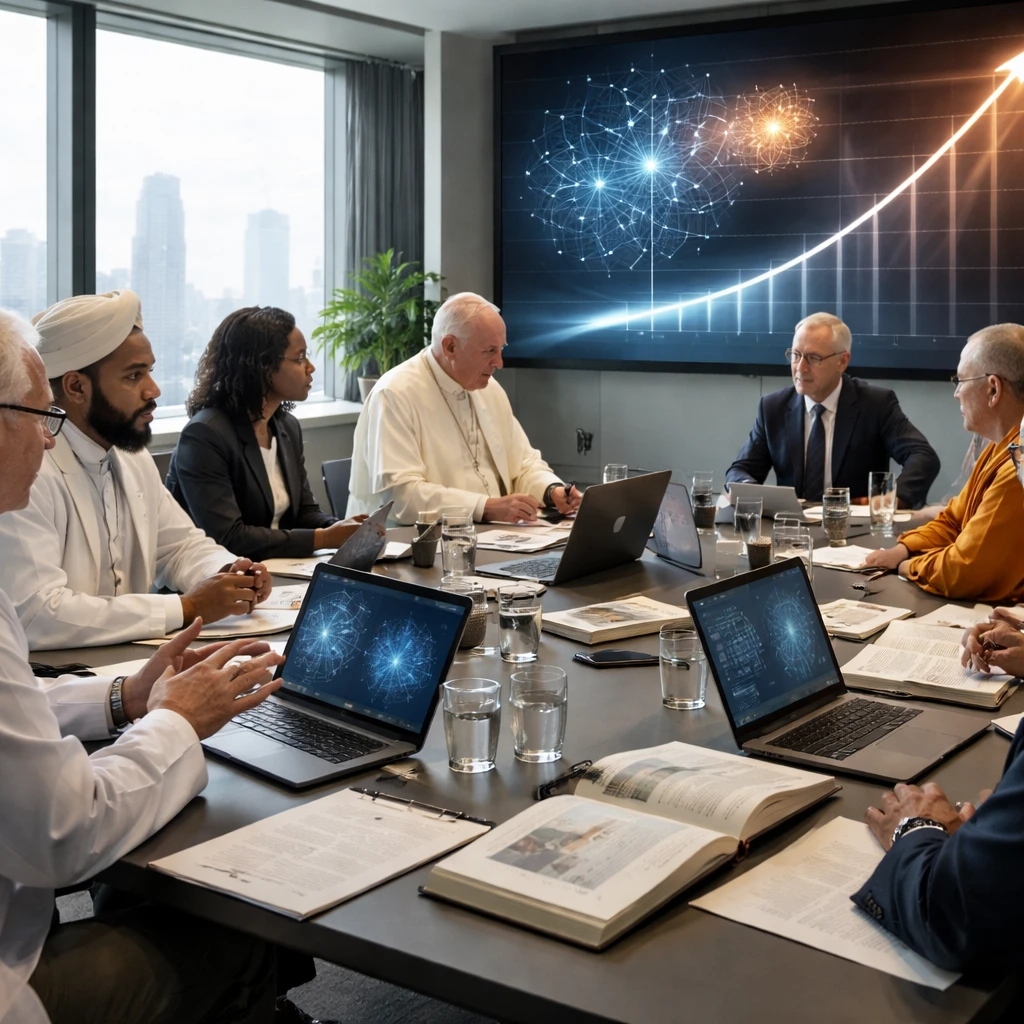
An independent scientific panel convened under United Nations auspices delivered a stark assessment on July 1: the complexity of tasks handled by artificial intelligence systems is accelerating, doubling roughly every 4 to 7 months. The group concluded that current scientific understanding cannot guarantee that, as capabilities continue to increase, AI will not cause catastrophic harm - whether through autonomous malfunction or malicious use.
That technical forecast intersected with visible signs of market momentum and public debate in the same week. Reporting cited by Lutheran Science & Technology indicated OpenAI was preparing an initial public offering that could value the company around $1 trillion. Financial instruments tracking the sector showed mixed but generally strong performance: the TCW Artificial Intelligence ETF (NASDAQ:AIFD) closed Wednesday at $53.74, down 3.05% on the session but markedly above its 52-week low of $28.86; the Robo Global Artificial Intelligence ETF (NASDAQ:THNQ) closed at $90.50 and was indicated up about 0.55% in pre-market trading ahead of Thursday’s open, according to Investing.com data.
The juxtaposition of surging capital and rising apprehension has taken on moral and theological dimensions. On June 27, Pope Leo XIV issued an encyclical titled Magnifica Humanitas that warned against what he called the "Babel syndrome" - the idolatry of technology produced without reference to God. In the encyclical he cautioned against "the idolatry of profit that sacrifices the weak, a uniformity that neutralizes differences, and the pretense that a single language - even a digital one, can translate everything, including the mystery of the person, into data and performance." In the Pope’s framing, the allegory of the Tower of Babel is not simply a pause in human ambition but a collapse.
Tech industry leaders offered a counterpoint. SoftBank CEO Masayoshi Son defended the technology’s trajectory, declaring: "It’s blasphemy against AI if you say it’s a bubble. It’s just the beginning." Cultural commentators have also weighed in. Australian essayist Anna Goldsworthy, in a Quarterly Essay published June 28, framed AI as a mirror of humanity, asserting that it reflects "its evasions, fantasies, cruelties and consolations," and adding a memorable line: "The god that may destroy us is the god of ourselves."
Beyond moral debate, economic institutions have signaled structural concerns. The Bank for International Settlements, in its annual report released June 30, warned that if AI displaces a material share of human labor, the result could be collapsing purchasing power among workers and a subsequent stall in investment. The BIS cautioned that in such a scenario "productivity stalls not because of technological limitation, but because the demand to justify further capacity expansion is missing." Capital spending by hyperscalers on AI infrastructure is projected to reach $1 trillion in 2026, and Goldman Sachs has estimated cumulative hyperscaler investment of $7.6 trillion through 2031 - large-scale figures that feed the debate about whether demand could ultimately lag behind supply.
The debate about acceptable risk has also surfaced within private research organizations. Anthropic reportedly hired a Stanford economist who, according to reporting cited by Futurism, argued that a 33 percent chance of human extinction could be an acceptable trade-off for the economic gains AI could generate. The argument itself has not been made public, but the hiring and the described calculus crystallized public concern that a safety-focused lab might enshrine a risk assessment far outside mainstream tolerance.
Differences in perspective between experts and the broader public were underscored by a July 1 survey published in the journal AI & Society. The survey found "radically different visions" of an AI-automated future, with technology experts emphasizing potential benefits while everyday users were more focused on hazards.
United Nations Secretary-General António Guterres responded to the panel’s findings with a cautionary note about governance, saying: "The world cannot govern what it cannot understand." He added that while the potential of AI is great, the risks are real and the cost of delay in addressing governance issues is rising.
Religious organizations and ethicists are preparing formal responses. The ELCA Theological Ethics team is drafting a paper that applies denominational social teaching to AI use, and the 2027 Lutheran Ethicists Gathering has allocated a full session to AI ethics across denominations. How these doctrinal deliberations might influence public policy, IPO prospectuses or congressional testimony remains uncertain.
For now, financial markets continue to allocate capital to AI-related bets. THNQ has posted a 63.5% gain over the past 52 weeks, while AIFD has nearly doubled from its low earlier in the year. Those moves suggest investors are willing to fund ambitious AI projects even as scientists, faith leaders and economic institutions warn of potential systemic and existential costs.
Summary
The UN panel reported rapid increases in AI task complexity and warned of unresolved risks of catastrophic harm. That technical assessment coincided with major investment activity, doctrinal statements from religious leaders, central banking concerns about demand effects and reports of controversial internal risk calculations at research labs. Markets continue to show strong inflows to AI-focused funds despite growing public debate.
Key points
- UN independent panel: AI task complexity doubling every 4 to 7 months and no scientific guarantee that catastrophic harm can be avoided as capabilities grow.
- Capital markets: OpenAI reportedly preparing for an IPO at around $1 trillion valuation; ETFs tracking AI show recent strong returns and continuing investor interest.
- Institutional and moral debate: Religious leaders, central banks and corporate actors are publicly debating trade-offs between economic growth and systemic or existential risks.
Risks and uncertainties
- Labor market and demand shock - If AI materially displaces human labor, worker purchasing power could fall and investment could stall, risking broader macroeconomic slowdown; this chiefly affects labor-intensive sectors and aggregate demand-sensitive markets.
- Existential and governance uncertainty - The UN panel and reported internal risk calculations at private labs raise questions about whether current governance and scientific understanding are sufficient to prevent catastrophic outcomes.
- Market concentration and capital allocation - Heavy hyperscaler investment and large projected capital spending might lead to imbalances if demand for additional capacity fails to materialize, affecting technology, infrastructure and financial sectors.