
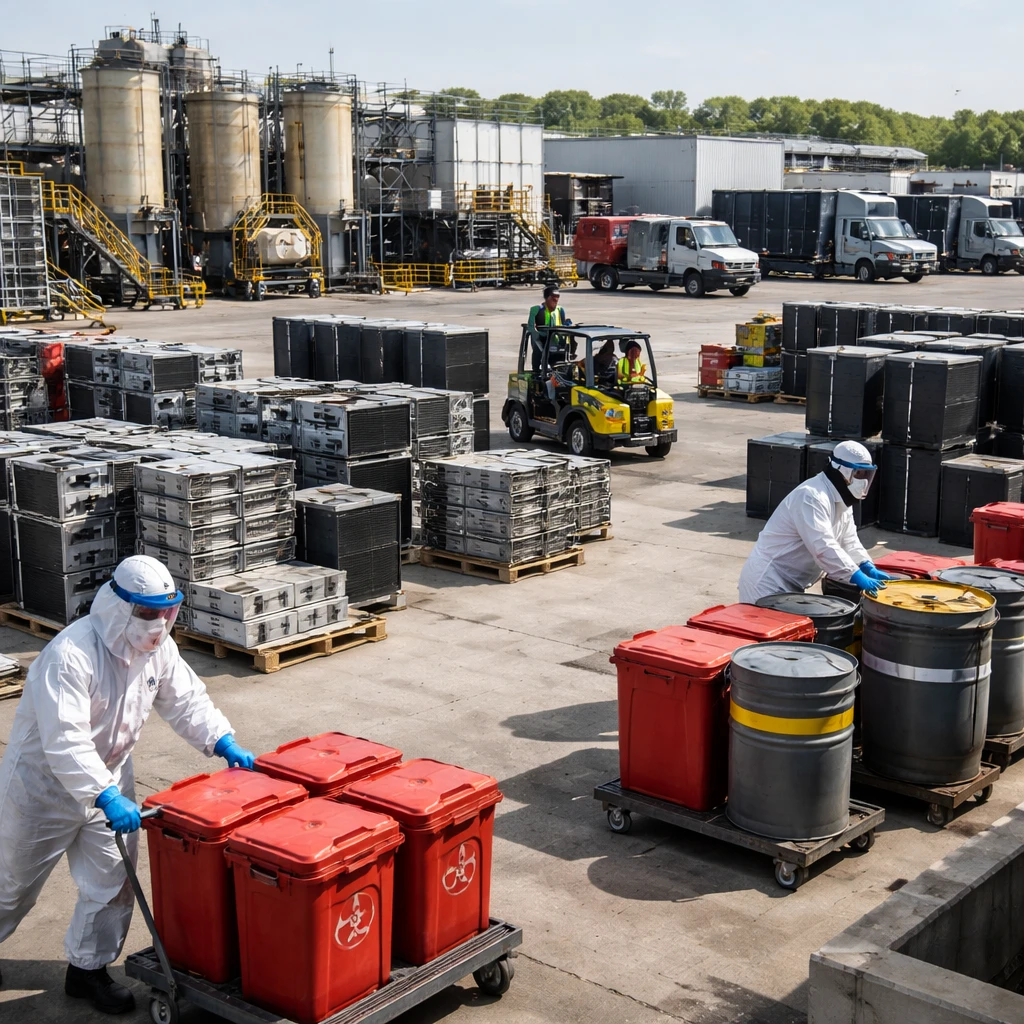
The market for medical waste management is projected to expand from $23.1 billion in 2025 to $46.3 billion, and that structural rise in regulated waste volumes is intersecting with an AI-driven data center expansion to form what analysts describe as a multi-year supercycle for specialized waste processors.
Clean Harbors (NYSE:CLH), the largest U.S. handler of hazardous and medical waste, sits squarely at the juncture of these dynamics. The stock has gained roughly 27.2% year-to-date in 2026 and trades near $298, with a consensus analyst price target of $319. On June 27, 2026, CLH was simultaneously added to the Russell 1000 Growth and Russell 1000 Value indices - a dual inclusion that forces index-tracking funds to initiate or enlarge holdings as part of rebalancing. That mechanical demand has amplified the company's market visibility heading into the second half of the year.
The upswing in medical waste volumes is primarily anchored to healthcare expansion and stricter disposal rules. Hospitals, outpatient centers and pharmaceutical manufacturers are producing more regulated, biohazardous material that requires certified handling. Clean Harbors’ integrated network of treatment and disposal facilities affords it pricing leverage that smaller regional operators lack. In addition to medical waste, the company processes industrial chemicals and contaminated soils, tying a portion of its revenue base to regulatory compliance spending rather than discretionary budgets - a resilience trait that has drawn institutional buyers beyond the Russell reconstitution flows.
Beyond medical waste, a second growth vector emerges from the AI infrastructure buildout. Goldman Sachs has estimated $7.6 trillion in cumulative AI-infrastructure capital expenditures between 2026 and 2031, according to a data center underwriting report referenced by GlobeNewswire. Each GPU cluster and accelerator generation has an eventual retirement and decommissioning cycle. As hyperscalers refresh hardware to install successive accelerator generations, the volume of retired equipment requiring certified IT asset disposal will compound.
Public-sector procurement is already reflecting that hardware demand. Reporting dated June 30, 2026 indicated that the U.S. federal government increased its AI contract count from 472 in 2022 to more than 1,700 in 2026, with $90 billion in spending led by the Department of Defense. That wave of contracts contributes to sustained hardware turnover, which in turn creates a larger stream of IT assets entering the certified disposal pipeline.
Parallel to durable demand, upstream and downstream capacity signals are appearing. The global recycling inspection market - which supports sorting infrastructure for e-waste flows - is projected to grow from $1.38 billion in 2026 to $1.95 billion by 2031, per a GlobeNewswire report published July 1, 2026. That expansion suggests capital is already moving into the processing layer needed to handle accelerating data center scrap.
Large-cap municipal and commercial collectors are also benefiting from related construction and demolition volumes tied to data center builds. Waste Management (NYSE:WM) is up roughly 18.58% year-to-date, according to Yahoo Finance sector data, reflecting investor appetite for waste infrastructure exposed to incremental debris streams. Republic Services (NYSE:RSG) was highlighted by StockStory as a relative outperformer in Q1 2026 earnings compared with peers Waste Management and Waste Connections (NYSE:WCN), with commercial collection volumes bolstered by the same construction cycle.
The e-waste disposal segment, however, remains fragmented. Australia-listed Sims Limited (ASX:SGM) is one of the few publicly traded operators with meaningful certified IT asset disposal capability, but there is not yet a U.S.-listed pure-play GPU recycling company that has attracted institutional capital tied to Goldman’s capex projections. That void in the U.S. market represents either an acquisition target for an integrated operator such as Clean Harbors or an opening for a dedicated recycler to access public markets as volumes accelerate.
For Clean Harbors specifically, the immediate catalyst to monitor is the completion of the Russell index rebalancing flows after the June 27 inclusion. Funds tracking the Russell 1000 Growth and Value benchmarks are obliged to hold the stock in proportion to its weighting, so passive inflows remain in the process of being allocated. With a consensus analyst price target of $319 implying roughly 7% upside from current levels, and with structural demand drivers in both regulated healthcare waste and AI hardware disposal still in early stages, the sector's 2026 rally may persist.
Summary
Medical waste volumes rising from healthcare expansion and tougher disposal rules, combined with an anticipated surge in decommissioned AI hardware as data centers upgrade, are creating sustained demand for certified waste handling and IT asset disposal. Clean Harbors is a prominent beneficiary, supported by a strong 2026 stock performance and a rare concurrent listing in two Russell 1000 indices. Broader waste and recycling players are seeing related benefits as recycling inspection capacity and construction-related debris grow.
- Key points
- Medical waste market projected to grow from $23.1 billion in 2025 to $46.3 billion, supporting long-term volume growth for specialized handlers.
- Goldman Sachs estimates $7.6 trillion in AI-infrastructure capex from 2026-2031, which will drive hardware turnover and certified IT asset disposal demand.
- Clean Harbors’ simultaneous addition to the Russell 1000 Growth and Value indices on June 27, 2026 creates mechanical passive inflows during rebalancing.
- Risks and uncertainties
- Index rebalancing flows are a near-term mechanical catalyst; their completion could slow the pace of passive inflows supporting the stock - impacts equity markets and passive funds.
- The e-waste processing market remains fragmented and lacks a U.S. pure-play GPU recycler; consolidation or competition dynamics could change market share outcomes - impacts recycling and M&A activity in the waste sector.
- Projections for AI-infrastructure capex and government procurement underpin hardware turnover expectations; if those investment patterns change, the anticipated volume of retired hardware needing certified disposal would be affected - impacts data center supply chains and downstream recyclers.