
Overview
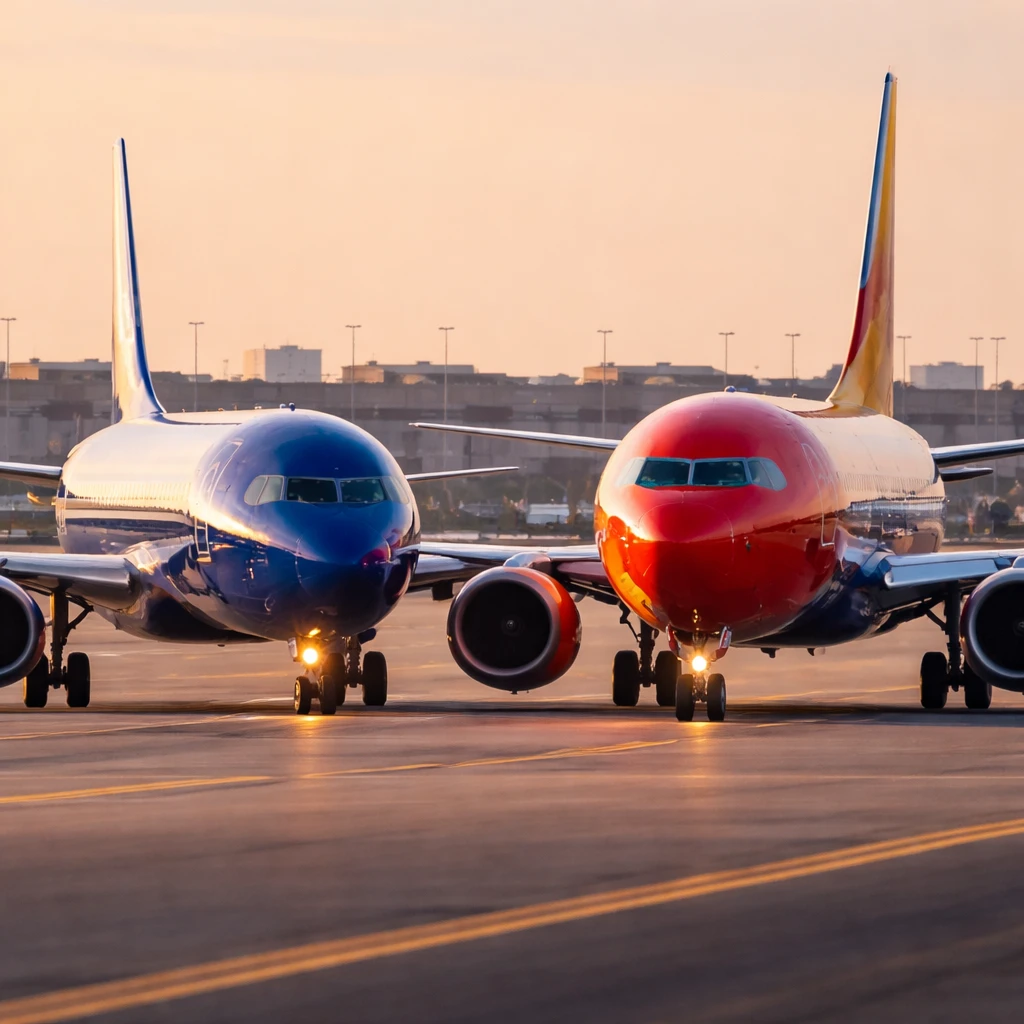
Two major U.S. carriers have chosen contrasting methods to chase premium customers. JetBlue is focused on product upgrades designed to entice higher-value travelers, while Southwest is reshaping parts of its business model to extract more revenue from its broader network. The outcomes for investors and customers depend on execution and the strength of each carrier's financial position.
Two distinct strategies
Although both airlines frame their moves as upmarket initiatives, they are addressing different strategic priorities.
- JetBlue is emphasizing product differentiation. Enhancements such as Mint cabins, BlueHouse lounges and newly tiered premium fares are intended to attract customers willing to pay more for an elevated experience.
- Southwest is building additional revenue layers into an existing operating model. Elements such as assigned seating, seat selection fees, baggage charges, a basic economy fare class and a planned network of lounges are designed to monetize a much larger route system.
Recent milestones underline the contrast. JetBlue opened its second BlueHouse lounge in Boston on August 27, 2026, expanding lounge access for Mint customers and introducing a lower-priced Mint Base tier that separates core premium benefits from the cheapest fares. Southwest has announced plans for at least 11 lounges, with the first four expected to open in late 2027. Chase will support Southwest's lounge network and a new premium Rapid Rewards card.
The financial divide
The carriers differ sharply on scale, profitability and balance-sheet flexibility. Key figures as of early September 2026 are as follows:
- JetBlue Airways Corp (JBLU) - Trading at $4.66 as of Sep. 2, 2026 at 10:21 AM EDT (Market Cap: $1.69B). 2025 revenue: $9.06B. 2025 net income: -$602M. Total debt: $9.39B as of Jun. 30, 2026. Fair Value Upside: 6.5%.
- Southwest Airlines Company (LUV) - Trading at $38.92 as of Sep. 2, 2026 at 10:21 AM EDT (Market Cap: $18.43B). 2025 revenue: $28.06B. 2025 net income: $441M. Total debt: $6.89B as of Jun. 30, 2026. Fair Value Upside: 1.9%.
Revenue trends tell an important part of the story. JetBlue's top line declined from $9.62B in 2023 to $9.06B in 2025, while Southwest's revenue rose from $26.09B to $28.06B over the same period. Both carriers reported gross margins near 22% in 2025, so differences in scale and profitability, not unit margin, explain much of the financial gap.
Monetization versus differentiation
Southwest benefits from monetization advantages tied to a larger network. Because it serves a much bigger system, each new fee or premium offering can be applied at scale. Analyst earnings estimates project Southwest's 2026 EPS at $3.38, increasing to $4.80 in 2027, reflecting expectations that new premium features will contribute to existing profitability.
JetBlue's strength lies in a crisper premium product. Its Mint cabins and BlueHouse lounges can deliver a more distinct customer experience. Yet consensus estimates still show material losses: a $2.25 loss per share projected for 2026 and a $0.45 loss per share in 2027. In essence, Southwest is layering premium revenue on top of an already profitable engine, while JetBlue is relying on premium revenue to help rebuild profitability.
What could go wrong
Both strategies carry execution and market risks that could influence travel, leisure and airline-sector performance.
- Southwest risks - Introducing assigned seating and baggage fees may erode parts of the carrier's long-standing customer-friendly reputation. Operational and technology transitions required to implement these changes could also hurt reliability, which would affect airline operations and consumer confidence.
- JetBlue risks - Investments in premium amenities may not be enough to counter weak demand in coastal markets. JetBlue's balance sheet is more constrained, with a 0.7x current ratio and $9.39B in total debt as of June 30, 2026, leaving less room for setbacks.
- Balance-sheet context - Southwest's current ratio of 0.5x is also tight. However, positive earnings and larger scale provide more flexibility to absorb execution challenges.
Timing differences add another layer of risk. JetBlue's BlueHouse lounges are already operating, but the extent to which they will translate into sustained financial improvement is not yet proven. Southwest's lounge benefits and associated premium card support will not begin to arrive in scale until late 2027.
Bottom line
On balance, Southwest appears better positioned to convert premium initiatives into durable cash flow. It combines scale, positive earnings, stronger revenue momentum and a clearer route from incremental premium features to operating cash. JetBlue offers a potentially more attractive premium product, but it represents a higher-variance bet: analysts showed a 34.2% target upside for JetBlue versus a 32.7% target upside for Southwest as of Jun. 30, 2026, yet the similar upside masks much different business risk profiles.
The simple takeaway is that Southwest is monetizing an established network, while JetBlue is selling a premium experience in the hope that it will help the airline regain profitability and growth.