
Introduction
The month-long Singles Day shopping period in China has evolved into a real-world stress test for artificial intelligence in commerce. Across major e-commerce ecosystems, AI tools are being deployed to help shoppers discover products, try on apparel virtually, apply discounts and even complete transactions without leaving a single platform. The intensity of this deployment provides a clear signal of how quickly AI selling is being adopted, but the ultimate effect on total consumer spending is not yet settled.
AI-driven discovery and conversion
E-commerce firms including Alibaba, JD.com and PDD Holdings are using AI to keep consumers engaged amid intense competition. Alibaba’s properties - Tmall for prominent brands and Taobao for a broader merchant base - are embedding AI features for research and virtual try-ons, in addition to tools designed to help users locate discounts. Short video and social commerce platform Douyin generated roughly 5% of purchases through chatbot links in October, according to data from WPIC Marketing + Technologies. For more deliberative categories such as supplements, that share rose above 20%.
Jacob Cooke, chief executive of the research firm that produced the WPIC data, described this as an incipient channel: "This is still a very new gateway and discovery channel," he said. "I expect it to account for a growing share of direct purchases, comparable to livestreaming or social commerce." The rate at which AI conversion grows, and whether it materially changes purchase volumes, remains to be seen.
Winners and losers among brands
Platform tuning and brand pricing appear to influence who benefits. "Some brands benefit more based on how the platforms are tuned or how the brands are pricing their products," said Ben Cavender, managing director at Shanghai-based China Market Research Group. He added that brands could be harmed if consumer behavior shifts toward AI assistants handling searches and purchases: "if they are no longer showing up in product searches because the consumer is defaulting to letting an AI assistant do the 'shopping'," he said.
These dynamics create an uneven landscape for merchants. Platforms that can more effectively integrate AI assistants into discovery and checkout may capture a larger share of consumer spend, while brands that rely on traditional search and placement could lose visibility if they are not optimized for AI-driven workflows.
Measured sales so far
Third-party platform Syntun reported that sales for Singles Day climbed 2.4% between October 7 and October 31. That growth is larger than the 1.1% rise in China’s retail sales for the year through end-September, though Syntun will publish an updated figure covering the entire Singles Day period at a later date.
How AI is embedded in shopping
AI has become more tightly integrated into Chinese e-commerce than in many Western markets, helped by the prevalence of super apps that handle multiple services in a single environment. AI agents on those platforms can research options, complete transactions, apply coupons and arrange deliveries without forcing users to switch between separate applications. The convenience this offers can reduce friction in the shopping journey.
Researching specific product requirements has also been simplified. Liu Xingliang, a Beijing-based independent technology analyst, described the process: a shopper can ask a chatbot to identify a washing machine that fits a narrow balcony, operates quietly at night and stays within a given budget. That level of specificity in discovery has become more straightforward with AI assistance.
Engagement metrics and product trends
JD.com reported that its AI shopping assistant, named Dongdong, drew nearly 80 million users seeking advice for this year’s Singles Day festival, more than triple the user count from the prior year. The company presented this as a sign of rapidly rising engagement with AI tools on its platform.
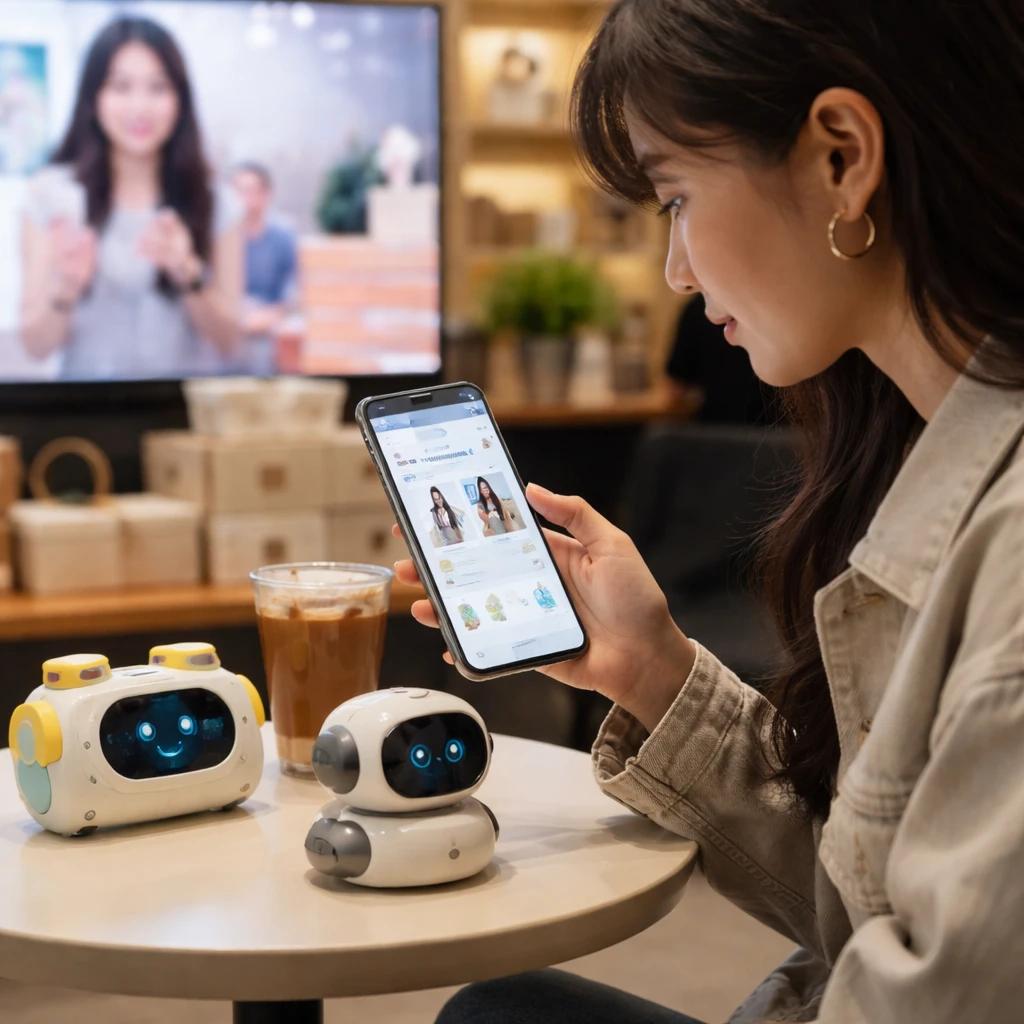
AI-enabled devices are also seeing strong promotion and sales. Alibaba said AI toys exceeded 100 million yuan in sales on its platforms within one year after being introduced as a new category. Sales of AI companion robots rose nearly fivefold year-on-year in the second half of October, Alibaba added, though it did not disclose the exact number of units sold. Tmall reported that sales of AI tokens - packages of computing units consumers buy to access AI models - increased by more than 700% between October 15 and November 5, compared with the period from September 15 to October 5.
Top livestreamer Austin Li included AI products in his programming for the first time during the festival and sold 100,000 monthly subscriptions to Alibaba’s QwenWork within 30 minutes, demonstrating rapid consumer uptake in some segments.
Consumer impressions
For many shoppers, AI features have become a routine part of the online buying experience. Amanda Gao, a 40-year-old office worker in Beijing, said she uses Taobao’s AI virtual try-on function whenever she shops for clothes: "I find the function useful and fun," she said.
Market context
The article included brief market ticks: JD -0.25%, BABA -2.52%, PDD -1.37% reflected on the day. Exchange rate noted in reporting was $1 = 6.6703 Chinese yuan.
Conclusion
China’s Singles Day has become a proving ground for AI in commerce, from conversational assistants to AI devices and tokenized compute offerings. Platforms and merchants are learning how AI reshapes discovery and conversion, but current data leave open whether these tools will lift aggregate spending materially. Further, brand outcomes may diverge depending on how platforms route discovery and how merchants price and present products in an AI-driven shopping environment.